











1. Search Result
Search Result
Results for "

cytotoxic T lymphocyte epitope

" in MedChemExpress (MCE) Product Catalog:

17

Inhibitors & Agonists

17

Peptides

Targets Recommended:
Cat. No. Product Name Target Research Areas Chemical Structure
  • HY-P3333

    MHC Inflammation/Immunology Cancer
    KSPWFTTL is an immunodominant Kb-restricted epitope from the p15E transmembrane protein. KSPWFTTL can restore susceptibility of a tumor line to anti-AKR/Gross MuLV cytotoxic T lymphocytes .
    KSPWFTTL
  • HY-P1907

    HPV Cancer
    Human Papillomavirus (HPV) E7 protein (49-57) is a cytotoxic T lymphocyte (CTL) epitope peptide derived from HPV16 E7 protein (sequence: RAHYNIVTF). Human Papillomavirus (HPV) E7 protein (49-57) induces E749-57-specific CTL responses. Human Papillomavirus (HPV) E7 protein (49-57) can be used for the research of cervical cancer .
    Human Papillomavirus (HPV) E7 protein (49-57)
  • HY-P5470

    EBV IFNAR Inflammation/Immunology
    LMP2A (426-434) is a HLA-A2-restricted cytotoxic T lymphocyte (CTL) epitope of Epstein-Barr virus (EBV) latent membrane protein 2A (LMP2A). LMP2A (426-434) can trigger an immune response in individuals expressing different HLA-A*02 subtypes (A*02:01, A*02:03, A*02:06 and A*02:07). LMP2A (426-434) can induce a strong IFN-γ secretion response, stimulating the production of a high proportion of CD8 + IFN-γ + T cells. LMP2A (426-434) induces specific CTLs to effectively kill target cells expressing LMP2A. LMP2A (426-434) can be used to study EBV-related malignant tumors (such as Hodgkin's disease and nasopharyngeal carcinoma) .
    LMP2A (426-434)
  • HY-106374

    VEGFR Cancer
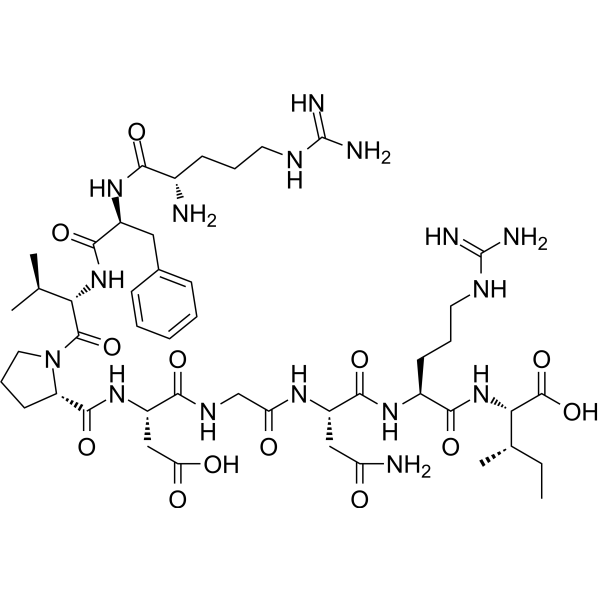
    Elpamotide is an epitope peptide derived from VEGFR2. Elpamotide induces cytotoxic T lymphocytes (CTLs) to kill VEGFR2-expressing endothelial cells. Elpamotide has potential immunostimulatory and antineoplastic activities. Elpamotide can be used in the research of cancer, such as pancreatic cancer .
    Elpamotide
  • HY-P3742

    Tyrosinase MHC Cancer
    Tyrosinase (192-200), human mouse is a HLA-B*4403-restricted tyrosinase epitope with affinity for HLA-B4403 and HLA-B4402. Tyrosinase (192-200), human mouse binds to HLA-B*4403 to form a complex, which is recognized by the autologous cytotoxic T lymphocyte clone 22/31 derived from melanoma. Tyrosinase (192-200), human mouse binds to HLA-B4402 to form a complex, which is recognized by the CTL clone 329B/5 derived from healthy HLA-B4402 donors. Tyrosinase (192-200), human mouse is applicable to melanoma-related research .
    Tyrosinase (192-200), human mouse
  • HY-P3333A

    MHC Inflammation/Immunology Cancer
    KSPWFTTL TFA is an immunodominant Kb-restricted epitope from the p15E transmembrane protein. KSPWFTTL TFA can restore susceptibility of a tumor line to anti-AKR/Gross MuLV cytotoxic T lymphocytes .
    KSPWFTTL TFA
  • HY-P1881

    HPV Cancer
    HPV16-E711-20 epitope is a well-known HLA-A *0201-restricted human cytotoxic T lymphocyte (CTL) epitope of the HPV16 E7 protein that shows high-affinity binding to HLA-A2 in vitro. HPV16 CTL epitopes may be good candidates for the development of an effective peptide-based antitumor vaccine .
    HPV16-E711-20 epitope
  • HY-P10593

    Transmembrane Glycoprotein Influenza Virus Cancer
    Influenza A NP (383-391) (HLA-B27) is a peptide sequence derived from tetanus toxin. Influenza A NP (383-391) (HLA-B27) is a broadly immunogenic CD4+ T helper cell epitope that enhances CD8+ cytotoxic T lymphocyte (CTL) responses. Influenza A NP (383-391) (HLA-B27) can be used in breast cancer research .
    Influenza A NP (383-391) (HLA-B27)
  • HY-P1862

    HSV Infection
    HSV-gB2 (498-505) is an immunodominant epitope from herpes simplex virus (HSV) glycoprotein B residues 498-505, acts as H-2Kb-restricted and HSV-1/2-cross-reactive cytotoxic T-lymphocyte (CTL) recognition epitope .
    HSV-gB2 (498-505)
  • HY-P2521

    Influenza Virus Infection Inflammation/Immunology
    NS2 (114-121), Influenza, the 114-121 fragment of influenza nonstructural protein 2 (NS2), is a influenza-derived epitope. NS2 (114-121), Influenza can be used for the research of CD8 + cytotoxic T lymphocyte (CTL) in antiviral immune responses .
    NS2 (114-121), Influenza
  • HY-P1835

    Influenza Virus Inflammation/Immunology
    CEF8, Influenza Virus NP (383-391), an influenza A virus nucleoprotein containing residues 383 to 391, is the most important HLA-B *2705-restricted epitope in the nucleoprotein of influenza A viruses and is associated with escape from cytotoxic T lymphocytes-mediated immunity .
    CEF8, Influenza Virus NP (383-391)
  • HY-P10245

    RSV Inflammation/Immunology
    Fusion glycoprotein 92-106 is a polypeptide from fusion protein of respiratory syncytial virus (RSV). Fusion glycoprotein 92-106 acts as MHC class I-restricted CTL epitope, that all 15 amino acids are required for efficient recognition by cytotoxic T lymphocyte (CTL) .
    Fusion glycoprotein (92-106)
  • HY-P3070

    MHC Infection Others
    H2-D b restricted epitopes VSV Nucleoprotein (52-59) is a 9-mer peptide derived from the nucleoprotein of Vesicular Stomatitis Virus (VSV). H2-D b restricted epitopes VSV Nucleoprotein (52-59) binds to MHC class I molecules and presents itself to CD8+ T cells, thereby activating cytotoxic T lymphocytes (CTLs), which can recognize and kill cells expressing the corresponding antigen. H2-D b restricted epitopes VSV Nucleoprotein (52-59) can be used in the development of CTL vaccines against Ebola virus .
    H2-D b restricted epitopes VSV  Nucleoprotein (52-59)
  • HY-P10607

    EBV Cancer
    IALYLQQNW is a specific nonapeptide sequence derived from the tumor-associated antigen latent membrane protein 1 (LMP1) encoded by Epstein-Barr virus (EBV). As a latent T-cell epitope, IALYLQQNW is able to activate EBV-specific cytotoxic T lymphocytes (CTLs), which are able to recognize and kill EBV-infected cells expressing LMP1. IALYLQQNW plays an important role in the immune response against EBV-associated tumors and can be used in the study of Hodgkin's disease and nasopharyngeal carcinoma .
    IALYLQQNW
  • HY-P1920

    EBV Inflammation/Immunology
    CEF19, Epstein-Barr Virus latent NA-3A (458-466) is a single peptide epitope, YPLHEQHGM, representing residues 458-466 of the type 1 Epstein-Barr Virus (EBV) nuclear antigen 3A protein (B95.8 strain). CEF19, Epstein-Barr Virus latent NA-3A (458-466) can significantly affect cytotoxic T-lymphocyte (CTL) recognition .
    CEF19, Epstein-Barr Virus latent NA-3A (458-466)
  • HY-P11713

    EBV MHC Infection Cancer
    EBNA3B 399-408 is an immunodominant HLA-A11-restricted cytotoxic T-lymphocyte epitope in EBNA3B. EBNA3B 399-408 can be used in the research of EBV infection, empyema-associated lymphoma, and nasal natural killer cell lymphoma .
    EBNA3B 399-408
  • HY-106187B

    Cancer
    MART-1 (27-35) (human) (TFA) is the amino acid fragment spanning positions 27 to 35 of the MART-1 protein, and it represents an immunogenic epitope recognizable by HLA-A2-restricted melanoma-specific tumor-infiltrating lymphocytes (TILs). MART-1 (27-35) (human) (TFA) can be used in studies related to melanoma .
    MART-1 (27-35) (human) TFA

Inquiry Online

Your information is safe with us. * Required Fields.

Salutation


Country or Region *

Applicant Name *


Organization Name *

Department *


Email Address *


Product Name *

Cat. No.


Requested quantity *

Phone Number *


Remarks

Inquiry Online

Inquiry Information

Product Name:
Cat. No.:
Quantity:
MCE Japan Authorized Agent:

