
10 Results for "

fear conditioning

" in MedChemExpress (MCE) Product Catalog:
Products (10)

10 Results for "fear conditioning" in MCE Product Catalog:

4
4 Cited Publications
Cat. No.: HY-P1107
CAS No.: 220673-95-0
Synonyms: aSvg-30
Target:  

CRFR

Research Areas:  

Neurological Disease

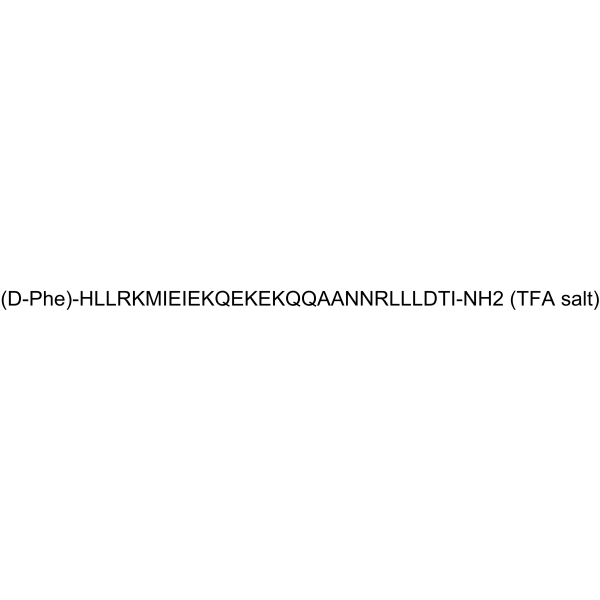
Antisauvagine-30 (aSvg-30) is a selective peptide antagonist of the CRF2 receptor, with an IC50 of 1.1 nM for mouse CRF2. Antisauvagine-30 modulates cAMP signaling, gastric emptying, food intake, fear conditioning, anxiety-like behavior, stress responses, corticosterone levels, c-Fos expression, and CRF expression. Antisauvagine-30 is used in studies of anxiety-related disorders .
loading...
    loading...
4
4 Cited Publications
Cat. No.: HY-P1107A
Synonyms: aSvg-30 TFA
Target:  

CRFR

Research Areas:  

Neurological Disease

Antisauvagine-30 TFA (aSvg-30 TFA) is a selective peptide antagonist of the CRF2 receptor, with an IC50 of 1.1 nM for mouse CRF2. Antisauvagine-30 TFA modulates cAMP signaling, gastric emptying, food intake, fear conditioning, anxiety-like behavior, stress responses, corticosterone levels, c-Fos expression, and CRF expression. Antisauvagine-30 TFA is used in studies of anxiety-related disorders .
loading...
    loading...
3
3 Cited Publications
Cat. No.: HY-110279
CAS No.: 1309198-71-7
Purity:  99.58%
Target:  

GPR68

Research Areas:  

Neurological Disease

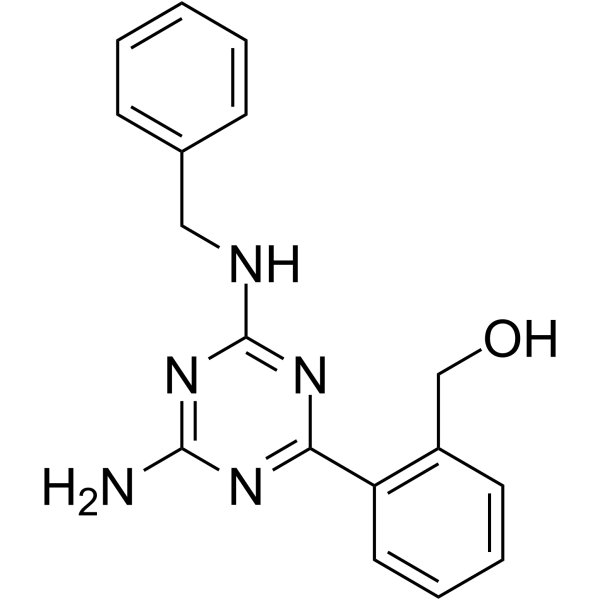
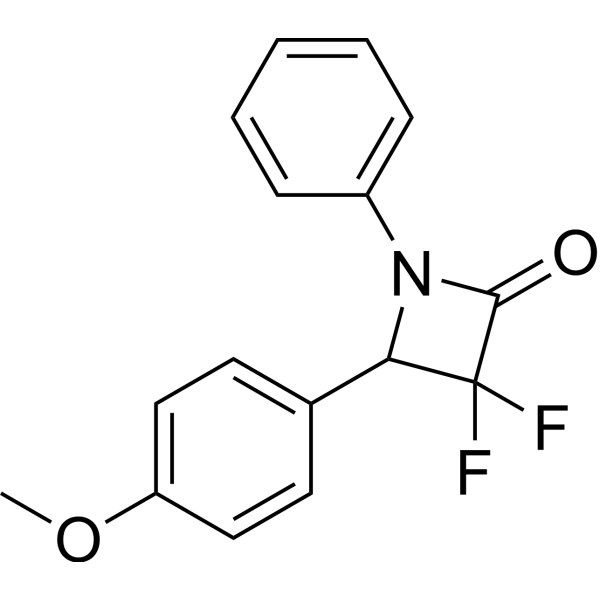
Ogerin, a chemical probe, is a selective GPR68 positive aliasing modulator (PAM) (pEC50=6.83) with a moderate antagonistic effect on A2A (Ki=220 nM). Ogerin inhibits the fear conditioning reflex in mice and also inhibits TGF-β-induced myofibroblast differentiation of fibroblasts from multiple organ systems. Ogerin can be used in the studies of fibrotic diseases and neurological disorders .
loading...
    loading...
2
2 Cited Publications
Cat. No.: HY-P2259
CAS No.: 1404188-93-7
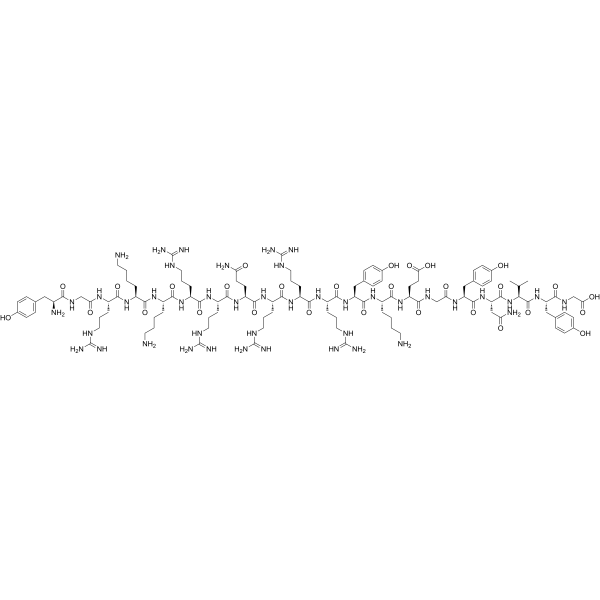
TAT-GluA2 3Y is a blood-brain barrier-permeable AMPA receptor inhibitory peptide that crosses cell membranes via the HIV-1 TAT protein domain. TAT-GluA2 3Y blocks the endocytosis of AMPA receptors, including the internalization of GluA1/GluA2 subunits, by disrupting interactions with the AP2, Brag2 and Syt3-GluA2 complexes, while also inhibiting long-term depression. TAT-GluA2 3Y blocks hypoxia-mediated AMPAR internalization, alleviates A1R-induced persistent synaptic inhibition, and reduces cerebral ischemic volume, neurological deficits and spatial memory deficits. TAT-GluA2 3Y blocks the effect of NLRP3 deficiency on fear generalization, inhibits amphetamine-induced behavioral/neurochemical sensitization, weakens the unconditioned stimulus-conditioned stimulus association of morphine, and promotes the extinction of morphine CPP. TAT-GluA2 3Y can be used in studies related to fear generalization, ischemic stroke, hypoxia, drug addiction and opioid addiction .
loading...
    loading...
1
1 Cited Publications
Cat. No.: HY-117709
CAS No.: 1404562-17-9
Purity:  98.90%
Target:  

HDAC

Research Areas:  

Neurological Disease

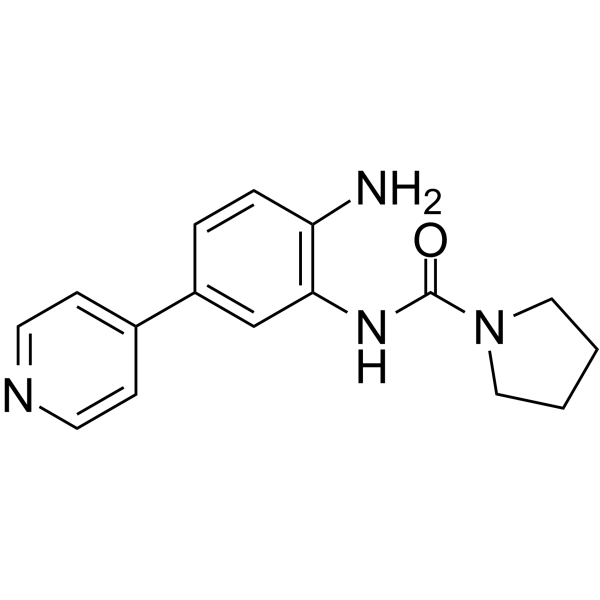
BRD6688 is a selective HDAC2 inhibitor. BRD6688 increases H4K12 and H3K9 histone acetylation in primary mouse neuronal cells. BRD6688 crosses the blood brain barrier and rescues the memory defects associated with p25 induced neurodegeneration in contextual fear conditioning in a CK-p25 mouse model .
loading...
    loading...
Cat. No.: HY-W011725
CAS No.: 2002-35-9
Synonyms: m6dA
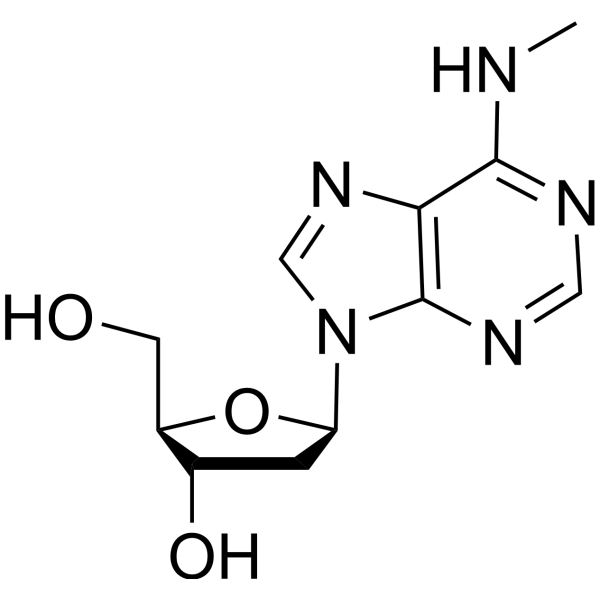
N-6-Methyl-2-deoxyadenosine (m6dA) is an adenine nucleoside analogue. N-6-Methyl-2-deoxyadenosine targets nuclear processes and DNA replication machineries including WER, SATB1, TFAM, Jumu, SSBP1, DNA polymerase η and phage polymerase Gp90 exo . N-6-Methyl-2-deoxyadenosine acts as a multifunctional epigenetic regulator that modulates transcription, DNA damage response, cell cycle, transposon silencing, stress adaptation, epigenetic crosstalk, and nucleosome organization in both prokaryotes and eukaryotes. N-6-Methyl-2-deoxyadenosine regulates mitochondrial epigenetic inheritance and is required for fear extinction memory in mice. N-6-Methyl-2-deoxyadenosine exhibits dysregulated levels in cancers. N-6-Methyl-2-deoxyadenosine can be used for the research of glioblastoma, triple negative breast cancer, and conditioned fear (fear extinction impairment) .
loading...
    loading...
Cat. No.: HY-128057
CAS No.: 342779-66-2
Purity:  99.94%
Target:  

GPR139

NCRW0005-F05 is a GPR139 antagonist with an IC50 of 147.9 nM against zebrafish GPR139. NCRW0005-F05 blocks agonist-induced GPR139 activity and inhibits intracellular calcium mobilization. NCRW0005-F05 suppresses fear memory consolidation, increases and decreases the peak amplitude of calcium transients, reduces KCl-induced calcium transients, induces thigmotaxis, and decreases locomotor speed after conditioning. NCRW0005-F05 can be used in research related to Parkinson's disease, diabetes, and obesity .
loading...
    loading...
Cat. No.: HY-100822A
CAS No.: 111821-58-0
Synonyms: (-)-HA 966
Target:  

iGluR

Research Areas:  

Neurological Disease

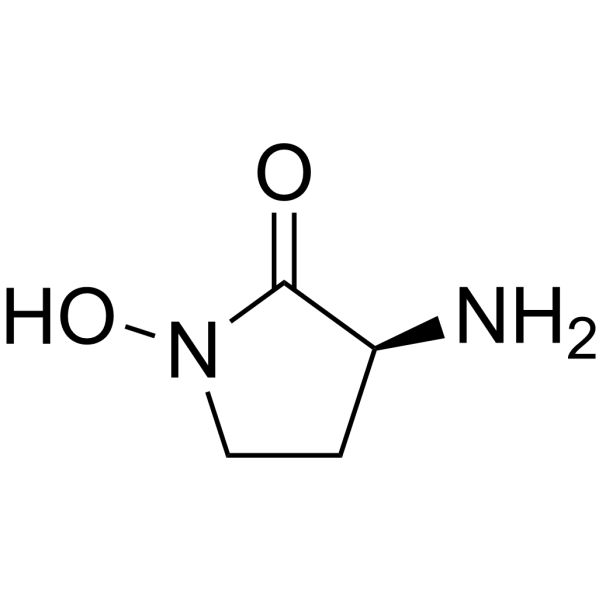
(S)-(-)-HA 966 ((-)-HA 966), a γ-Hydroxybutyrate-like agent, is weakly active as an NMDA-receptor antagonist. (S)-(-)-HA 966 possesses muscle relaxant action and prevents enhanced mesocorticolimbic dopamine metabolism and behavioral correlates of restraint stress, conditioned fear .
loading...
    loading...
Cat. No.: HY-184366
CAS No.: 88441-08-1
Target:  

5-HT Receptor

Research Areas:  

Neurological Disease

2C-CN hydrochloride is a selective agonist of the 5-HT2A Receptor. 2C-CN hydrochloride derivative NBOH-2C-CN hydrochloride can block risperidone-induced hypothermia in gerbils and enhance rigidity behavior in mice after predictable fear conditioning. 2C-CN hydrochloride can be used in studies related to thermoregulation and anxiety disorders .
loading...
    loading...
Cat. No.: HY-110279R
CAS No.: 1309198-71-7
Research Areas:  

Neurological Disease

Ogerin (Standard) is the analytical standard of Ogerin (HY-110279). This product is intended for research and analytical applications. Ogerin, a chemical probe, is a selective GPR68 positive aliasing modulator (PAM) (pEC50=6.83) with a moderate antagonistic effect on A2A (Ki=220 nM). Ogerin inhibits the fear conditioning reflex in mice and also inhibits TGF-β-induced myofibroblast differentiation of fibroblasts from multiple organ systems. Ogerin can be used in the studies of fibrotic diseases and neurological disorders .
loading...
    loading...

