
10 Results for "

hydrogen-bonding networks

" in MedChemExpress (MCE) Product Catalog:
Products (10)

10 Results for "hydrogen-bonding networks" in MCE Product Catalog:

Cat. No.: HY-112624J
CAS No.: 9004-54-0
Synonyms: Dextran 4; Dextran D4; Dextran T4(MW 3200-4800)
Dextran 4,000 is a mucus rheology modifier. The dextran molecules in Dextran 4,000 can reduce the cross-link density of mucus through osmotic effects and hydrogen bond substitution, and reduce viscoelasticity and improve the mucociliary/cough clearance index by destroying the DNA-mucin network structure in mucus. Dextran 4,000 has the ability to improve the rheological properties and clearance ability of cystic fibrosis (CF) sputum, and can be used in the study of inhalation therapy or aerosol delivery of mucostatic respiratory diseases. The Dextran series of compounds are also natural polysaccharide drug carriers that can be connected to drugs through covalent bonding methods such as ester bonds, amide bonds or click chemistry, or self-assembled to form carriers such as nanoparticles and hydrogels. Dextran is biodegradable and biocompatible, and can achieve targeted delivery and controlled release of drugs. Dextran derivatives can prolong the half-life of drugs, increase local concentrations, and reduce the activity of immune clearance .
loading...
    loading...
Cat. No.: HY-W127776
CAS No.: 176736-49-5
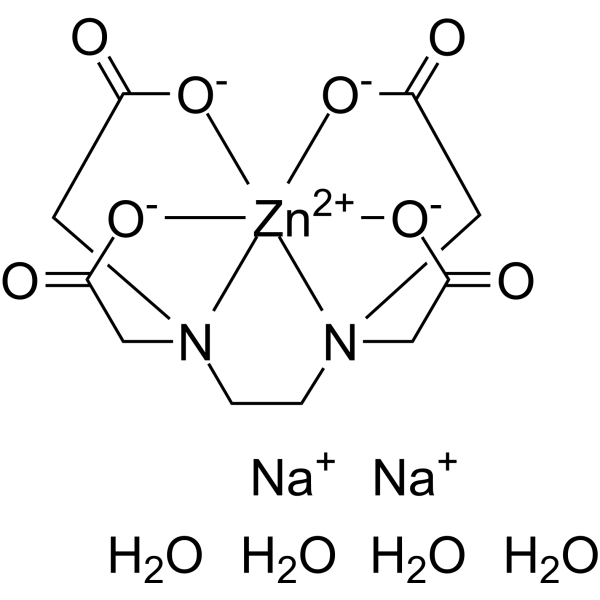
Synonyms: Ethylenediaminetetraacetic acid zinc disodium tetrahydrate
Zn(II)-EDTA (Ethylenediaminetetraacetic acid zinc) disodium tetrahydrate is a coordinating agent. Zn(II)-EDTA disodium tetrahydrate coordinates with Zn 2+ to modify its solvated structure, provides pre-synthesized EDTA-Zn complexes that release Zn 2+ to repair zinc anode defects under interfacial electric field, adsorbs onto zinc anode surface to block oxygen and water molecules, inhibits corrosion and hydrogen evolution reactions, promotes uniform Zn 2+ deposition, suppresses zinc dendrite formation, and modulates the hydrogen bonding network within the electrolyte. Zn(II)-EDTA disodium tetrahydrate acts as an electrolyte additive to enhance reversibility and stability of zinc anodes in aqueous zinc-ion batteries .
loading...
    loading...
Cat. No.: HY-170406
CAS No.: 1949840-87-2
Target:  

Bcl-2 Family

Research Areas:  

Cancer

BCL-XL-IN-3 is a cell-impermeable BCL-XL inhibitor with a Ki of 16 pM. BCL-XL-IN-3 disrupts the critical hydrogen bond network via methylation of the nitrogen atom on the P2-binding amide bond, resulting in complete loss of cellular activity against BCL-XL. BCL-XL-IN-3 can be used in non-small cell lung cancer and cancer-related research .
loading...
    loading...
Cat. No.: HY-182346
Target:  

FBPase

Research Areas:  

Metabolic Disease

FBPase-IN-7 is a fructose-1,6-bisphosphatase (FBPase) inhibitor with an IC50 of 0.75 μM. FBPase-IN-7 binds to a cryptic allosteric pocket of FBPase, induces conformational rearrangement of key residues, forms a hydrogen-bond network, and disrupts substrate catalysis. FBPase-IN-7 confirms cellular stabilizes HuFBPase in hepatic cells. FBPase-IN-7 has hypoglycemic activity. FBPase-IN-7 can be used for the research of type 2 diabetes .
loading...
    loading...
Cat. No.: HY-187677
CAS No.: 94159-34-9
Target:  

PCSK9 LDLR

Research Areas:  

Metabolic Disease

PCSK9-IN-36 is a PCSK9 inhibitor and a flavonoid glycoside derivative. PCSK9-IN-36 binds stably within the surface groove of PCSK9 through hydrophobic interactions involving its flavonoid scaffold and an electrostatic hydrogen-bonding network formed by its polar glycosidic group, thereby competitively blocking the interaction between PCSK9 and the low-density lipoprotein receptor (LDLR). PCSK9-IN-36 can be used for research on hypercholesterolemia .
loading...
    loading...
Cat. No.: HY-182344
MLKL ligand-2 is a mixed lineage kinase domain-like pseudokinase (MLKL) PROTAC ligand with a KD of 9.408 μM. MLKL ligand-2 forms hydrogen bond networks and hydrophobic interactions with specific MLKL residues, and stabilizes MLKL in hepatic cells. MLKL ligand-2 can be used to synthesize PROTAC MLKL Degrader-3 (HY-182343) .
loading...
    loading...
Cat. No.: HY-187697
CAS No.: 915978-94-8
Research Areas:  

Cancer

DB1255 is an ERG inhibitor that binds to the minor groove of DNA, with KD values of 26 nM and 86 nM for the ATGA and AATT sequences, respectively. DB1255 targets and binds to specific DNA minor grooves (single GC/AT-rich sequences), forming a hydrogen bond network with G bases and AT pairs via its thiophene group and amidino group, respectively, thereby blocking the binding of transcription factors. DB1255 can be used in the research of leukemia and prostate cancer .
loading...
    loading...
Cat. No.: HY-111300
CAS No.: 848952-37-4
Target:  

HSP EGFR

Research Areas:  

Cancer

G3130 is a reversible HSP90 inhibitor with a Kd value of 280 nM for the N-terminal ATP-binding domain of purified human Hsp90α. G3130 binds to the adenine site via a multi-hydrogen bond network . G3130 induces the degradation of Hsp90 client protein Her-2 in breast cancer cells. G3130 activates Hsp70 promoter-driven luciferase expression in 293T cells. G3130 can be used in breast cancer-related research .
loading...
    loading...
Cat. No.: HY-189398
Research Areas:  

Cancer

Tubulin polymerization-IN-94 is a tubulin polymerization inhibitor. Tubulin polymerization-IN-94 inhibits tubulin polymerization, forms a hydrogen bond with β-Asn349, and exhibits π-stacking with β-Lys352. Tubulin polymerization-IN-94 shows potent antiproliferative activity against multiple cancer cell lines. Tubulin polymerization-IN-94 induces G2/M cell cycle arrest, apoptosis, and disruption of the microtubule network. Tubulin polymerization-IN-94 can be used in research related to cervical cancer, gastric cancer, and breast cancer .
loading...
    loading...
Cat. No.: HY-181888
Target:  

HIV HIV Protease

Research Areas:  

Infection

GRL-142 is a potent HIV-1 protease inhibitor capable of crossing the blood-brain barrier. GRL-142 exhibits extremely high inhibitory activity against both wild-type and multidrug-resistant strains (IC50=0.0094 nM). GRL-142 acts synergistically with the P2/P2' segments via a unique scaffold binding mechanism, utilizes fluorine-mediated stable interactions to maintain its bioactive conformation, adapts to p51 HIV-1 protease mutants, and maintains the flap-closed state by directly acting on the flap tip residues. GRL-142 disrupts the flap-water hydrogen bond network of wild-type protease, thereby effectively blocking viral replication. GRL-142 can be used to study HIV-1 infection and the associated neurocognitive disorder (HAND) .
loading...
    loading...

