1. Search Result
Search Result
Results for "

kinome profiling

" in MedChemExpress (MCE) Product Catalog:
Cat. No. Product Name Target Research Areas Chemical Structure
  • HY-15985
    CTX-0294885
    3 Publications Verification

    Akt Metabolic Disease Inflammation/Immunology Cancer
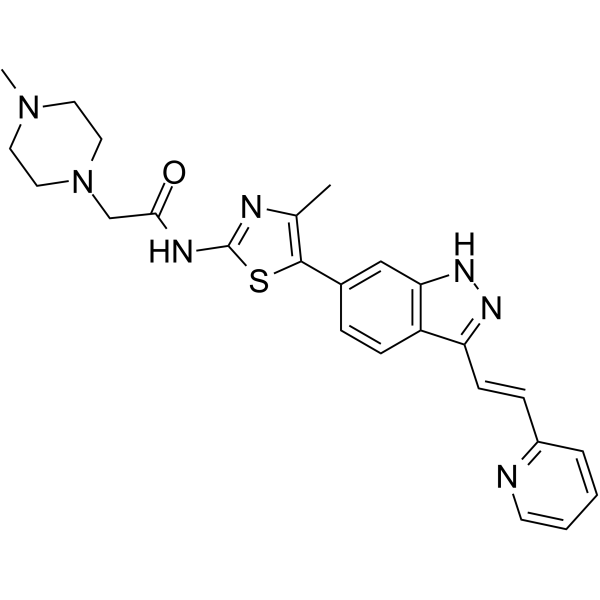
    CTX-0294885 is a broad spectrum kinase inhibitor that can capture 235 kinases from MDA-MB-231 cells, and can capture all members of the AKT family. CTX-0294885 is a powerful reagent for analysis of kinome signaling networks that can be used for the research of diseases like inflammation, diabetes, and cancer .
    CTX-0294885
  • HY-15985A
    CTX-0294885 hydrochloride
    3 Publications Verification

    Akt Metabolic Disease Inflammation/Immunology Cancer
    CTX-0294885 hydrochloride is a broad spectrum kinase inhibitor that can capture 235 kinases from MDA-MB-231 cells, and can capture all members of the AKT family. CTX-0294885 hydrochloride is a powerful reagent for analysis of kinome signaling networks that can be used for the research of diseases like inflammation, diabetes, and cancer .
    CTX-0294885 hydrochloride
  • HY-146697

    Trk Receptor c-Fms PDGFR Bcr-Abl c-Kit Apoptosis Cancer
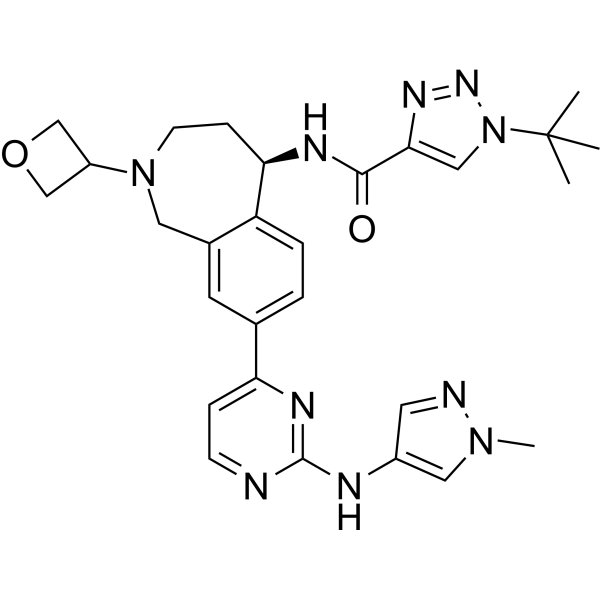
    IHMT-TRK-284 (Compound 34) is a potent, orally active type II TRK kinase inhibitor with IC50 values of 10.5, 0.7, and 2.6 nM to TRKA, B, and C respectively. IHMT-TRK-284 displays great selectivity profile in the kinome and good in vivo antitumor efficacies .
    IHMT-TRK-284
  • HY-183584

    GSK-3 Src DYRK Tau Protein Microtubule/Tubulin Neurological Disease
    ARN25699 is a kinase inhibitor with an IC50 of 5.5 nM against GSK-3β, 2.2 nM against FYN-α, and 242.3 nM against DYRK1A, and it exhibits oral bioavailability. ARN25699 reduces hyperphosphorylation of tau protein and promotes microtubule bundle formation. ARN25699 has a broader kinome inhibitory profile and targets kinases associated with the pathogenic mechanisms linked to Alzheimer's disease. ARN25699 can be used in the research of Alzheimer's disease and related tauopathies .
    ARN25699
  • HY-103566A

    mGluR EGFR p38 MAPK Apoptosis Neurological Disease
    LY456236 free base is a selective, non-competitive and orally active antagonist of glutamate receptor 1 (mGlu1), which can inhibit phosphatidylinositol hydrolysis with an IC50 of 0.145 μM. LY456236 free base can also inhibit EGFR, with an IC50 of 0.918 μM. LY456236 free base blocks cell proliferation by inhibiting the MAPK pathway, reversing the anti-apoptotic effect of DHPG (HY-12598A). LY456236 free base can be used in epilepsy research .
    LY456236 free base
  • HY-183569

    c-Fms Akt PERK Aminotransferases (Transaminases) Apoptosis TNF Receptor Interleukin Related Metabolic Disease
    CSF1R-IN-27 is a CSF1R inhibitor with oral effectiveness, kinome-wide selective profile, low cellular cytotoxicity, and CSF1R IC50 values of 19 nM, 88 nM, 173 nM, 797 nM, 1448 nM, and >3000 nM. CSF1R-IN-27 suppresses M-CSF-induced phosphorylation of CSF1R, AKT, and ERK in macrophages, and inhibits hepatic p-CSF1R/p-AKT/p-ERK signaling. CSF1R-IN-27 reduces serum transaminase levels, improves hepatic histopathology, alleviates inflammatory cell infiltration, and decreases circulating TNF-α and IL-6 levels. CSF1R-IN-27 can be used for the research of acute liver injury .
    CSF1R-IN-27
  • HY-181699

    ULK Cancer
    ULK1-IN-5 (Compound D1) is a selective ULK1 inhibitor with an IC50 of 14.91 nM. ULK1-IN-5 functionally inhibits the kinase activity of ULK1. ULK1-IN-5 reduces the phosphorylation level of ATG13. ULK1-IN-5 exerts antiproliferative effects on cervical cancer cells. ULK1-IN-5 is applicable to relevant research on cervical cancer .
    ULK1-IN-5

Inquiry Online

Your information is safe with us. * Required Fields.

Salutation


Country or Region *

Applicant Name *


Organization Name *

Department *


Email Address *


Product Name *

Cat. No.


Requested quantity *

Phone Number *


Remarks

Inquiry Online

Inquiry Information

Product Name:
Cat. No.:
Quantity:
MCE Japan Authorized Agent:

