15 Results for "

living mice

" in MedChemExpress (MCE) Product Catalog:
Products (15)

15 Results for "living mice" in MCE Product Catalog:

1
1 Cited Publications
Cat. No.: HY-D3004
CAS No.: 1888323-45-2
GSH Tracker Probe (CPDSA) is a cyanine-based fluorescent probe with a NIR emission that is specific for GSH (excitation: 635 nm; emission: 655-755 nm). CPDSA can monitor and image GSH levels in live cells and in vivo .
loading...
    loading...
Cat. No.: HY-P4154
CAS No.: 2276787-79-0
Synonyms: ALM-488
Target:  

Fluorescent Dye

Research Areas:  

Neurological Disease Cancer

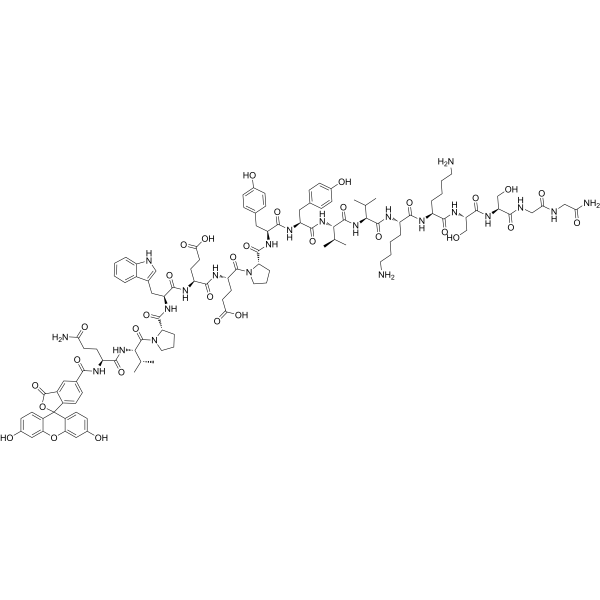
Bevonescein (ALM-488) is a fluorescein-conjugated peptide that facilitates the targeted delivery of a fluorescent moiety (5-FAM (HY-66022)) to nerves after intravenous (IV) administration. Bevonescein binds nerve-associated connective tissue, labels peripheral nerves under real-time fluorescence imaging (FL) in living mice and human ex vivo nerve tissue. Bevonescein is a peptide-linked tracer which fluorescently labeled both intact and degenerated nerves (Ex/Em = 480/530 nm) .
loading...
    loading...
Cat. No.: HY-151852
CAS No.: 76487-51-9
Purity:  ≥95.0%
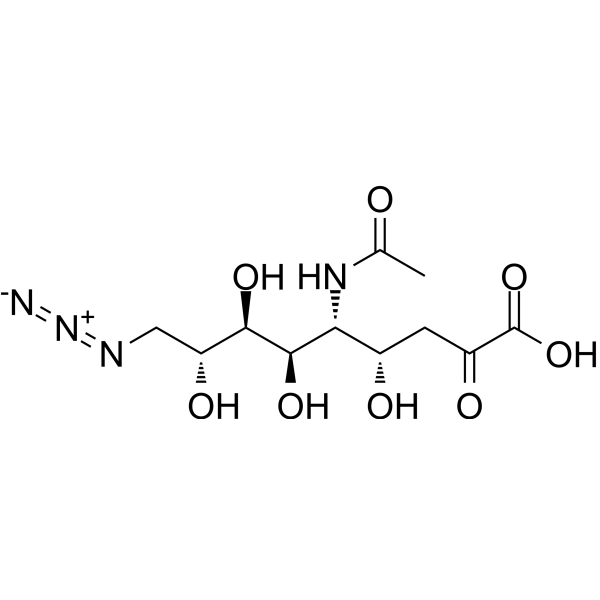
9AzNue5Ac, 9-azido-9-deoxy-N-acetylneuraminic acid, is a click chemistry reagent and a Neu5Ac analogue with the substitution of 9-hydroxyl group with an azide. 9AzNue5Ac could be metabolized and incorporated into sialoglycans in living cells and mice. Click chemistry has great potential for use in binding between nucleic acids, lipids, proteins, and other molecules, and has been used in many research fields because of its beneficial characteristics, including high yield, high specificity, and simplicity . It contains an azide group and can undergo copper-catalyzed azide-alkyne cycloaddition (CuAAc) with molecules containing alkyne groups. It can also undergo ring strain-promoted alkyne-azide cycloaddition (SPAAC) with molecules containing DBCO or BCN groups.
loading...
    loading...
Cat. No.: HY-151704
CAS No.: 1622335-41-4
Purity:  99.17%
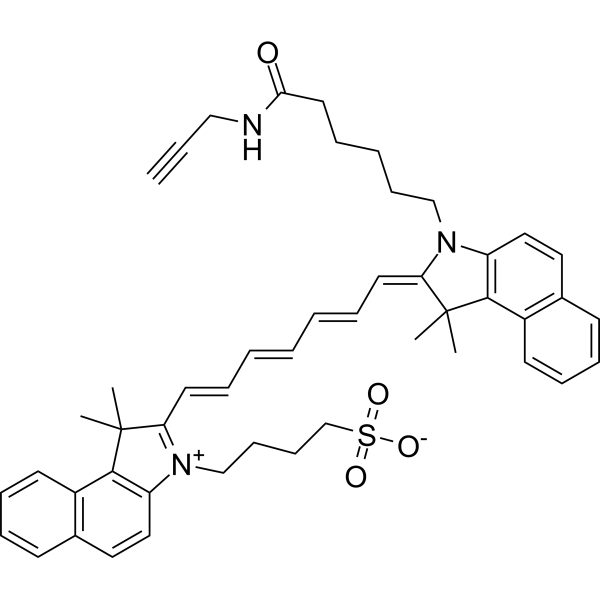
ICG-alkyne is a short-wave infrared (SWIR)-emitting cyanine fluorescent probe based on alkyne-derivatized indocyanine green. ICG-alkyne can undergo click chemistry reaction to conjugate with antibody molecules via binding to the azide groups introduced into antibodies. ICG-alkyne enables SWIR fluorescent molecular imaging of breast tumors in living mice. ICG-alkyne can be used in breast cancer-related research .
loading...
    loading...
Cat. No.: HY-D1065
CAS No.: 1392488-04-8
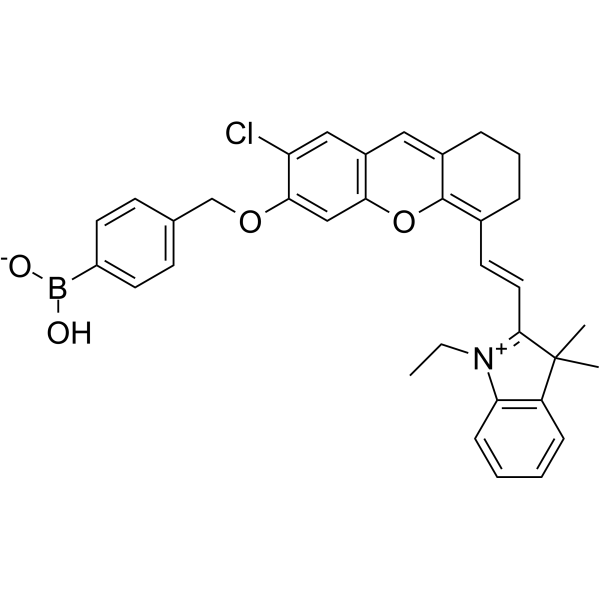
NIR-H2O2 is a cell-permeable near-infrared (NIR) fluorescent turn-on sensor. NIR-H2O2 has both absorption and emission in the NIR region. NIR-H2O2 responds to H2O2 with a large turn-on NIR fluorescence signal upon excitation in the NIR region. NIR-H2O2 is capable of imaging endogenously produced H2O2 in living cells and mice .
loading...
    loading...
Cat. No.: HY-148548
CAS No.: 1175142-38-7
Target:  

Amyloid-β

Research Areas:  

Neurological Disease

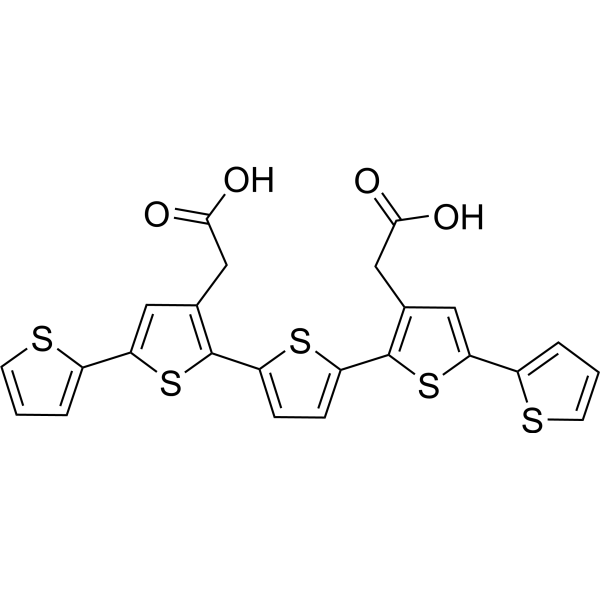
p-HTAA is a pentamer hydrogen thiophene acetic acid. p-HTAA specifically labels Aβ deposits in the mice living brain .
loading...
    loading...
Cat. No.: HY-D1066
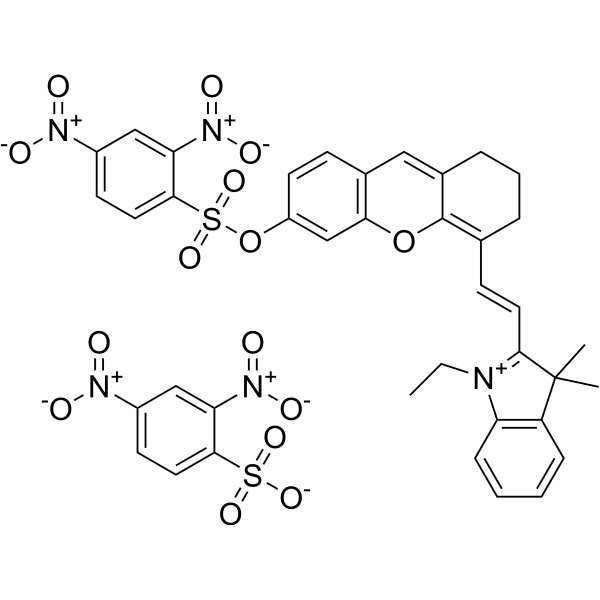
NIR-Thiol dinitrobenzenesulfonate has both absorption and emission in the NIR region. NIR-Thiol dinitrobenzenesulfonate responds to thiol with a large turn-on NIR fluorescence signal upon excitation in the NIR region. NIR-Thiol dinitrobenzenesulfonate is capable of imaging endogenously produced thiol in living cells and mice .
loading...
    loading...
Cat. No.: HY-D3214
CAS No.: 1895099-34-9
NIR-Cu (Ⅱ) is a near-infrared fluorescent Cu 2+ probe. NIR-Cu (Ⅱ) enables fluorescence imaging of Cu 2+ in living mice. NIR-Cu (Ⅱ) reduces self-absorption and exhibits minimal photobleaching, thus supporting in vivo imaging applications .
loading...
    loading...
Cat. No.: HY-D2970
Golgi-P is a near-infrared Golgi-targeted fluorescent probe specifically used for the detection of Golgi polarity in living cells and living tissues. Golgi-P exhibits a significant polarity-dependent spectral behavior, with its emission wavelength shifting redward with polarity (Ex/Em: 700 nm/780-825 nm). Golgi-P achieves near-infrared fluorescence imaging directly in the brain tissue of depressed mice. Golgi-P combines polarity sensing with Golgi-targeting functionality, providing a new tool for the molecular diagnosis of depression .
loading...
    loading...
Cat. No.: HY-D3370
CAS No.: 3114128-41-2
Target:  

Fluorescent Dye iGluR

Research Areas:  

Others

CL-NC is a chemiluminescent probe used for in vivo imaging of N-methyl-D-aspartate receptors (NMDARs), and its detection mechanism relies on bioorthogonal activation achieved via a tetrazine-triggered click-to-release reaction. The isonitrile group of CL-NC undergoes a click reaction with tetrazine, followed by hydrolysis and β-elimination to release a phenoxide anion, which induces the departure of adamantane and generates chemiluminescence. CL-NC has a maximum absorption wavelength of approximately 425 nm, a maximum fluorescence emission wavelength of approximately 670 nm, and a maximum chemiluminescence emission wavelength of 710 nm. When used in combination with Tz-IFDL (HY-D3369), an NMDAR ligand conjugated with tetrazine, CL-NC enables targeted imaging of NMDARs in living cells, as well as in the brain and spinal cord of living mice .
loading...
    loading...
Cat. No.: HY-D3152
CAS No.: 2361979-91-9
NRh-Cu is a highly sensitive near-infrared fluorescence turn-on indicator and Cu 2+-selective probe (λex=680 nm, λem=740 nm). When NRh-Cu interacts with Cu 2+, it undergoes a structural transition from a non-fluorescent spirocyclic state to a fluorescent ring-opened state, which drives the enhancement of fluorescence emission. NRh-Cu can be used for Cu 2+ imaging in live cells and in vivo .
loading...
    loading...
Cat. No.: HY-D3081
Target:  

Fluorescent Dye

Research Areas:  

Inflammation/Immunology

BTCV-CO is a ratiometric AIE fluorescent probe for the detection and fluorescent imaging of carbon monoxide (CO). BTCV-CO reacts with CO under the mediation of Pd 2+, undergoes allyl cleavage and cyclization to form the highly fluorescent product BTIC, resulting in enhanced fluorescence at 546 nm and weakened fluorescence at 710 nm. Ex/Em = 465/546 nm (λex = 465 nm in spectral experiments; λex = 476 nm in cell imaging) .
loading...
    loading...
Cat. No.: HY-D3068
CAS No.: 3077446-86-4
Target:  

Fluorescent Dye

Research Areas:  

Metabolic Disease

LDs-BCA is a BF2-chelated AIE fluorescent probe with a positive solvatochromic effect, which can specifically target intracellular lipid droplets (Ex/Em = 565/620-730 nm). LDs-BCA monitors the dynamic changes in the morphology, size and quantity of intracellular lipid droplets under oleic acid induction and starvation stress. LDs-BCA, after intraperitoneal injection, accumulates in the gastric fat of living obese mice, allowing continuous monitoring via its fluorescent signal. LDs-BCA is applicable to studies related to intracellular lipid droplet polarity imaging and in vivo gastric fat visualization .
loading...
    loading...
Cat. No.: HY-D3442
CAS No.: 3121565-89-4
ALDH2 probe 5 is a ALDH2 isoform-selective fluorescent probe with an emission wavelength centered at 494 nm. ALDH2 probe 5 is a turn-on fluorescent substrate for ALDH2; in its unreacted aldehyde form, twisted intramolecular charge transfer (TICT) occurs, resulting in fluorescence quenching. After ALDH2 probe 5 is catalytically oxidized to carboxylate by ALDH2, TICT is inhibited and fluorescence is significantly enhanced. ALDH2 probe 5 enables highly sensitive quantitative imaging of ALDH2 activity in recombinant enzymes, live cells, blood, tissue homogenates, and the brains of living mice. ALDH2 probe 5 can be used for studies related to neuroinflammation .
loading...
    loading...
Cat. No.: HY-W783351
CAS No.: 1416808-87-1
Synonyms: Coppersensor 790 acetoxymethyl ester
Target:  

Fluorescent Dye

Research Areas:  

Metabolic Disease

CS790AM (Coppersensor 790 acetoxymethyl ester) is a cell-permeable, Cu +-targeted near-infrared fluorescent probe (λabs=760 nm, λem=790 nm) applicable to live cells. CS790AM can cross lipophilic cell membranes, and is converted into negatively charged CS790 under the action of intracellular esterases to be retained, thus enabling highly sensitive, reversible "turn-on" detection of labile Cu + pools in live cells and mice. CS790AM possesses excellent biocompatibility and selectivity, avoids interference from other metal ions, shows no obvious toxicity, and can be rapidly cleared. CS790AM allows long-term longitudinal monitoring of individual mice, visualizes copper levels in internal organs and isolated livers, and effectively evaluates abnormal copper accumulation in Wilson's disease models (Atp7b -/-) as well as dynamic changes after chelator treatment. CS790AM can be used for research on Wilson's disease and related copper metabolic disorders .
loading...
    loading...
  • 1

