













1. Search Result
Search Result
Pathways Recommended: Membrane Transporter/Ion Channel
Results for "

magnesium ions

" in MedChemExpress (MCE) Product Catalog:

32

Inhibitors & Agonists

7

Fluorescent Dyes

13

Biochemical Assay Reagents

1

MCE Kits

1

Natural
Products

2

Oligonucleotides

Cat. No. Product Name Target Research Areas Chemical Structure
  • HY-W019981B

    MgCl2 hexahydrate, for molecular biology

    Calcium Channel Biochemical Assay Reagents Metabolic Disease
    Magnesium chloride hexahydrate (MgCl2 hexahydrate), for molecular biology is the hexahydrate form of magnesium dichloride. Magnesium chloride hexahydrate can be used as a source of magnesium ion and a co-foactor for many enzymes. Magnesium chloride hexahydrate increases the activity of Ca 2+ ATPase .
    Magnesium chloride hexahydrate, for molecular biology
  • HY-W019981C

    MgCl2 hexahydrate, for cell culture

    Calcium Channel Biochemical Assay Reagents Metabolic Disease
    Magnesium chloride hexahydrate (MgCl2 hexahydrate), for cell culture is the hexahydrate form of magnesium dichloride. Magnesium chloride hexahydrate, for cell culture can be used as a source of magnesium ion and a co-foactor for many enzymes. Magnesium chloride hexahydrate, for cell culture increases the activity of Ca 2+ ATPase .
    Magnesium chloride hexahydrate, for cell culture
  • HY-W018746
    EDTA disodium
    20+ Cited Publications

    Ethylenediaminetetraacetic acid disodium

    Environmental Pollutants Biochemical Assay Reagents Others
    EDTA disodium salt, also known as ethylenediaminetetraacetic acid disodium, belongs to the chelating agent category, which is formed by chelating a central metal ion with four carboxylate groups and two amine groups. This compound, with its ability to bind and chelate metal ions such as calcium, magnesium and iron, is commonly used in a variety of applications, including industrial, medical and research settings. It is used as a preservative in food and beverage, as a stabilizer in medicine, as a chelating agent in water treatment, and as a reagent in biochemical and biomedical research. In addition, EDTA disodium salt has been studied for potential research effects such as improving heavy metal poisoning and cardiovascular disease.
    EDTA disodium
  • HY-101898
    Indo-1 AM
    1 Publications Verification

    Indo-1 Acetoxymethyl ester

    Fluorescent Dye Others
    Calcium is an important part of the human body, usually in the form of calcium, a large number of bones and teeth of the human body, a small amount of blood and tissues. MCE calcium ion detection probe can specifically identify intracellular calcium ions, with high sensitivity, low cytotoxicity, increased AM acetylmethyl ester can enter the cell well, after being sheared by the intracellular esterase stay in the cell to bind to calcium ions, produce strong fluorescence, in addition, Mag-indo-1/AM and Mag-Fluo-4 AM at a certain concentration (usually 5 mM) can effectively identify intracellular magnesium ions .
    Indo-1 AM
  • HY-D1247

    Biochemical Assay Reagents Others
    Hydroxynaphthol Blue is an azo dye and serves as a metal indicator. Hydroxynaphthol Blue binds to specific metal ions to form stable complexes with distinct color and fluorescence properties. Hydroxynaphthol Blue is used for the visual monitoring of isothermal nucleic acid amplification results. A visible color difference appears between positive and negative nucleic acid amplification reactions, allowing result discrimination by the naked eye without opening the reaction tube .
    Hydroxynaphthol Blue
  • HY-W013178

    Biochemical Assay Reagents Others
    DCTA monohydrate is an organic acid. DCTA refers to N,N,N',N' -tetraacetic acid, which has a strong chelating ability. DCTA monohydrate can be used as a chelating agent and coordination reagent for metal ions. DCTA monohydrate, for example, forms stable complexes with many metal ions, including calcium, magnesium and zinc. DCTA modified with ethylene glycol is selective to calcium ions in the presence of magnesium ions .
    DCTA monohydrate
  • HY-W110910

    Biochemical Assay Reagents Infection
    Eriochrome black T, Indicator is a complexing agent for metal ions (e.g., Ca 2+, Mg 2+) and is used as an indicator in complexometric titrations. Eriochrome black T, Indicator forms colored complexes with metal ions through covalent coordination bonds, and indicates the endpoint of the titration by color change. Eriochrome black T, Indicator can be used as an anionic azo dye in photocatalytic degradation studies to evaluate the performance of photocatalysts. The reaction solution of Eriochrome black T, Indicator combined with Mg 2+ is initially purple. During loop-mediated isothermal amplification (LAMP), the color changes from purple to sky blue due to the consumption of Mg 2+ by the formation of magnesium pyrophosphate, indicating a positive reaction. The optimal concentration of Eriochrome black T, Indicator in LAMP is 60 μM, and the detection limit for Mycobacterium tuberculosis is 1 pg DNA/reaction .
    Eriochrome black T, Indicator
  • HY-W250149

    Biochemical Assay Reagents Cancer
    Chlorophosphonazo III is a cell membrane-permeable contrast agent and spectrophotometric reagent. Chlorophosphonazo III forms stable 1:1 complexes with intracellular calcium, magnesium, uranium, titanium, zirconium, thorium, scandium, equivalent actinides and protactinium. Chlorophosphonazo III generates photoacoustic signals correlated with Ca 2+ concentrations, which is applicable for imaging 3D tumor cell cultures and tumor spheroids. Chlorophosphonazo III exhibits no cytotoxicity, can be used for spectrophotometric detection of target ions, and the absorbance of its complexes remains stable for up to one week within the pH range of 2.2 to 7.0 .
    Chlorophosphonazo III
  • HY-111648

    Nucleoside Antimetabolite/Analog Others
    6-O-Methyl Guanosine is a Ribonucleoside. Replacement of the conserved G5, G8 or G12 residues in hammerhead ribozymes with 6-O-Methyl Guanosine reduces kcat without altering Km. 6-O-Methyl Guanosine exerts position-dependent regulatory effects on ribosomal velocity and fidelity. When 6-O-Methyl Guanosine is located at the first or third position of a codon, it decreases the accuracy of tRNA selection. When 6-O-Methyl Guanosine is located at the second position of a codon, it slows down the peptide bond formation rate of cognate aminoacyl-tRNA but does not change the reaction rate of near-cognate aminoacyl-tRNA .
    6-O-Methyl Guanosine
  • HY-W042301

    Anion Exchangers Carbonic Anhydrase Endothelin Receptor Cardiovascular Disease
    Xipamide is an orally active carbonic anhydrase (CA) inhibitor and Na +/Cl --potassium transporter inhibitor with diuretic and antihypertensive effects. Xipamide reduces NaCl reabsorption by inhibiting the Cl -/NaCO3 - anion exchanger, and increases calcium reabsorption while promoting potassium and magnesium excretion. Xipamide is mainly cleared via the renal pathway and causes a temporary decrease in glomerular filtration rate under specific conditions. Xipamide does not affect Ca 2+ signaling induced by endothelin-1 and other factors, nor does it inhibit various ion cotransport or pump activities in red blood cells. Xipamide can be used in researches related to cardiovascular diseases, hypertension (especially with left ventricular hypertrophy), advanced renal failure, and liver cirrhosis with ascites .
    Xipamide
  • HY-W013851

    Environmental Pollutants Biochemical Assay Reagents Others
    EDTA-OH is a chelating agent, which forms thermodynamically stable chelates with metal ions like calcium, magnesium, iron, zinc and copper . EDTA-OH exhibits ability of phytoremediation in heavy-metal-contaminated soils . EDTA-OH is able to cross brain-blood barrier .
    EDTA-OH
  • HY-W088069

    Biochemical Assay Reagents Others
    Dipotassium hydrogen phosphate trihydrate, which is commonly used as a buffer and source of phosphorus and potassium in various applications, such as fertilizers, food processing, and pharmaceuticals, in biochemistry and molecular biology, Dipotassium hydrogen phosphate trihydrate is used in the preparation of cell culture media And reagent buffer system, in addition, it has been used in analytical chemistry as a reagent for the determination of calcium and magnesium ions in water samples.
    Dipotassium hydrogen phosphate trihydrate
  • HY-D1702

    Fluorescent Dye Others
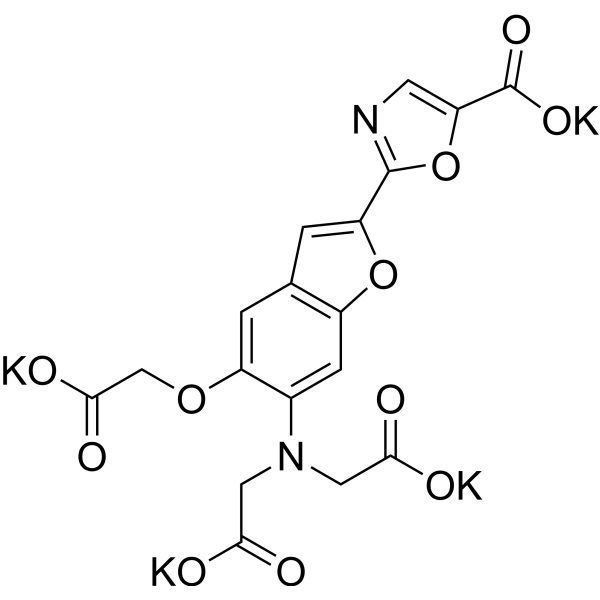
    Mag-Fura-2 tetrapotassium is a cell-impermeant UV excitable rational fluorescent Mg 2+/Ca 2+ indicator (Ex=334-360 nm, Em=510 nm). Mag-Fura-2 tetrapotassium can be used for the determination of Mg 2+ and Ca 2+ concentrations .
    Mag-Fura-2 tetrapotassium
  • HY-Y0682I

    0.5M EDTA Solution, pH 8.0

    Biochemical Assay Reagents Others
    0.5M Ethylenediaminetetraacetic acid Solution, pH 8.0 (0.5M EDTA Solution, pH 8.0) is a commonly used molecular biology reagent used for chelating magnesium ions, etc. This product is prepared using EDTA-Na2 and the pH value is adjusted to 8.0 with NaOH.
    0.5M Ethylenediaminetetraacetic acid Solution, pH 8.0
  • HY-W018746R

    Ethylenediaminetetraacetic acid disodium (Standard)

    Biochemical Assay Reagents Reference Standards Others
    EDTA (disodium) (Standard) is the analytical standard of EDTA (disodium). This product is intended for research and analytical applications. EDTA disodium salt, also known as ethylenediaminetetraacetic acid disodium, belongs to the chelating agent category, which is formed by chelating a central metal ion with four carboxylate groups and two amine groups. This compound, with its ability to bind and chelate metal ions such as calcium, magnesium and iron, is commonly used in a variety of applications, including industrial, medical and research settings. It is used as a preservative in food and beverage, as a stabilizer in medicine, as a chelating agent in water treatment, and as a reagent in biochemical and biomedical research. In addition, EDTA disodium salt has been studied for potential research effects such as improving heavy metal poisoning and cardiovascular disease.
    EDTA disodium (Standard)
  • HY-D0228

    Azo Violet; Magneson I

    Fluorescent Dye Others
    4-(4-Nitrophenylazo)resorcinol (Azo Violet) is an azo purple dye used experimentally as a pH indicator, showing yellow when the pH value is lower than 11 and purple when the pH value is higher than 13. In slightly alkaline or alkaline environments, it also turns dark blue in the presence of magnesium salts. Azo Violet can also be used to test for the presence of ammonium ions. The color of the ammonium chloride or ammonium hydroxide solution will change depending on the concentration of azo violet used .
    4-(4-Nitrophenylazo)resorcinol
  • HY-W008661A

    dGTP trisodium,100 mM Solution,PCR Grade; 2'-Deoxyguanosine-5'-triphosphate trisodium,100 mM Solution,PCR Grade

    DNA/RNA Synthesis Others
    Deoxyguanosine triphosphate (dGTP) trisodium,100 mM Solution,PCR Grade is one of the raw materials used by DNA polymerases to synthesize long DNA strands during DNA replication. Deoxyguanosine triphosphate trisodium,100 mM Solution,PCR Grade is used in polymerase chain reaction (PCR) for DNA amplification. This product is supplied in the form of an aqueous solution .
    Deoxyguanosine triphosphate  trisodium,100 mM Solution,PCR Grade
  • HY-126789

    Biochemical Assay Reagents Metabolic Disease
    DM-Nitrophen is a photolabile caged calcium compound that acts as a calcium releaser. DM-Nitrophen binds Ca 2+ with high affinity and Mg 2+ with considerable affinity before photolysis. DM-Nitrophen releases Ca 2+ into the cytosol upon ultraviolet light irradiation. DM-Nitrophen induces calcium concentration pulses, triggers cytosolic calcium transients, promotes calcium-dependent exocytosis. DM-Nitrophen can be used for the research of calcium-dependent cellular processes .
    DM-Nitrophen
  • HY-128536

    Fluorescent Dye Others
    KMG-104AM is a Mg 2+ fluorescent probe. KMG-104AM is a membrane-permeable ester-modified derivative of KMG-104, which serves as a reporter and imaging agent. KMG-104AM can track the increase in intracellular free magnesium ion concentration induced by mitochondrial uncoupling. KMG-104AM enables visualization of the three-dimensional distribution of intracellular magnesium ion concentration. KMG-104AM is applicable to research related to the functions of intracellular magnesium ions .
    KMG-104AM
  • HY-D1700

    Fluorescent Dye Others
    Mag-indo-1/AM is a cell-permeable fluorescent indicator for Mg 2+ and also for Ca 2+ (Ex=340-390 nm, Em=410-490 nm). Mag-indo-1/AM can be used to determine intracellular Mg 2+ and Ca 2+ concentrations .
    Mag-indo-1/AM
  • HY-W133934A

    Biochemical Assay Reagents Others
    EDTA magnesium disodium, 99% is a chelating agent with the ability to effectively bind metal ions (including calcium, magnesium, and iron) and remove them from solution.
    EDTA magnesium disodium,99%
  • HY-D1701

    Fluorescent Dye Others
    Calcium is an important part of the human body, usually in the form of calcium, a large number of bones and teeth of the human body, a small amount of blood and tissues. MCE calcium ion detection probe can specifically identify intracellular calcium ions, with high sensitivity, low cytotoxicity, increased AM acetylmethyl ester can enter the cell well, after being sheared by the intracellular esterase stay in the cell to bind to calcium ions, produce strong fluorescence, in addition, Mag-indo-1/AM and Mag-Fluo-4 AM at a certain concentration (usually 5 mM) can effectively identify intracellular magnesium ions .
    Mag-Fura-2 AM
  • HY-B2143

    Environmental Pollutants Biochemical Assay Reagents Bacterial Infection
    Montmorillonite is composed of two layers of co-top connected silicon oxygen tetrahedral sheet and one layer of co-edge connected aluminum (magnesium) oxygen (hydroxide) octahedral sheet, which consists of a 2:1 structure containing water of crystal. Montmorillonite can be used for large-scale industrial decontamination and can effectively remove harmful ions in sewage. Montmorillonite can also be used as a carrier of ionic antibacterial agents because of its exchangeable hydrated cations, which can adsorb bacteria .
    Montmorillonite
  • HY-W923366

    ETH 4030

    Biochemical Assay Reagents Endogenous Metabolite
    Magnesium ionophore III (ETH 4030) is an ionophore that has the activity of regulating the intracellular magnesium concentration. Magnesium ionophore III can promote the permeability of cell membranes to magnesium ions and enhance cell functions and metabolic activities. Magnesium ionophore III is also used to study the importance of magnesium ions in biological processes and its effects on cell physiology.
    Magnesium ionophore III
  • HY-Y1005

    Biochemical Assay Reagents Others
    Triammonium phosphate trihydrate interacts with the magnesium ions to form a precipitate, which can be used for magnesium separation from lithium in salt-lake brines .
    Triammonium phosphate trihydrate
  • HY-N6687R

    A-23187 (Standard); Antibiotic A-23187 (Standard)

    Oxidative Phosphorylation Reference Standards Bacterial Fungal Apoptosis Autophagy Antibiotic Infection Cancer
    Calcimycin (Standard) is the analytical standard of Calcimycin. This product is used for research and analytical applications. Calcimycin is an antibiotic and a unique divalent cation ionophore, such as calcium ions and magnesium ions. Calcimycin induces Ca 2+ -dependent cell death by increasing the intracellular calcium concentration. Calcimycin inhibits the growth of Gram-positive bacteria and some fungi, and also inhibits the activity of ATPase and uncouples the oxidative phosphorylation (OXPHOS) of mammalian cells, inducing apoptosis and autophagy.
    Calcimycin (Standard)
  • HY-W339484

    Biochemical Assay Reagents Others
    1-Ethyl-2-methyl-3-hydroxypyrid-4-one is an α-ketohydroxypyridinium iron chelator with high specificity for iron and no specific activity against other metal ions such as copper, zinc, calcium and magnesium. In rabbits with iron overload, 1-Ethyl-2-methyl-3-hydroxypyrid-4-one increased iron excretion after oral or parenteral administration.
    1-Ethyl-2-methyl-3-hydroxypyrid-4-one
  • HY-138185

    SF 2738A

    Bacterial Apoptosis Cancer
    Collismycin A is a bacterial metabolite originally isolated from Streptomyces that has diverse biological activities, including antibacterial, antiproliferative, and neuroprotective properties. It is active against a variety of bacteria (MICs=6.25 and 100 μg/mL) and fungi (MICs=12.5-100 μg/mL). It inhibits proliferation of A549 lung, HCT116 colon, and HeLa cervical cancer cells (IC50s=0.3, 0.6, and 0.3 μM, respectively) and NIH373 fibroblasts (IC50=56.6 μM) but not MDA-MD-231 breast cancer cells (IC50=>100 μM). Collismycin A forms a complex with Fe(II) and Fe(III) at a 2:1 ratio, and the addition of iron ions inhibits the antiproliferative effect of collismycin A on HeLa cells, an effect that does not occur with the addition of zinc, manganese, copper, or magnesium ions.3 Collismycin A (1 μM) prevents apoptosis in the brain region of zebrafish larvae in a model of neuronal cell death induced by all-trans retinoic acid.
    Collismycin A
  • HY-Y0306

    Environmental Pollutants Biochemical Assay Reagents Others
    Ammonium bromide is an inorganic electrolyte additive used in halogen-free magnesium-sulfur battery electrolytes, which serves dual functions as a regulator and a resistance-reducing agent. Ammonium bromide effectively optimizes the interfacial reaction kinetics of batteries by guiding the uniform deposition of magnesium, reducing the activation energy for magnesium ion transport, and decreasing the stripping/deposition overpotential. Ammonium bromide significantly enhances the cycle life and initial discharge capacity of magnesium-sulfur batteries .
    Ammonium bromide
  • HY-123883

    HIV HIV Integrase Infection
    MK-0536 is a highly potent HIV-1 integrase inhibitor that effectively suppresses the replication of wild-type viruses. MK-0536 retains significant antiviral activity against multiple key drug-resistant mutants such as Y143R and N155H, and shows no toxicity to uninfected cells. MK-0536 selectively blocks the strand transfer reaction of integrase by chelating magnesium ions at the active site and interacting with viral DNA and enzyme residues. MK-0536 is applicable to the study of HIV infection mechanisms .
    MK-0536
  • HY-D3006

    Fluorescent Dye Others
    The Mg Tracker Probe (Probe 2) is a Mg 2+ probe (Ex: 390 nm; Em: 500/530 nm) .
    Mg Tracker Probe
  • HY-W077245

    BCDMH

    Environmental Pollutants Bacterial Others
    Bromochloro-5,5-dimethylhydantoin is a bactericidal agent and membrane-disrupting agent. Bromochloro-5,5-dimethylhydantoin disrupts bacterial cell membranes, alters membrane structure and permeability, and induces leakage of soluble proteins and ions from bacterial cells. Bromochloro-5,5-dimethylhydoin exhibits bactericidal activity against bacteria .
    Bromochloro-5,5-dimethylhydantoin

Inquiry Online

Your information is safe with us. * Required Fields.

Salutation


Country or Region *

Applicant Name *


Organization Name *

Department *


Email Address *


Product Name *

Cat. No.


Requested quantity *

Phone Number *


Remarks

Inquiry Online

Inquiry Information

Product Name:
Cat. No.:
Quantity:
MCE Japan Authorized Agent:

