10 Results for "

microsomal fractions

" in MedChemExpress (MCE) Product Catalog:
Products (10)

10 Results for "microsomal fractions" in MCE Product Catalog:

Cat. No.: HY-112487
CAS No.: 78934-83-5
Pureté:  99.35%
Target:  

Acyltransferase

Domaines de recherche:  

Metabolic Disease

Sandoz 58-035 is a selective acyl-CoA:cholesterol acyltransferase (ACAT) inhibitor. Sandoz 58-035 inhibits this enzyme in intact cells and isolated microsomal fractions. Sandoz 58-035 blocks the esterification of exogenous vesicle-derived cholesterol and the incorporation of oleic acid into cellular cholesterol esters, reducing the formation and accumulation of cholesterol esters. Sandoz 58-035 causes a slight increase in cellular free cholesterol, and at high concentrations, it also causes a slight reduction in overall cellular protein synthesis. Sandoz 58-035 can be used in studies related to cellular cholesterol regulation .
loading...
    loading...
Cat. No.: HY-125954
CAS No.: 2616-64-0
Synonyms: UDP-α-D-glucuronic acid
Uridine diphosphate glucuronic acid (UDP-α-D-glucuronic acid) is a glucuronic acid donor. Uridine diphosphate glucuronic acid transfers its glucuronic acid moiety to acceptor molecules, thereby forming "ether" glucuronides, while being converted into uridine 5'-pyrophosphate. Uridine diphosphate glucuronic acid serves as a substrate for Arabidopsis UDP-GlcA 4-epimerase 1, and undergoes reversible 4-epimerization to generate UDP-α-D-galacturonic acid .
loading...
    loading...
Cat. No.: HY-177148
CAS No.: 134867-97-3
Domaines de recherche:  

Cardiovascular Disease

G256 is a cytochrome P450 substrate with antiarrhythmic properties. In recombinant monooxygenase systems, G256 undergoes N-hydroxylation of the terminal aminoguanidine nitrogen, as well as ring hydroxylation catalyzed by cytochrome P4502C3. G256 generates N-hydroxyaminoguanidine metabolites via N-hydroxylation in liver microsomal fractions. G256 produces phenol metabolites through ring hydroxylation in both liver microsomal fractions and recombinant cytochrome P450 systems. G256 can be used for research on arrhythmias .
loading...
    loading...
Cat. No.: HY-177148A
CAS No.: 134867-96-2
Domaines de recherche:  

Cardiovascular Disease

G256 dihydrochloride is a cytochrome P450 substrate with antiarrhythmic properties. In recombinant monooxygenase systems, G256 dihydrochloride undergoes N-hydroxylation of the terminal aminoguanidine nitrogen, as well as ring hydroxylation catalyzed by cytochrome P4502C3. G256 dihydrochloride generates N-hydroxyaminoguanidine metabolites via N-hydroxylation in liver microsomal fractions. G256 dihydrochloride produces phenol metabolites through ring hydroxylation in both liver microsomal fractions and recombinant cytochrome P450 systems. G256 dihydrochloride can be used for research on arrhythmias .
loading...
    loading...
Cat. No.: HY-131310
CAS No.: 111004-08-1
Target:  

Endogenous Metabolite

Domaines de recherche:  

Metabolic Disease

9(S)-HpOTrE is a monohydroperoxy polyunsaturated fatty acid produced by the action of 5-lipoxygenase (5-LO) on α-linolenic acid. It can be further metabolized to colnelenic acid by a divinyl ether synthase activity found in garlic and potato microsomal fractions. 9(S)-HpOTrE also serves as a substrate for further oxidation by both soybean and potato LOs, resulting in the formation of 9,16-dihydroperoxy acid.The suicide inactivation of LOs when 9(S)-HpOTrE is used as a substrate is thought to occur via formation of an unstable epoxide.
loading...
    loading...
Cat. No.: HY-116755
CAS No.: 55837-29-1
Synonyms: CR 605
Domaines de recherche:  

Neurological Disease

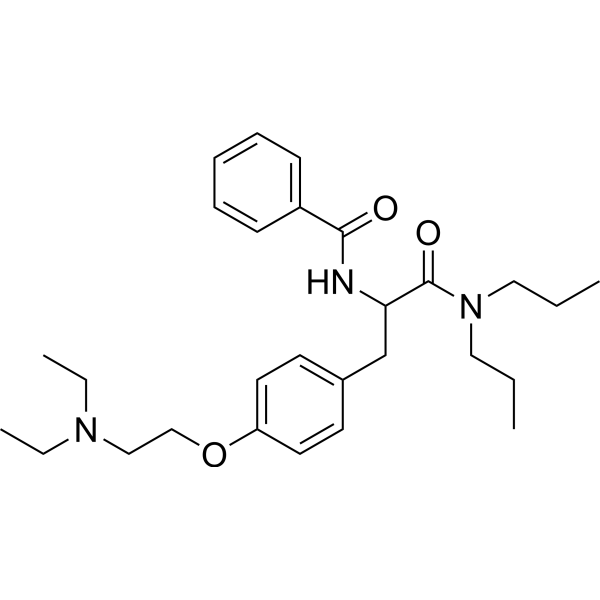
Tiropramide (CR 605) is a tyrosine derivative with antispastic properties. Tiropramide hydrochloride inhibits phosphodiesterase activity involved in cAMP catabolism in rabbit colon homogenates. Tiropramide relaxes smooth muscle in rabbit isolated colon. Tiropramide can be used for the research of irritable colon and biliary dyskinesia .
loading...
    loading...
Cat. No.: HY-135225
CAS No.: 75903-70-7
Domaines de recherche:  

Others

CH 402 is an antioxidant and radioprotective agent. CH 402 reduces the level of 60Co-γ ray-induced lipid peroxidation in in vitro liver microsomal preparations. CH 402 inhibits ascorbate-induced non-enzymatic lipid peroxidation in brain homogenates and microsomal fractions of rodents .
loading...
    loading...
Cat. No.: HY-177148B
CAS No.: 136623-15-9
Domaines de recherche:  

Cardiovascular Disease

(E/Z)-G256 (dihydrochloride) is an isomer of G256 dihydrochloride (HY-177148A). G256 dihydrochloride is a cytochrome P450 substrate with antiarrhythmic properties. In recombinant monooxygenase systems, G256 dihydrochloride undergoes N-hydroxylation of the terminal aminoguanidine nitrogen, as well as ring hydroxylation catalyzed by cytochrome P4502C3. G256 dihydrochloride generates N-hydroxyaminoguanidine metabolites via N-hydroxylation in liver microsomal fractions. G256 dihydrochloride produces phenol metabolites through ring hydroxylation in both liver microsomal fractions and recombinant cytochrome P450 systems. G256 dihydrochloride can be used for research on arrhythmias .
loading...
    loading...
Cat. No.: HY-169872
CAS No.: 4552-19-6
17-Hydroxystearic acid isolable from Torulopsis magnoliae fermentation oil. 17-Hydroxystearic acid is a saturated C18 ω2-hydroxy fatty acid existing in D- and L-enantiomeric forms .
loading...
    loading...
Cat. No.: HY-43934
CAS No.: 53567-47-8
Synonyms: CR 605 hydrochloride
Domaines de recherche:  

Neurological Disease

Tiropramide (CR 605) hydrochloride is a tyrosine derivative with antispastic properties. Tiropramide hydrochloride inhibits phosphodiesterase activity involved in cAMP catabolism in rabbit colon homogenates. Tiropramide hydrochloride relaxes smooth muscle in rabbit isolated colon. Tiropramide hydrochloride can be used for the research of irritable colon and biliary dyskinesia .
loading...
    loading...

