

15 Results for "

multidrug-resistant S. aureus

" in MedChemExpress (MCE) Product Catalog:
Products (15)

15 Results for "multidrug-resistant S. aureus" in MCE Product Catalog:

Cat. No.: HY-P10233A
Target:  

Bacterial

Research Areas:  

Infection

SAAP 148 TFA is a synthetic antimicrobial peptide (bacteria) that interacts with and disrupts the lipid bilayer of bacterial cytoplasmic membranes, thereby inducing changes in membrane permeability and bacterial death. SAAP 148 TFA kills drug-resistant, multidrug-resistant and persister bacterial strains, inhibits biofilm formation, eliminates established biofilms, and blocks bacterial colonization on implant surfaces. SAAP 148 TFA retains its activity after modification or immobilization, exhibits variable cytotoxicity in different human cell models, and shows reduced efficacy in protein-rich environments. SAAP 148 TFA can be used in infection-related research .
loading...
    loading...
Cat. No.: HY-P3328A
Target:  

Bacterial

Research Areas:  

Infection

MDP1 acetate, a Melittin-derived peptide, alters the integrity of both Gram-positive and Gram-negative bacterial membranes and kills the bacteria via membrane damages. MDP1 acetate has a high-antibacterial activity against multidrug resistant (MDR) and reference strains of S. aureus, E. coli, and P. aeruginosa .
loading...
    loading...
Cat. No.: HY-142124
CAS No.: 174513-95-2
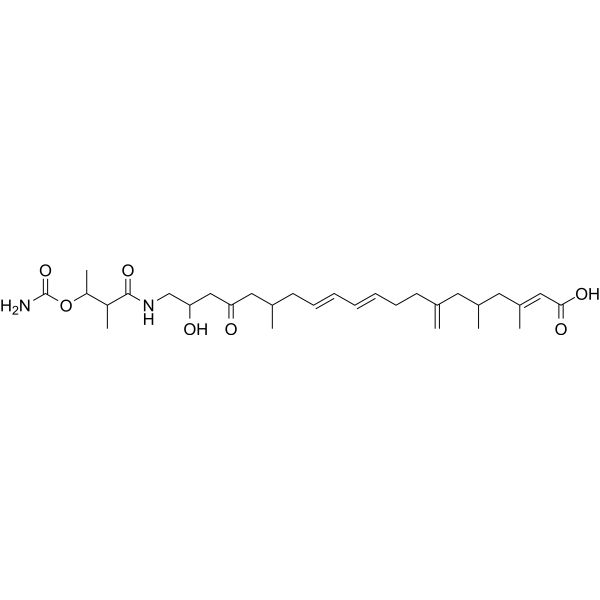
Kalimantacin A is an Antibiotic. Kalimantacin A is produced by Alcaligenes sp. YL-02632S. Kalimantacin A inhibits bacterial fatty acid biosynthesis. Kalimantacin A exerts selective antibacterial activity against staphylococci, including multidrug-resistant Staphylococcus aureus and Staphylococcus epidermidis. Kalimantacin A shows no activity against most Gram-negative bacteria and fungi. Kalimantacin A exhibits anticancer activity against leukemia and cervical cancer. Kalimantacin A can be used in studies related to staphylococcal infections .
loading...
    loading...
Cat. No.: HY-W763546A
CAS No.: 26403-72-5
Poly (ethylene glycol) diglycidyl ether (MW 500) is a crosslinker with epoxy functional groups at both ends . Poly (ethylene glycol) diglycidyl ether (MW 500) undergoes epoxy ring-opening reactions with the amino groups of ε-polylysine and the hydroxyl groups of hyaluronic acid to form a crosslinked network. Poly (ethylene glycol) diglycidyl ether (MW 500) helps endow materials with procoagulant, antibacterial and wound-healing properties .
loading...
    loading...
Cat. No.: HY-161797
CAS No.: 301304-67-6
Research Areas:  

Infection

Antibacterial agent 227 (Compd 29) is a SerRS (Seryl-tRNA synthetase) inhibitor. Antibacterial agent 227 has a significant inhibitory effect on the growth of planktonic and biofilm culture of Staphylococcus aureus 25923 with MIC (minimum inhibitory concentration) value of 32 µg/ml. Antibacterial agent 227 can be proposed as effective antiseptic toward multidrug-resistant biofilm-forming S. aureus isolates .
loading...
    loading...
Cat. No.: HY-121348
CAS No.: 59458-27-4
Synonyms: U-47929
Ficellomycin is a nitrogen-containing bicyclic antibiotic with strong activity against Gram-positive bacteria, including multidrug-resistant strains of Staphylococcus aureus. Ficellomycin works by inducing the formation of defective 34S DNA fragments, which interfere with the semi-conservative DNA replication process. These fragments lack the ability to integrate into larger DNA segments and eventually form a complete bacterial chromosome. Ficellomycin can be used in research for various bacterial diseases .
loading...
    loading...
Cat. No.: HY-149333
Target:  

Bacterial

Research Areas:  

Infection

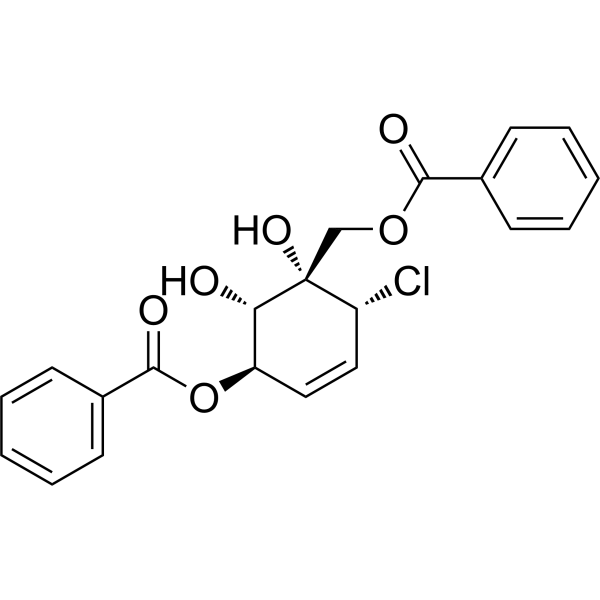
BO-1 is a benzoate ester with antibacterial activity. BO-1 inhibits multidrug-resistant Staphylococcus aureus, and acts function synergistically with antibiotic, such as Ciprofloxacin (HY-B0356). BO-1 can reverse the resistance of antibiotic-resistant S. aureus strains, and decreases the level of inflammatory factors IL-6 and C-reactive protein in vivo in mice .
loading...
    loading...
Cat. No.: HY-176776
CAS No.: 2131216-13-0
Target:  

Bacterial Antibiotic

Research Areas:  

Infection

Antibacterial agent 287 (Compound 26), a derivative of Deoxynybomycin (HY-116926), is an antibacterial agent. Antibacterial agent 287 has potent antibacterial activity against a variety of Gram-negative bacterium with MICs of 0.5, 0.5 and 0.06 μg/mL for WT S. aureus, WT E. coli and E. coli ΔtolC, respectively. Antibacterial agent 287 can be used for multidrug-resistant (MDR) bacterium infections research .
loading...
    loading...
Cat. No.: HY-P3328
Target:  

Bacterial

Research Areas:  

Infection

MDP1, a Melittin-derived peptide, alters the integrity of both Gram-positive and Gram-negative bacterial membranes and kills the bacteria via membrane damages. MDP1 has a high-antibacterial activity against multidrug resistant (MDR) and reference strains of S. aureus, E. coli, and P. aeruginosa .
loading...
    loading...
Cat. No.: HY-187201
Research Areas:  

Infection

Antimicrobial agent-54 is a ciprofloxacin-derived multi-target antimicrobial agent that inhibits E. coli DNA gyrase, S. aureus topoisomerase IV, LpxC and urease with IC50 values of 0.182, 3.501, 0.052 and 6.254 μM, respectively. The MIC of Antimicrobial agent-54 against E. coli ATCC 8739 is 0.20 μM. Antimicrobial agent-54 interferes with bacterial cell division, causes transient membrane disruption in Gram-positive bacteria, and induces aberrant penicillin-binding protein activity in Gram-negative bacteria. Antimicrobial agent-54 can be used in the research of bacterial infections, including multidrug-resistant bacterial infections and mycobacterial infections .
loading...
    loading...
Cat. No.: HY-183459
CAS No.: 591207-81-7
Target:  

Antibiotic Bacterial

Research Areas:  

Infection

LB 11058 is a Cephalosporin Antibacterial agent. LB 11058 inhibits the growth of pathogenic bacteria, including multidrug-resistant staphylococci and streptococci, but shows weak activity against Enterococcus faecium, Corynebacterium species, Enterobacteriaceae and non-fermenting Gram-negative bacilli. LB 11058 can be used in bacterial infection research .
loading...
    loading...
Cat. No.: HY-P11898
Target:  

Bacterial

Research Areas:  

Infection

RBWH15 is a synthetic broad-spectrum antimicrobial peptide. RBWH15 increases the permeability of bacterial outer and inner membranes, disrupts membrane integrity and induces bacterial death. RBWH15 exhibits biofilm eradication activity and can eliminate established bacterial biofilms. RBWH15 shows broad-spectrum antimicrobial activity against Gram-negative and Gram-positive ESKAPE pathogens, including multidrug-resistant strains. RBWH15 can be used in the research of multidrug-resistant bacterial infections .
loading...
    loading...
Cat. No.: HY-P11819
CAS No.: 3100335-76-7
SAP 2.8 peptide is an antimicrobial peptide. SAP 2.8 peptide induces bacterial membrane rupture and permeabilization, triggers an increase in intracellular ROS production, and causes bacterial death. SAP 2.8 peptide inhibits bacterial biofilm formation and disrupts established biofilms. SAP 2.8 peptide reduces bacterial load in animal models. SAP 2.8 peptide can be used for research on bacterial infections, skin and soft tissue infections, and peritonitis .
loading...
    loading...
Cat. No.: HY-P11583
Target:  

Bacterial

Research Areas:  

Infection

N2W2 is a tryptophan- and lysine-rich β-hairpin antimicrobial peptide. N2W2 exhibits potent antimicrobial activity but also high toxicity. N2W2 is highly susceptible to trypsin or chymotrypsin. N2W2 can be used for the research of bacterial infection .
loading...
    loading...
Cat. No.: HY-P11897
Target:  

Bacterial

Research Areas:  

Infection

RBWH11 is a synthetic antimicrobial peptide. RBWH11 disrupts the integrity of bacterial plasma membranes, induces changes in membrane permeability and causes bacterial death. RBWH11 can eliminate established bacterial biofilms. RBWH11 exhibits broad-spectrum antimicrobial activity against Gram-negative and Gram-positive ESKAPE pathogens, including multidrug-resistant strains. RBWH11 can be used for the research of multidrug-resistant bacterial infections .
loading...
    loading...
  • 1

