1. Search Result
Search Result
Results for "

p-nitroaniline

" in MedChemExpress (MCE) Product Catalog:

17

Inhibitors & Agonists

3

Fluorescent Dyes

1

Biochemical Assay Reagents

11

Peptides

Cat. No. Product Name Target Research Areas Chemical Structure
  • HY-131409

    D-Val-Leu-Lys-p-itoailide dihydrochloride; D-VLK-pNA dihydrochloride; S 2251 dihydrochloride

    Fluorescent Dye Others
    D-Val-Leu-Lys-pNA (D-Val-Leu-Lys-p-nitroanilide) dihydrochloride is a chromogenic peptide substrate that serves as a characteristic substrate for plasmin and plasminogen. D-Val-Leu-Lys-pNA dihydrochloride acts as a sensitive substrate for the DFE27 serine protease derived from Bacillus subtilis DC27. Catalyzed by plasmin, D-Val-Leu-Lys-pNA dihydrochloride binds and hydrolyzes to release p-nitroaniline (pNA), which can be detected colorimetrically at 405 nm as a measure of fibrinolytic activity .
    D-Val-Leu-Lys-pNA dihydrochloride
  • HY-P4545

    Angiotensin Receptor Others
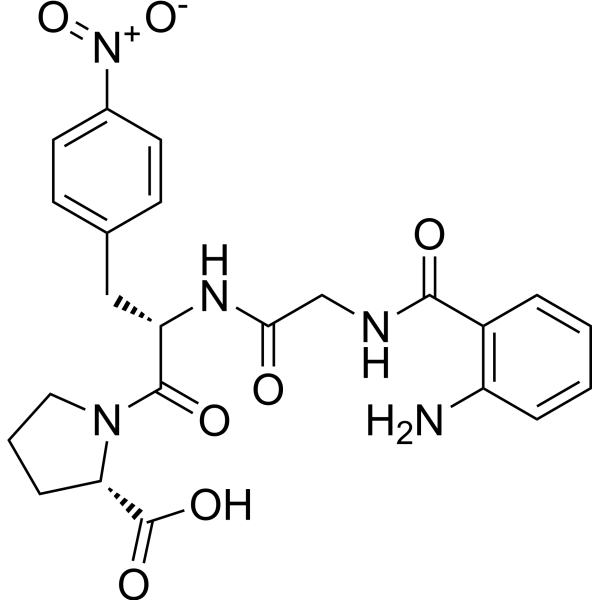
    Abz-Gly-p-nitro-Phe-Pro-OH is the fluorescent substrate angiotensin I converting enzyme (ACE-I) with 355 nm excitation and 405 nm emission wavelengths .
    Abz-Gly-p-nitro-Phe-Pro-OH
  • HY-137872

    Biochemical Assay Reagents Others
    L-Leucyl-4-nitroanilide hydrochloride is a commonly used substrate in various biochemical assays to measure the activity of enzymes that cleave peptide bonds, such as proteases. L-Leucine p-nitroanilide hydrochloride has unique chemical properties that allow it to be cleaved by these enzymes to form a yellow product called p-nitroaniline. This makes it a useful tool for detecting and quantifying protease activity in biological samples such as blood or tissue extracts.
    L-Leucyl-4-nitroanilide hydrochloride
  • HY-134019

    Others Others
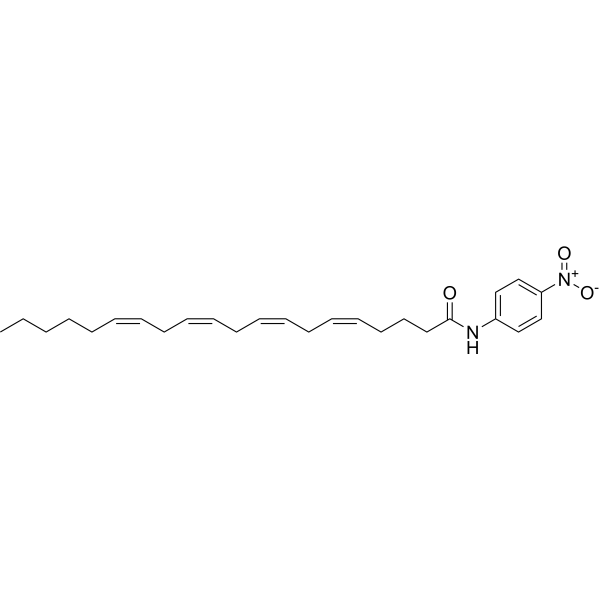
    Arachidonoyl p-nitroaniline is a substrate for the hydrolysis of p-nitroaniline by FAAH in Dictyostelium discoideum with long-chain unsaturated fatty acids. Arachidonoyl p-nitroaniline can be used in enzyme kinetic studies. Examples include determining the hydrolysis rate of Arachidonoyl p-nitroaniline and analyzing the fatty acid amide hydrolase activity of recombinant His-FAAH purified from Dictyostelium to characterize the binding and catalytic specificity of mammalian FAAH enzymes .
    Arachidonoyl p-nitroaniline
  • HY-P4561

    Cathepsin Others
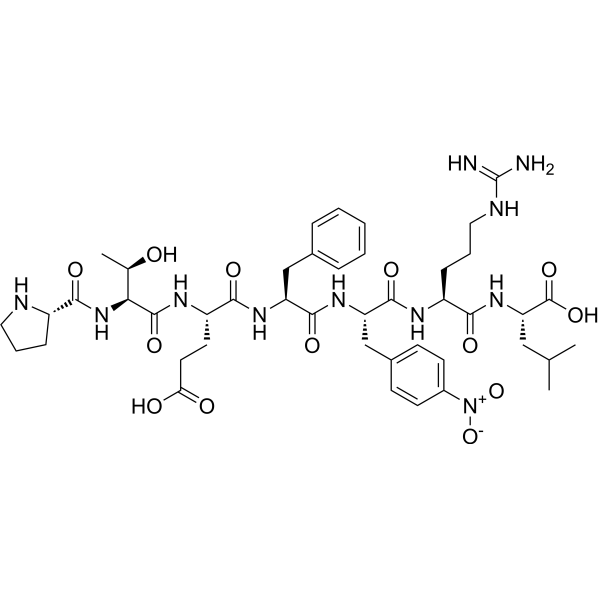
    H-Pro-Thr-Glu-Phe-p-nitro-Phe-Arg-Leu-OH is a water-soluble polypeptide that can serve as a substrate for cathepsin D, pepsin and pepsinogen. H-Pro-Thr-Glu-Phe-p-nitro-Phe-Arg-Leu-OH has potential applications in biochemical analysis .
    H-Pro-Thr-Glu-Phe-p-nitro-Phe-Arg-Leu-OH
  • HY-P4725

    Fluorescent Dye Others
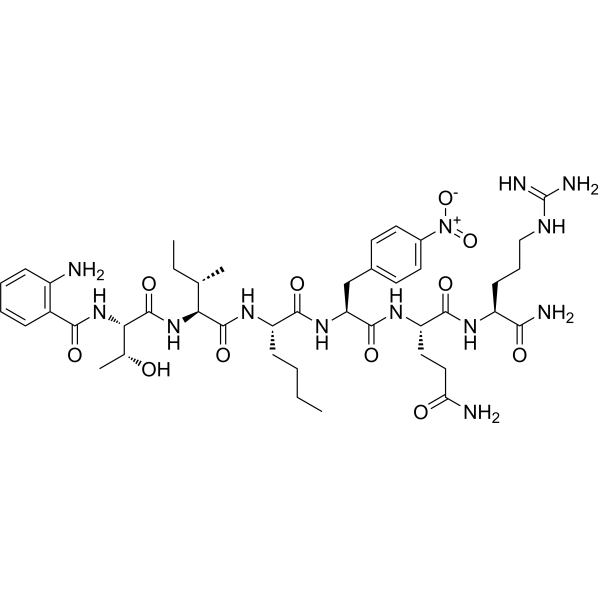
    Abz-Thr-Ile-Nle-p-nitro-Phe-Gln-Arg-NH2 is a fluorogenic substrate, that can be used for the fluorescence screening assay .
    Abz-Thr-Ile-Nle-p-nitro-Phe-Gln-Arg-NH2
  • HY-120971

    DepNA

    Endogenous Metabolite Metabolic Disease
    N-Decanoyl p-nitroaniline (DepNA) is one of several nitroaniline fatty acid amides which can be used to measure fatty acid amide hydrolase (FAAH) activity.1 FAAH is a relatively unselective enzyme in that it accepts a variety of amide head groups other than the ethanolamine of its endogenous substrate anandamide (AEA). It also will hydrolyze fatty acid amides with fewer carbons and fewer double bonds than arachidonate. Exposure of DepNA to FAAH activity results in the release of the yellow colorimetric dye p-nitroaniline (ε=13,500 at 410 nm). This allows the fast and convenient measurement of FAAH activity using a 96 well plate spectrophotometer.
    N-Decanoyl p-Nitroaniline
  • HY-P11392

    Cholinesterase (ChE) Biochemical Assay Reagents Others
    Ac-IEAR-pNA is the chromogenic substrate for quantifying endotoxin levels. Ac-IEAR-pNA is cleaved by HuBChE to produce p-nitroaniline product .
    Ac-IEAR-pNA
  • HY-137798

    Fluorescent Dye Others
    Chromozym PL is a chromogenic substrate for plasmin, and the enzymatic reaction can be carried out in 0.1mL Tris-HCl buffer (50 mM, pH 7.8). 100 μM Chromozym PL was dissolved and prepared. After adding the hydrolase, the generation of p-nitroaniline (pNA) at 405 nm was continuously observed, and the hydrolysis products were calculated .
    Chromozym PL
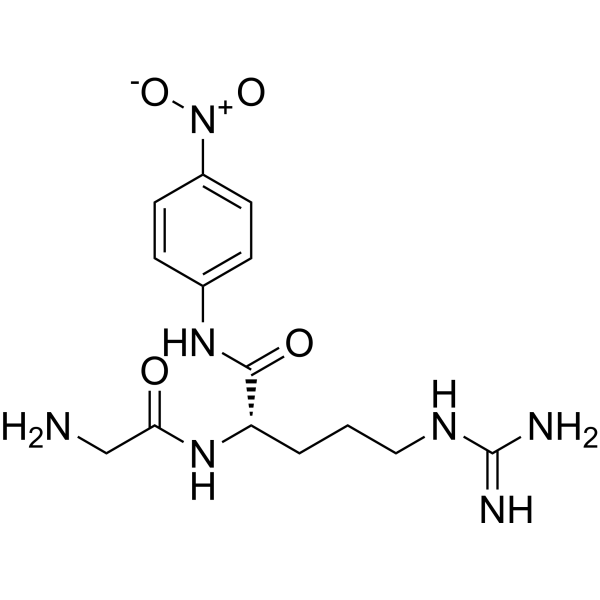
  • HY-137858

    Gly-Arg-4-NA hydrochloride; GR-pNA hydrochloride; GR p-itoailide hydrochloride

    Fluorescent Dye Others
    H-Gly-Arg-pNA hydrochloride (GR-pNA hydrochloride) is a colorimetric substrate for thrombin. H-Gly-Arg-pNA is preferentially bound by thrombin and cleaves the Gly-Arg (GR) peptide sequence, releasing p-nitroaniline (pNA) that can be detected colorimetrically at 405 nm. H-Gly-Arg-pNA hydrochloride is used as a fluorescent dye to measure thrombin activity .
    H-Gly-Arg-pNA hydrochloride
  • HY-P4465

    Fluorescent Dye Others
    Gly-Arg-pNA is a fluorogenic substrate for the measurement of protease activity. Gly-Arg-pNA undergoes hydrolysis and releases the fluorescent product p-nitroaniline. p-nitroaniline is in a fluorescent state under ultraviolet light irradiation and can emit a fluorescent signal .
    Gly-Arg-pNA
  • HY-P10666

    Caspase Others
    Ac-VDQQD-pNA is a substrate of Caspase 2 and can be cleaved to produce yellow pNA (p-nitroaniline) .
    Ac-VDQQD-pNA
  • HY-168378

    S-2251

    Fluorescent Dye Others
    D-Val-Leu-Lys-pNA (S-2251) is a chromogenic peptide substrate that serves as a characteristic substrate for plasmin and plasminogen. D-Val-Leu-Lys-pNA acts as a sensitive substrate for the DFE27 serine protease derived from Bacillus subtilis DC27. Catalyzed by plasmin, D-Val-Leu-Lys-pNA binds and hydrolyzes to release p-nitroaniline (pNA), which can be detected colorimetrically at 405 nm as a measure of fibrinolytic activity .
    D-Val-Leu-Lys-pNA
  • HY-P11734

    Ser/Thr Protease Others
    Suc-AAPY-pNA is an oligptide compound and protease substrate. Suc-AAPY-pNA undergoes hydrolysis by proteases at the peptide bond between tyrosine and p-nitroaniline, releasing p-nitroaniline with an absorption peak at OD410. Suc-AAPY-pNA functions as a substrate in preclinical assays for measuring activity of acidic, neutral, and alkaline proteases .
    Suc-AAPY-pNA
  • HY-W612175

    Leukotriene Receptor Others
    H-Ala-pNA is an L-amino acid p-nitroaniline (pNA) derivative and a specific substrate for leukotriene A4 hydrolase. The D-enantiomer of H-Ala-pNA shows no activity toward leukotriene A4 hydrolase. H-Ala-pNA can be catalytically hydrolyzed by leukotriene A4 hydrolase, and the p-nitroaniline produced during the reaction is monitored spectrophotometrically at 405 nm to enable quantitative detection of enzyme activity. H-Ala-pNA is used to evaluate the potency of inhibitors targeting the amidase activity of leukotriene A4 hydrolase .
    H-Ala-pNA
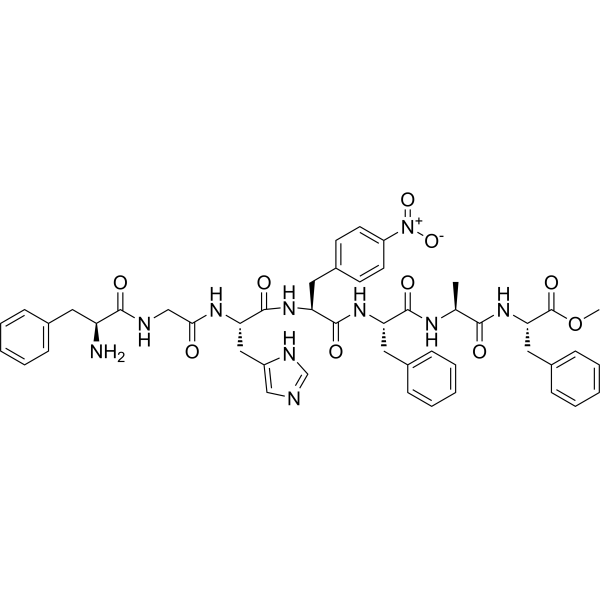
  • HY-P4556

    Biochemical Assay Reagents Others
    H-Phe-Gly-His-p-nitro-Phe-Phe-Ala-Phe-OMe is a polypeptide that can be hydrolyzed by Rennin (HY-P2810). H-Phe-Gly-His-p-nitro-Phe-Phe-Ala-Phe-OMe is commonly used as a biochemical reaction reagent .
    H-Phe-Gly-His-p-nitro-Phe-Phe-Ala-Phe-OMe
  • HY-168378A

    S-2251 acetate

    Fluorescent Dye Others
    D-Val-Leu-Lys-pNA acetate (S-2251 acetate) is a chromogenic peptide substrate that serves as a characteristic substrate for plasmin and plasminogen. D-Val-Leu-Lys-pNA acetate acts as a sensitive substrate for the DFE27 serine protease derived from Bacillus subtilis DC27. Catalyzed by plasmin, D-Val-Leu-Lys-pNA acetate binds and hydrolyzes to release p-nitroaniline (pNA), which can be detected colorimetrically at 405 nm as a measure of fibrinolytic activity .
    D-Val-Leu-Lys-pNA acetate

Inquiry Online

Your information is safe with us. * Required Fields.

Salutation


Country or Region *

Applicant Name *


Organization Name *

Department *


Email Address *


Product Name *

Cat. No.


Requested quantity *

Phone Number *


Remarks

Inquiry Online

Inquiry Information

Product Name:
Cat. No.:
Quantity:
MCE Japan Authorized Agent:

