
1. Search Result
Search Result
Results for "

peptide sequence analysis

" in MedChemExpress (MCE) Product Catalog:

7

Inhibitors & Agonists

7

Peptides

Cat. No. Product Name Target Research Areas Chemical Structure
  • HY-P2895

    Clostridiopeptidase B

    Endogenous Metabolite Others
    Clostripain (Clostridiopeptidase B) is a thiol protease isolated from Clostridium histolyticum. Clostripain exhibits proteolytic activity as well as amidase-esterase activity. The specificity of Clostripain is primarily restricted to arginine residues, but it also shows minor hydrolytic activity toward most lysine-containing substrates. Clostripain catalyzes the ammonolysis of Carbobenzoxyarginyl methyl ester to generate various dipeptides .
    Clostripain
  • HY-E70564

    Biochemical Assay Reagents Others
    Endoproteinase Arg-C is a serine endoproteinase that hydrolyzes peptide bonds on the carboxyl side of arginyl residues and has esterase and amidase activities. Endoproteinase Arg-C can be isolated from Clostridium histolyticum. Endoproteinase Arg-C is of mass spectrometry grade and can be used for peptide mapping, sequence analysis, cell separation .
    Endoproteinase Arg-C
  • HY-P5325A

    Bcl-2 Family Others
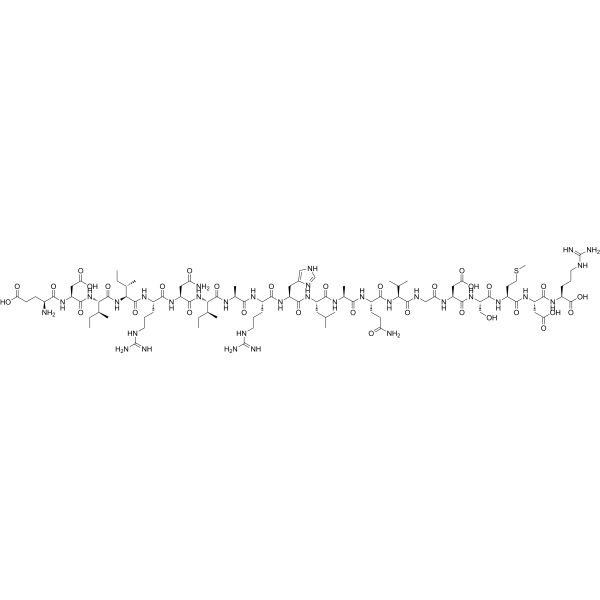
    Bid BH3 (80-99) acetate is a biological active peptide. (BID is a pro-apoptotic member of the 'BH3-only' (BOPS) subset of the BCL-2 family of proteins that constitute a critical control point in apoptosis. Bid is the first of the BOPs reported to bind and activate Bcl-2, Bax, and Bak. Bid serves as a death-inducing ligand that moves from the cytosol to the mitochondrial membrane to inactivate Bcl-2 or to activate Bax.Pyroglutamyl (pGlu) peptides may spontaneously form when either Glutamine (Q) or Glutamic acid (E) is located at the sequence N-terminus. The conversion of Q or E to pGlu is a natural occurrence and in general it is believed that the hydrophobic γ-lactam ring of pGlu may play a role in peptide stability against gastrointestinal proteases. Pyroglutamyl peptides are therefore considered a normal subset of such peptides and are included as part of the peptide purity during HPLC analysis.)
    Bid BH3 (80-99) acetate
  • HY-P5325

    Bcl-2 Family Others
    Bid BH3 (80-99) is a biological active peptide. (BID is a pro-apoptotic member of the 'BH3-only' (BOPS) subset of the BCL-2 family of proteins that constitute a critical control point in apoptosis. Bid is the first of the BOPs reported to bind and activate Bcl-2, Bax, and Bak. Bid serves as a death-inducing ligand that moves from the cytosol to the mitochondrial membrane to inactivate Bcl-2 or to activate Bax.Pyroglutamyl (pGlu) peptides may spontaneously form when either Glutamine (Q) or Glutamic acid (E) is located at the sequence N-terminus. The conversion of Q or E to pGlu is a natural occurrence and in general it is believed that the hydrophobic γ-lactam ring of pGlu may play a role in peptide stability against gastrointestinal proteases. Pyroglutamyl peptides are therefore considered a normal subset of such peptides and are included as part of the peptide purity during HPLC analysis.)
    Bid BH3 (80-99)
  • HY-P10457

    15-PGDH (92-105)

    15-PGDH Others
    5-Hydroxy prostaglandin dehydrogenase blocking peptide (15-PGDH (92-105)) is a blocking peptide that corresponds to the amino acids (AGVNNEKNWEKTLQ) located at positions 92-105 of the 15-hydroxy prostaglandin dehydrogenase (15-PGDH) sequence. 5-Hydroxy prostaglandin dehydrogenase blocking peptide can block the formation of protein-antibody complexes during immunohistochemical analysis of 15-PGDH .
    15-Hydroxy prostaglandin dehydrogenase blocking peptide
  • HY-P5439

    PKC MARCKS Others
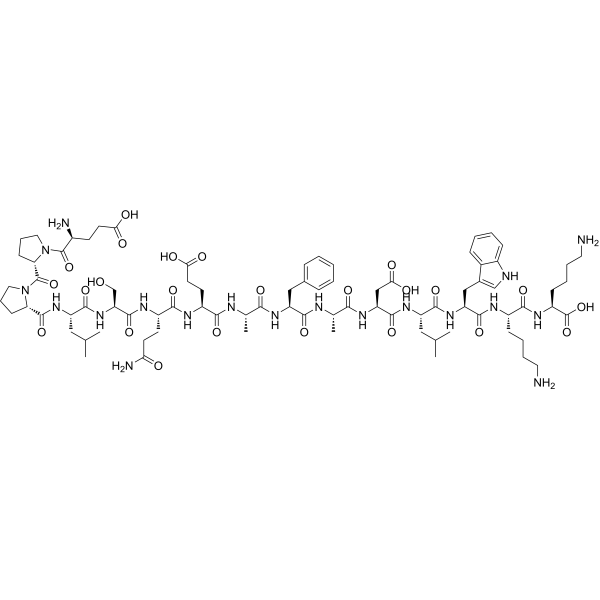
    Epsilon-V1-2, Cys-conjugated is a biological active peptide. (This peptide is the εPKC specific inhibitor. Its inhibitory activity is based on εPKC translocation and MARCKS phosphorylation. This peptide interferes with εPKC interaction with the anchoring protein εRACK. This peptide contains a cysteine residue added to the C-terminus for potential S-S bond formation with a carrier protein.Pyroglutamyl (pGlu) peptides may spontaneously form when either Glutamine (Q) or Glutamic acid (E) is located at the sequence N-terminus. The conversion of Q or E to pGlu is a natural occurrence and in general it is believed that the hydrophobic γ-lactam ring of pGlu may play a role in peptide stability against gastrointestinal proteases. Pyroglutamyl peptides are therefore considered a normal subset of such peptides and are included as part of the peptide purity during HPLC analysis.)
    Epsilon-V1-2, Cys-conjugated
  • HY-E70971

    Aminopeptidase Metabolic Disease
    Aminopeptidase M, Porcine (EC 3.4.11.2), is a metalloproteinase that hydrolyzes almost all N-terminal amino acids of unsubstituted oligopeptides. It does not cleave X-Pro bonds or N-terminal blocked amino acids. Aminopeptidase M can be used for peptide sequence analysis.
    Aminopeptidase M, Porcine

Inquiry Online

Your information is safe with us. * Required Fields.

Salutation


Country or Region *

Applicant Name *


Organization Name *

Department *


Email Address *


Product Name *

Cat. No.


Requested quantity *

Phone Number *


Remarks

Inquiry Online

Inquiry Information

Product Name:
Cat. No.:
Quantity:
MCE Japan Authorized Agent:

