5 Results for "

proteasome-mediated MDM2 degradation

" in MedChemExpress (MCE) Product Catalog:
Products (5)

5 Results for "proteasome-mediated MDM2 degradation" in MCE Product Catalog:

Cat. No.: HY-158684
CAS No.: 3049076-98-1
Purity:  99.86%
Research Areas:  

Cancer

YX-02-030 is a VHL-dependent MDM2 PROTAC degrader with a Kd of 35 nM. YX-02-030 recruits the VHL E3 ligase to form a ternary complex, leading to ubiquitination and proteasome-mediated degradation of MDM2. YX-02-030 inhibits MDM2-p53 and VHL-HIF1α binding with IC50 values of 63 and 1350 nM. YX-02-030 activates TAp73, upregulates p53 family target genes and induces apoptosis. YX-02-030 demonstrates on-target efficacy in TNBC xenograft-bearing mice, extending survival without normal cell toxicity .
loading...
    loading...
Cat. No.: HY-114324
CAS No.: 2369022-68-2
Purity:  99.74%
Target:  

PROTACs PARP Apoptosis

Research Areas:  

Cancer

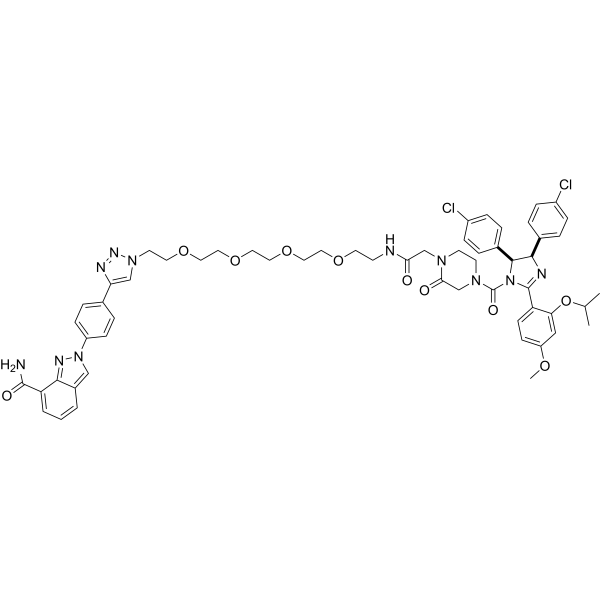
PROTAC PARP1 degrader is a PROTAC PARP1 degrader. PROTAC PARP1 degrader mediates the interaction between PARP1 and MDM2 E3 ubiquitin ligase, thereby inducing ubiquitination of PARP1 and subsequent proteasome-mediated degradation. PROTAC PARP1 degrader selectively inhibits the growth of breast cancer cells. PROTAC PARP1 degrader induces cell apoptosis by activating caspase-3 and phosphatidylserine externalization. PROTAC PARP1 degrader can be used in the research of triple-negative breast cancer .
loading...
    loading...
Cat. No.: HY-114324A
Purity:  98.99%
Target:  

PROTACs PARP Apoptosis

Research Areas:  

Cancer

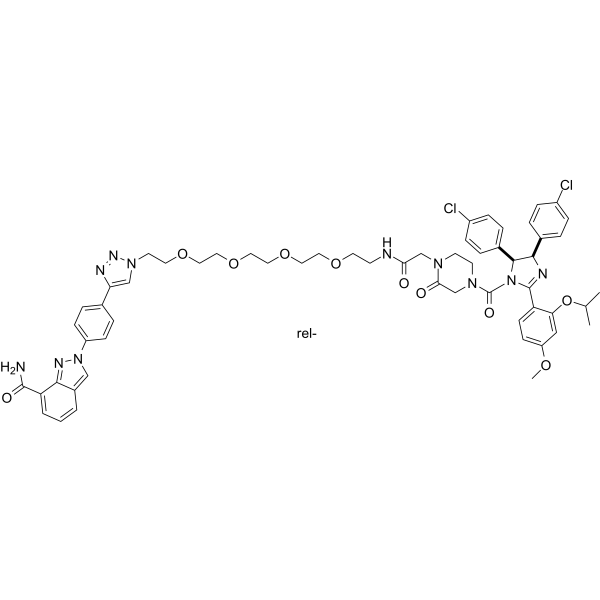
rel-PROTAC PARP1 degrader is the relative configuration of ROTAC PARP1 degrader (HY-114324). PROTAC PARP1 degrader is a PROTAC PARP1 degrader. PROTAC PARP1 degrader mediates the interaction between PARP1 and MDM2 E3 ubiquitin ligase, thereby inducing ubiquitination of PARP1 and subsequent proteasome-mediated degradation. PROTAC PARP1 degrader selectively inhibits the growth of breast cancer cells. PROTAC PARP1 degrader induces cell apoptosis by activating caspase-3 and phosphatidylserine externalization. PROTAC PARP1 degrader can be used in the research of triple-negative breast cancer .
loading...
    loading...
Cat. No.: HY-119709
CAS No.: 1353384-61-8
Target:  

MDM-2/p53 Apoptosis

Research Areas:  

Cancer

AQ-101 is a MDM2 degrader. Upon binding to MDM2, it blocks the MDM2-MDM4 interaction, inducing autoubiquitination and proteasome-mediated degradation of MDM2. AQ-101 activates p53, upregulates downstream targets including p21 and PUMA, and induces apoptosis and cell cycle arrest in tumor cells. AQ-101 inhibits the progression of acute lymphoblastic leukemia in xenograft animal models. AQ-101 can be used for research related to acute lymphoblastic leukemia .
loading...
    loading...
Cat. No.: HY-L128
187 compounds

Proteolysis-targeting chimera (PROTAC) has been developed to be a useful technology for targeted protein degradation. PROTACs consist of a ligand for E3 ligase (E3 ligase binder), a linker and a ligand (mostly small-molecule inhibitor) for protein of interest(target binder). Upon binding to the target protein, the PROTACs can recruit E3 for target protein ubiquitination, which is subjected to proteasome-mediated degradation.

Although there are more than 600 E3 ubiquitin ligases, only several with small molecule ligands have been used for designing PROTACs, including Skp1-Cullin-F box complex containing Hrt1 (SCF), Von Hippel-Lindau tumor suppressor (VHL), Cereblon (CRBN), inhibitor of apoptosis proteins (IAPs), and mouse double minute 2 homolog (MDM2).

MCE carefully prepared a unique collection of 187 ligands for E3 ligase, which have been reported to be used in PROTAC design. MCE E3 ligase ligand library is a useful tool for PROTAC development.

