4 Results for "

respiratory arrest

" in MedChemExpress (MCE) Product Catalog:
Products (4)

4 Results for "respiratory arrest" in MCE Product Catalog:

1
1 Cited Publications
Cat. No.: HY-D0976
CAS No.: 202983-32-2
Research Areas:  

Infection

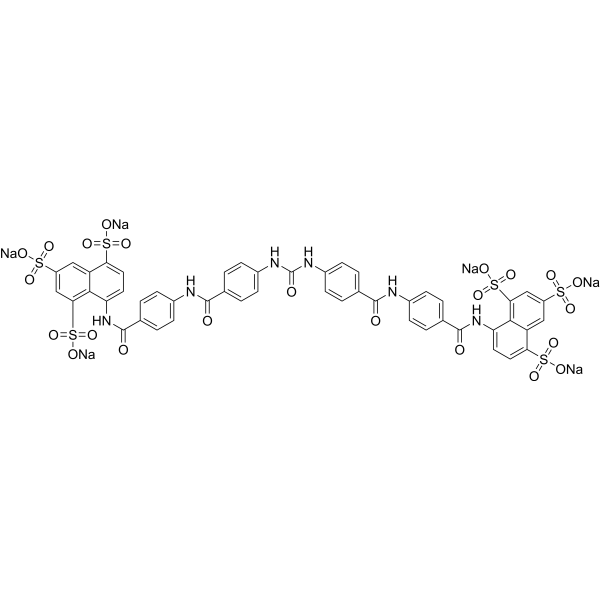
NF279 is a selective P2X1 receptor antagonist and NTPDase inhibitor, with a P2X1 IC50 value of 19 nM. NF279 suppresses GABA-evoked currents, reduces ATP-excited respiratory activity, alters hypoglossal nerve burst parameters, and blocks CXCR4, CCR5, CXCR3, and CXCR7-mediated calcium responses. NF279 arrests HIV-1 fusion downstream of CD4 binding, inhibits R5- and X4-tropic HIV-1 strains. NF279 can be used for the research of HIV-1 infection .
loading...
    loading...
Cat. No.: HY-N6609
CAS No.: 6801-40-7
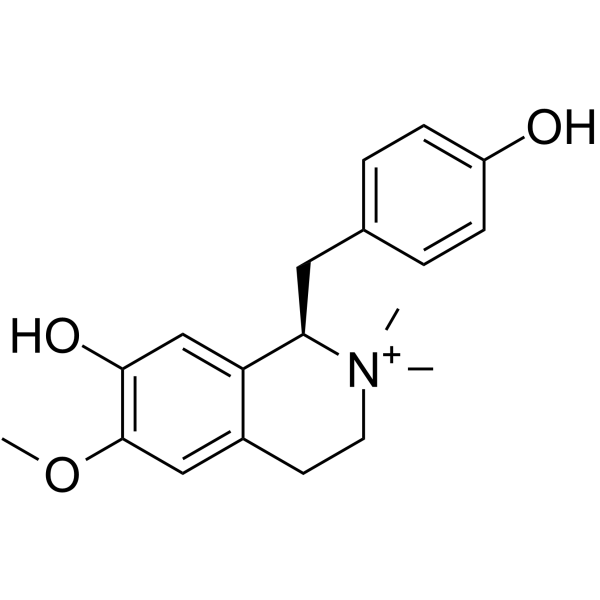
Magnocurarine is a neuromuscular junction blocker that inhibits muscle contraction by functionally blocking signal transmission without directly damaging nerve or muscle tissues. In frog, mouse and rabbit models, Magnocurarine exerts a dose-dependent paralytic effect, which progresses gradually from limb weakness and loss of righting reflex to respiratory depression and even cardiac arrest. Although high doses cause complete cessation of movement, Magnocurarine does not affect the spinal multineuronal reflex in frogs. Magnocurarine exhibits biological activity similar to that of tubocurarine (HY-125901) in various animal models .
loading...
    loading...
Cat. No.: HY-N21573
CAS No.: 34391-10-1
Milliamine A is an alkaloid ingenol ester derivative and a toxic substance that can be isolated from the dried roots of Euphorbia millii Ch. des Moulins. Milliamine A induces respiratory arrest caused by circulatory system damage, ptosis, diarrhea, weakened respiration, decreased body temperature, tremors, dyspnea, clonic-tonic convulsions, hemorrhage, and congestion of the lungs and spleen in mice .
loading...
    loading...
Cat. No.: HY-N6609B
CAS No.: 75413-87-5
Magnocurarine chloride is a neuromuscular junction blocker that inhibits muscle contraction by functionally blocking signal transmission without directly damaging nerve or muscle tissues. In frog, mouse and rabbit models, Magnocurarine chloride exerts a dose-dependent paralytic effect, which progresses gradually from limb weakness and loss of righting reflex to respiratory depression and even cardiac arrest. Although high doses cause complete cessation of movement, Magnocurarine chloride does not affect the spinal multineuronal reflex in frogs. Magnocurarine chloride exhibits biological activity similar to that of tubocurarine (HY-125901) in various animal models .
loading...
    loading...

