18 Results for "

snake+venom

" in MedChemExpress (MCE) Product Catalog:
Products (18)

18 Results for "snake+venom" in MCE Product Catalog:

11
11 Publications Verification
Cat. No.: HY-P1902
CAS No.: 115722-23-1
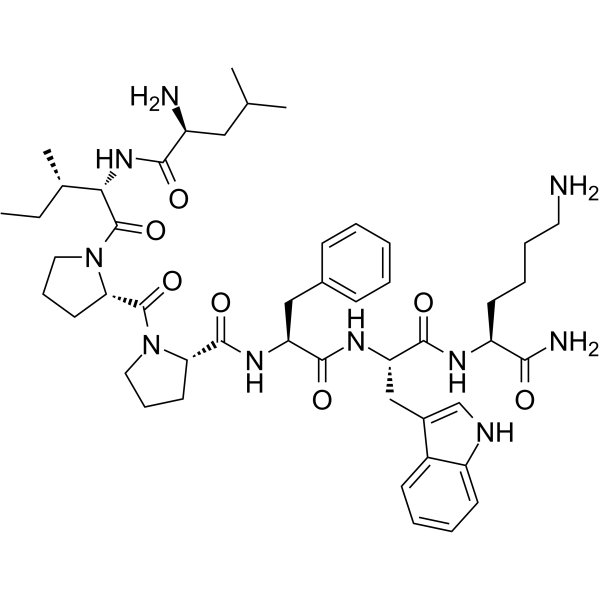
Cardiotoxin Analog (CTX) IV (6-12) is a membrane active peptide that specifically targets negatively charged phospholipid membranes (such as phosphatidylserine and phosphatidylinositol). Cardiotoxin Analog (CTX) IV (6-12) was discovered in the venom of the Taiwan cobra. Cardiotoxin Analog (CTX) IV (6-12) is a chemically synthesized snake venom cardiotoxin that binds to cell membranes and embeds into lipid bilayers through hydrophobic interactions and electrostatic attraction, thereby destroying the stability of membrane structure. Cardiotoxin Analog (CTX) IV (6-12) can induce membrane lipid disorder and cell lysis, exhibiting hemolysis and cytotoxicity .
loading...
    loading...
11
11 Publications Verification
Cat. No.: HY-P1902A
CAS No.: 2918768-05-3
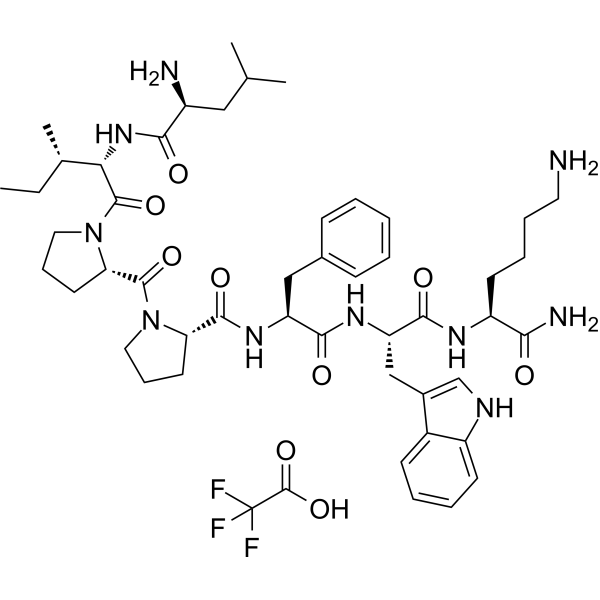
Cardiotoxin Analog (CTX) IV (6-12) TFA is a membrane active peptide that specifically targets negatively charged phospholipid membranes (such as phosphatidylserine and phosphatidylinositol). Cardiotoxin Analog (CTX) IV (6-12) TFA was discovered in the venom of the Taiwan cobra. Cardiotoxin Analog (CTX) IV (6-12) TFA is a chemically synthesized snake venom cardiotoxin that binds to cell membranes and embeds into lipid bilayers through hydrophobic interactions and electrostatic attraction, thereby destroying the stability of membrane structure. Cardiotoxin Analog (CTX) IV (6-12) TFA can induce membrane lipid disorder and cell lysis, exhibiting hemolysis and cytotoxicity .
loading...
    loading...
1
1 Cited Publications
Cat. No.: HY-P72815
Purity:  ≥ 90%, as determined by reducing SDS-PAGE.
Synonyms: ADAM17; Snake Venom-Like Protease; Prev. TACE; ADAM Metallopeptidase Domain 18; CSVP; Uncharacterized Protein ADAM17; Disintegrin And Metalloproteinase Domain-Containing Protein 17; TNF-Alpha Converting Enzyme; TNF-Alpha Convertase; CD156b Antigen; CD156B
Species:  
Rat
Source:  
HEK293
loading...
    loading...
1
1 Cited Publications
Cat. No.: HY-P78717
Purity:  ≥ 95%, as determined by reducing SDS-PAGE.
Synonyms: ADAM17; Snake Venom-Like Protease; Prev. TACE; ADAM Metallopeptidase Domain 18; CSVP; Uncharacterized Protein ADAM17; Disintegrin And Metalloproteinase Domain-Containing Protein 17; TNF-Alpha Converting Enzyme; TNF-Alpha Convertase; CD156b Antigen; CD156B
Species:  
Mouse
Source:  
HEK293
loading...
    loading...
Cat. No.: HY-P1189
CAS No.: 154303-05-6
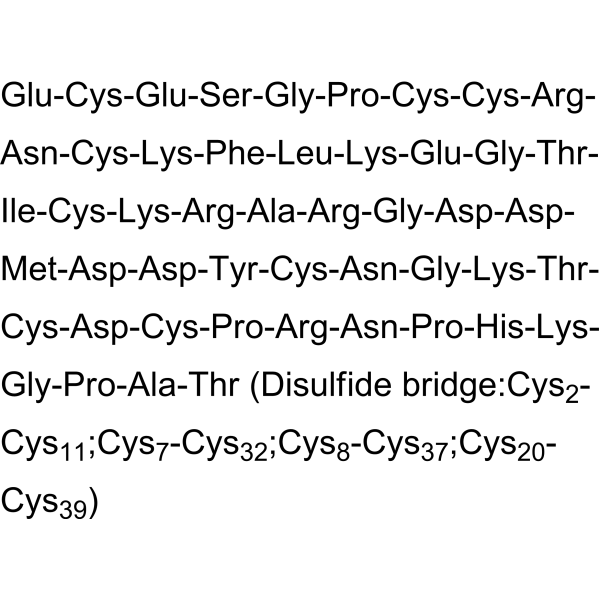
Echistatin is a naturally derived RGD-containing snake venom peptide. Echistatin exhibits an IC50 of 0.6 nM against mouse αvβ3 integrin, and acts as an antagonist against αvβ3, αII3, α5β1 integrins, pp125 FAK and paxillin. Echistatin reduces the phosphorylation of pp125 FAK and paxillin, inhibits the autophosphorylation and kinase activity of pp125 FAK, and weakens its binding to pp60src and paxillin. Echistatin disrupts the actin cytoskeleton and focal adhesions, induces melanoma cell detachment from fibronectin, and regulates cell adhesion and motility. Echistatin inhibits osteoclast maturation and migration, bone resorption, platelet aggregation, bone loss, as well as adhesion and metastasis of Lewis lung cancer cells; it also increases the number of osteoclasts and bone coverage area in mice with secondary hyperparathyroidism. Echistatin can be used in research related to melanoma, lung cancer and secondary hyperparathyroidism .
loading...
    loading...
Cat. No.: HY-P1189A
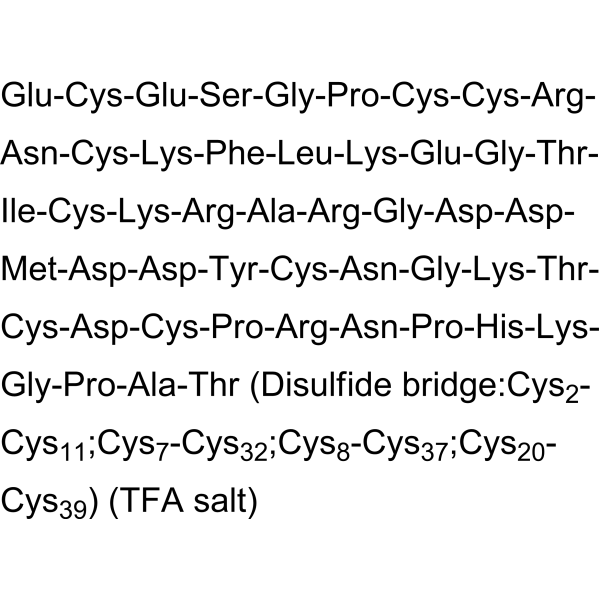
Echistatin TFA is a naturally derived RGD-containing snake venom peptide. Echistatin TFA exhibits an IC50 of 0.6 nM against mouse αvβ3 integrin, and acts as an antagonist against αvβ3, αII3, α5β1 integrins, pp125 FAK and paxillin. Echistatin TFA reduces the phosphorylation of pp125 FAK and paxillin, inhibits the autophosphorylation and kinase activity of pp125 FAK, and weakens its binding to pp60src and paxillin. Echistatin TFA disrupts the actin cytoskeleton and focal adhesions, induces melanoma cell detachment from fibronectin, and regulates cell adhesion and motility. Echistatin TFA inhibits osteoclast maturation and migration, bone resorption, platelet aggregation, bone loss, as well as adhesion and metastasis of Lewis lung cancer cells; it also increases the number of osteoclasts and bone coverage area in mice with secondary hyperparathyroidism. Echistatin TFA can be used in research related to melanoma, lung cancer and secondary hyperparathyroidism .
loading...
    loading...
Cat. No.: HY-120078
CAS No.: 1845753-81-2
Target:  

Phospholipase

Research Areas:  

Cardiovascular Disease

AZD2716 is an orally active secretory phospholipase A2 (sPLA2) inhibitor. AZD2716 inhibits human GIIA sPLA2 (IC50=10 nM), human GV sPLA2 (IC50=40 nM), human GX sPLA2 (IC50=400 nM), snake venom sPLA2 (IC50=2 pM), and snake (Bothrops jararacussu) Lys49-PLA2-like toxin (Kd=110 μM). AZD2716 inhibits sPLA2 isoforms IIa, V, X, snake venom sPLA2s, and snake venom Lys49-PLA2-like toxin myotoxic activity via hydrophobic channel binding. AZD2716 suppresses GIIA sPLA2 production, neutralizes snake venom-induced myotoxicity, and improves survival in envenomed mice. AZD2716 can be used for the research of coronary artery disease, atherosclerosis, and snakebite envenoming .
loading...
    loading...
Cat. No.: HY-W013741
CAS No.: 2491-17-0
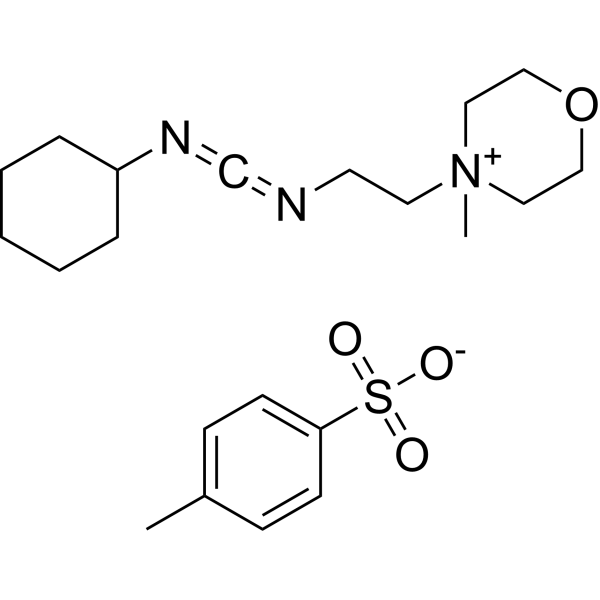
CME-carbodiimide is a nucleic acid modification reagent. CME-carbodiimide reacts specifically with uracil and guanine residues of RNA, as well as guanine and thymine residues of denatured DNA; it does not react with native DNA. Modification of DNA by CME-carbodiimide inhibits phosphodiester bond cleavage or DNA hydrolysis mediated by pancreatic ribonuclease, snake venom phosphodiesterase and deoxyribonuclease .
loading...
    loading...
Cat. No.: HY-23909
CAS No.: 89560-01-0
Synonyms: DEDA
Target:  

Phospholipase

Research Areas:  

Inflammation/Immunology

7,7-Dimethyl-(5Z,8Z)-eicosadienoic acid (DEDA), a phospholipase inhibitor, is a non-metabolizable analog of arachidonic or eicosadienoic acid. 7,7-Dimethyl-(5Z,8Z)-eicosadienoic acid (DEDA) inhibits P388D1 cell phospholipase A2 (PLA2) (IC50 = 16 µM) and snake venom PLA2 (IC50 = 14 µM) .
loading...
    loading...
Cat. No.: HY-176241
Target:  

Others

Research Areas:  

Cardiovascular Disease

DC-174 is an orally active inhibitor of snake venom metalloproteinases (SVMP) with a broad spectrum of inhibitory activity against a variety of snake venom SVMPs. DC-174 acts directly on the active site of SVMPs via zinc-binding groups, inhibiting their enzymatic activity and procoagulant toxicity. DC-174 can significantly prolong the survival time of mice attacked by snake venom. DC-174 can be used in the study of first aid for snake bites .
loading...
    loading...
Cat. No.: HY-N4016
CAS No.: 112137-81-2
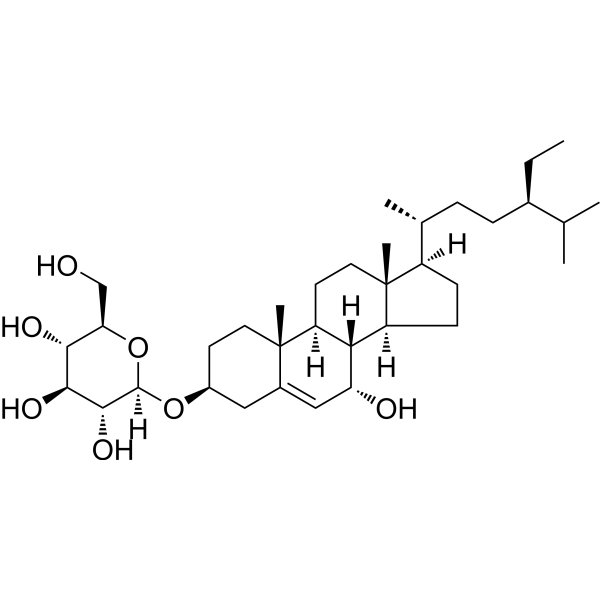
Ikshusterol 3-O-glucoside is a phytochemical that inhibits PLA2 from snake venoms .
loading...
    loading...
Cat. No.: HY-141555
CAS No.: 333409-31-7
Research Areas:  

Others

5,5′-(1,3-Propanediyl)bis-1,3,4-oxadiazole-2(3H)-thione is a weak inhibitor for snake venom and human recombinant phosphodiesterase 1 with IC50 of 429 and 467 μM. 5,5′-(1,3-Propanediyl)bis-1,3,4-oxadiazole-2(3H)-thione inhibits mushroom tyrosinase weakly, with Ki of 1.9 μM .
loading...
    loading...
Cat. No.: HY-P71455
Purity:  ≥ 90%, as determined by reducing SDS-PAGE.
Synonyms: Snake venom metalloproteinase adamalysin-2; EC:3.4.24.46; SVMP; Adamalysin II; Proteinase II
Species:  
Others
Source:  
E. coli
loading...
    loading...
Cat. No.: HY-187095
Research Areas:  

Others

PTAD-ergosta-3-one is a snake venom enzyme inhibitor. PTAD-ergosta-3-one inhibits the procoagulant activity of citrated plasma mediated by serine protease (SVSP) from Bothrops asper venom. PTAD-ergosta-3-one inhibits the esterase activity of PLA2 from Bothrops asper venom. PTAD-ergosta-3-one can be used in the research of snakebite envenoming .
loading...
    loading...
Cat. No.: HY-182434
CAS No.: 97012-61-8
Target:  

Phosphatase FAP

Research Areas:  

Inflammation/Immunology

CL 118326 is a potent, selective, competitive inhibitor of mammalian pancreatic phospholipase A2 (PLA2) and a weak antagonist of platelet-activating factor receptor (PAF receptor). CL 118326 competitively inhibits mammalian pancreatic PLA2 (porcine: IC50 = 1.55 μg/mL), and shows no activity against snake venom or bee venom PLA2. CL 118326 inhibits PAF-induced and thrombin-induced platelet aggregation, as well as the release of leukotriene (LTC4) and histamine from basophil-enriched leukocytes. CL 118326 can be used for research on inflammation and allergic reactions .
loading...
    loading...
Cat. No.: HY-P702499
Purity:  ≥ 80%, as determined by reducing SDS-PAGE.
Synonyms: ADAM17; Snake Venom-Like Protease; Prev. TACE; ADAM Metallopeptidase Domain 18; CSVP; Uncharacterized Protein ADAM17; Disintegrin And Metalloproteinase Domain-Containing Protein 17; TNF-Alpha Converting Enzyme; TNF-Alpha Convertase; CD156b Antigen; CD156B
Species:  
Human
Source:  
CHO
loading...
    loading...
Cat. No.: HY-185721
CAS No.: 25191-14-4
Synonyms: Polyguanylic acid
Target:  

DNA/RNA Synthesis

Research Areas:  

Others

Poly (G) (Polyguanylic acid) is a high-molecular-weight synthetic ribopolynucleotide. In the presence of Na + or K + ions, Poly (G) undergoes time-dependent structural modification, gradually self-assembling from a single strand into large G-quadruplex aggregates. Poly (G) undergoes cooperative secondary structure dissociation under alkaline conditions, but its secondary structure can withstand high temperatures up to 100°C and is resistant to snake venom diesterase at low Na + concentrations. Poly (G) forms stable 1:1 complexes with polycytidylic acid or poly 5-bromocytidylic acid, but does not bind to polyinosinic acid or polyadenylic acid. Poly (G) can be applied to studies on the interactions between drugs and G-rich DNA fragments in electrochemical biosensors .
loading...
    loading...
Cat. No.: HY-L220
90 compounds

Biotoxins, also referred to as natural toxins, are chemical substances produced by plants, animals, or microorganisms that exert toxic effects on other living organisms. Due to unique biological activities, biotoxins have been widely applied in molecular biology, physiology, pharmacology, and the clinical diagnosis and treatment of various human diseases, becoming an important source of natural drug development. Biotoxins can specifically bind to and interfere with intracellular signaling molecules or receptors, thereby altering cellular signaling processes. Leveraging this characteristic, biotoxins can be used to study the regulatory mechanisms of cellular signaling pathways. For example, neurotoxins such as snake venom peptides can be used to investigate the functional regulation of neurotransmitter receptors and ion channels. Additionally, biotoxins have demonstrated significant potential in drug development across various fields, including neurological diseases, cardiovascular diseases, anticoagulation, and anti-cancer therapies. With advancements in high throughput screening, structural optimization, and antibody-toxin conjugation technologies, numerous biotoxins or their structural analogs have been successfully brought to market, such as Ziconotide, Captopril, Bivalirudin, and Eptifibatide.

MCE offers 90 types of biotoxins, including neurotoxins, cardiotoxins, mycotoxins, and more.

  • 1

