
10 Results for "

supported lipid bilayers

" in MedChemExpress (MCE) Product Catalog:
Products (10)

10 Results for "supported lipid bilayers" in MCE Product Catalog:

Cat. No.: HY-P5366
Target:  

Liposome

Research Areas:  

Others

PEP1 is an amphipathic α-helical peptide containing 31 residues. The interaction of PEP1 with POPC-supported lipid bilayers (SLBs) is concentration-dependent: at low concentrations, it inserts into SLBs to generate compressive stress; at medium concentrations, it saturates the membrane surface to maintain constant stress; and at high concentrations, it solubilizes SLBs. PEP1 can be used for research on the mechanism of membrane-peptide interactions .
loading...
    loading...
Cat. No.: HY-122056
CAS No.: 39036-04-9
Synonyms: L-α-Diheptanoyllecithin; 12-Diheptanoyl-sn-glycero-3-PC
Research Areas:  

Others

1,2-Diheptanoyl-SN-glycero-3-phosphocholine (L-α-Diheptanoyllecithin; 12-Diheptanoyl-sn-glycero-3-PC) is a short-chain phospholipid. 11,2-Diheptanoyl-SN-glycero-3-phosphocholine forms bimolecular micelles with long-chain phospholipids, and these micelles undergo adsorption and spontaneous fusion to generate supported lipid bilayers. 1,2-Diheptanoyl-SN-glycero-3-phosphocholine enhances the transdermal penetration of hydrophilic low-molecular-weight compounds via micellar pretreatment of the skin of hairless mice. 1,2-Diheptanoyl-SN-glycero-3-phosphocholine can be used in studies of membrane biology, structural biology and transdermal drug delivery .
loading...
    loading...
Cat. No.: HY-W714524
CAS No.: 321863-21-2
Synonyms: 16:0-18:1 PS (POPS)
1-Palmitoyl-2-oleoyl-sn-glycero-3-PS sodium (16:0-18:1 PS (POPS)) is an anionic phosphatidylserine phospholipid with 16:0 (palmitoyl) and 18:1 (oleoyl) acyl chains. It serves as a component of biomimetic inner plasma membrane models and membrane vesicles for hemostatic response studies. 1-Palmitoyl-2-oleoyl-sn-glycero-3-PS sodium regulates membrane electrical properties by forming tethered bilayer lipid membranes. It enhances the stability of sHDL particles without altering the cholesterol efflux capacity of sHDL. 1-Palmitoyl-2-oleoyl-sn-glycero-3-PS sodium acts synergistically with phosphatidylcholine to support prothrombin activation. It serves as a component of the 4:1 POPC/POPS binary lipid bilayer model. 1-Palmitoyl-2-oleoyl-sn-glycero-3-PS sodium is applicable to research related to atherosclerosis .
loading...
    loading...
Cat. No.: HY-D1556
CAS No.: 384832-91-1
Synonyms: 1,2-dioleoyl-sn-glycero-3-phosphoethanolamine-N-(carboxyfluorescein) ammonium
Target:  

Fluorescent Dye

Research Areas:  

Cancer

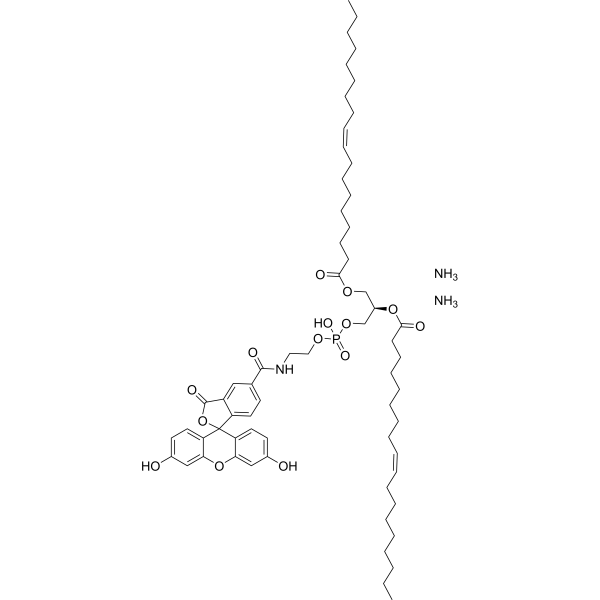
18:1 PE CF (1,2-dioleoyl-sn-glycero-3-phosphoethanolamine-N-(carboxyfluorescein) (ammonium)) is a pH-sensitive fluorescent indicator. 18:1 PE CF exhibits changes in fluorescence intensity in response to pH variations and reflects the electrostatic states of cationic liposomes and lipoplexes. 18:1 PE CF supports real-time visualization of pH distribution and membrane deformation in giant unilamellar vesicles and is suitable for steady-state fluorescence testing in large unilamellar vesicle membranes. 18:1 PE CF is capable of monitoring the surface electrical potential of cationic liposomes and lipoplexes and can effectively label lipid bilayers and nanomicelles. 18:1 PE CF can be used for the research of the investigation of lung cancer (Ex = 495 nm; Em = 520 nm) .
loading...
    loading...
Cat. No.: HY-D1305
CAS No.: 1443553-08-9
Target:  

Fluorescent Dye

Research Areas:  

Others

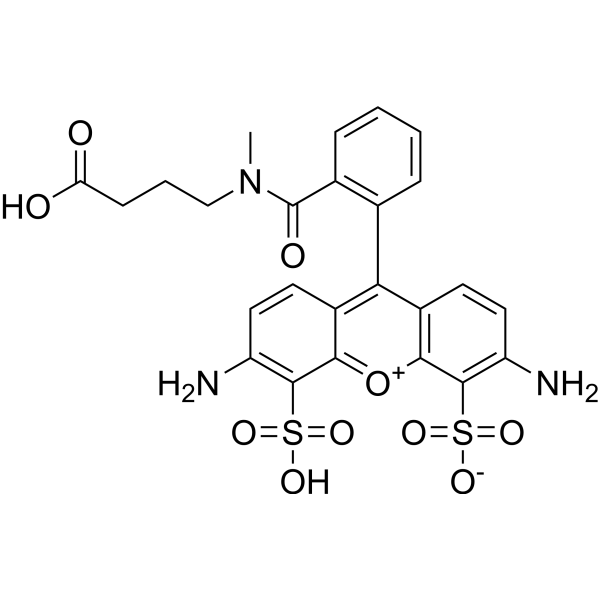
ATTO 488 carboxylic acid is a bright green fluorescent dye with high photostability, which is commonly used in protein fluorescent labeling, single-molecule fluorescence imaging and super-resolution microscopy studies. The carboxylic acid form of ATTO 488 can be covalently coupled to primary amines of proteins via activation, or prepared into a maleimide derivative for coupling with thiol groups; it emits green fluorescence after labeling. Ex/Em = 488/524 nm .
loading...
    loading...
Cat. No.: HY-125385
CAS No.: 187099-99-6
Purity:  ≥95.0%
Target:  

Endogenous Metabolite

Research Areas:  

Metabolic Disease

Sulforhodamine 101 DHPE is a fluorescent probe made from the conjugation of the phospholipid 1,2-dipalmitoyl-sn-glycero-3-PE to sulforhodamine 101, a red fluorescent dye that displays excitation/emission spectra of 586/605 nm, respectively. It integrates into phospholipid bilayers and has been used for imaging of solid supported lipid bilayers, detection of protein-ligand binding on bilayers, and to monitor colocalization of lipid probes in liposomes via resonance energy transfer (RET).
loading...
    loading...
Cat. No.: HY-145502
CAS No.: 384835-52-3
Research Areas:  

Others

1,2-Dipalmitoyl-sn-glycero-3-PE-N-(cap biotin) sodium is used in the composition of lipid vesicles for supported lipid bilayer (SLB) formation. 1,2-Dipalmitoyl-sn-glycero-3-PE-N-(cap biotin) sodium can be used as a probe for understanding the interactions between proteins and lipid-tethered ligands .
loading...
    loading...
Cat. No.: HY-P11742
CAS No.: 478288-80-1
Synonyms: Ac-GWW(LA)8LWWA-NH2
Research Areas:  

Others

WALP23 is a synthetic model peptide. WALP23 induces heterogeneity in lipid bilayers, forming stripe-like microdomains in DPPC bilayers. WALP23 can be used to study protein-membrane interactions. WALP23 is also used as a model peptide to determine helical orientation during the association process .
loading...
    loading...
Cat. No.: HY-203233
CAS No.: 126111-99-7
Rhodamine-DHPE is a fluorescently labeled phosphatidylethanolamine lipid that labels phospholipid bilayers. Rhodamine-DHPE serves as a fluorescence quenching substrate and membrane stain. The fluorescence lifetime of Rhodamine-DHPE decreases significantly in the presence of Cu 2+-PS complexes. Rhodamine-DHPE effectively stains the membranes of human red blood cells and mouse fibroblasts, and supports lifetime-resolved imaging via pump-probe fluorescence microscopy .
loading...
    loading...
Cat. No.: HY-D3576
Target:  

Fluorescent Dye

Research Areas:  

Others

AF532 C5 Maleimide is a Fluorescent dye used for protein labeling. AF532 C5 Maleimide covalently binds to thiol groups via its maleimide moiety. AF532 C5 Maleimide can label VASP to support visualization studies in phase separation and focused actin polymerization experiments .
loading...
    loading...

