6 Results for "

tail current

" in MedChemExpress (MCE) Product Catalog:
Products (6)

6 Results for "tail current" in MCE Product Catalog:

Cat. No.: HY-B0874
CAS No.: 67375-30-8
Synonyms: FMC 45497; Fendona; WL 85871
Research Areas:  

Infection Neurological Disease

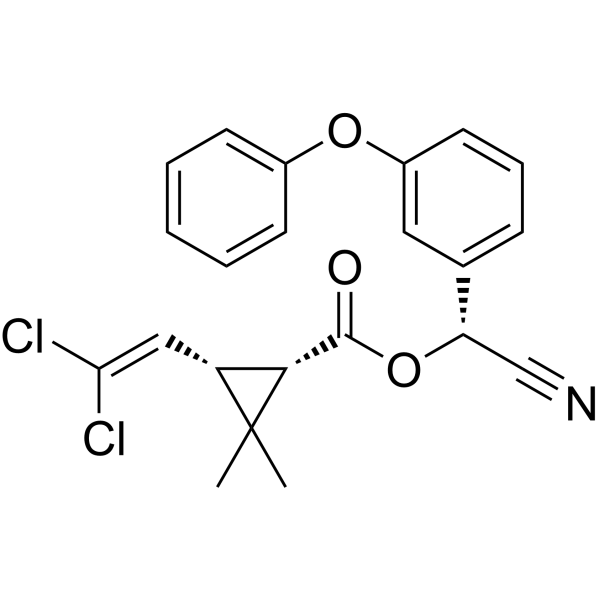
Alpha-Cypermethrin (FMC 45497; Fendona; WL 85871) is a type II pyrethroid insecticide. Alpha-Cypermethrin acts by delaying the inactivation of voltage-gated sodium channels, prolonging sodium tail currents, and triggering repetitive neural discharges. Alpha-Cypermethrin exhibits knockdown and lethal activity against target insects such as Musca domestica and Anopheles culicifacies. Alpha-Cypermethrin induces neurotoxicity in mammals, alters placental and fetal neurodevelopment, and causes acute mortality in fish. Alpha-Cypermethrin can be used in studies related to neurotoxicity, vector-borne diseases, and malaria .
loading...
    loading...
Cat. No.: HY-122024
CAS No.: 496793-75-0
Purity:  99.87%
Target:  

Potassium Channel

Research Areas:  

Cardiovascular Disease

AZSMO-23 is a potent hERG K + channel activator. AZSMO-23 activats WT hERG pre-pulse and tail current with EC50 values of 28.6, 11.2 µM, respectively. AZSMO-23 has the potential for the research of long QT syndrome .
loading...
    loading...
Cat. No.: HY-172140
Target:  

Potassium Channel

Research Areas:  

Neurological Disease

Ebio3 is a selective potassium channel (KCNQ2) inhibitor with an IC50 of 1.2 nM. Ebio3 binds to the KCNQ2 channel through its hydrophobic tail, causing the S6 helix to move inward, which leads to the closure of the inner gate. The inhibitory effect of Ebio3 is also effective in pathogenic mutants of KCNQ2 (such as R75C and I238L), where it can inhibit outward currents by more than 80%. Ebio3 is expected to be used in the research of neurological diseases such as epilepsy .
loading...
    loading...
Cat. No.: HY-B0874R
CAS No.: 67375-30-8
Synonyms: FMC 45497 (Standard); Fendona (Standard); WL 85871 (Standard)
Alpha-Cypermethrin (Standard) (FMC 45497 (Standard); Fendona (Standard); WL 85871 (Standard)) is the analytical standard of Alpha-Cypermethrin (HY-B0874). This product is intended for research and analytical applications. Alpha-Cypermethrin (FMC 45497; Fendona; WL 85871) is a type II pyrethroid insecticide. Alpha-Cypermethrin acts by delaying the inactivation of voltage-gated sodium channels, prolonging sodium tail currents, and triggering repetitive neural discharges. Alpha-Cypermethrin exhibits knockdown and lethal activity against target insects such as Musca domestica and Anopheles culicifacies. Alpha-Cypermethrin induces neurotoxicity in mammals, alters placental and fetal neurodevelopment, and causes acute mortality in fish. Alpha-Cypermethrin can be used in studies related to neurotoxicity, vector-borne diseases, and malaria .
loading...
    loading...
Cat. No.: HY-189531
CAS No.: 24978-47-0
Research Areas:  

Infection Cancer

Antioxidant agent-26 is a DPPH free radical scavenger. Antioxidant agent-26 has broad-spectrum ultraviolet absorption properties and iron-reducing ability. Antioxidant agent-26 blocks the hERG potassium channel and reduces the tail current. Antioxidant agent-26 inhibits the proliferation of dermatophytes and tumor cells. Antioxidant agent-26 can be used in research related to T-cell leukemia, melanoma, and dermatophytosis .
loading...
    loading...
Cat. No.: HY-182638
CAS No.: 1829530-11-1
Synonyms: CPL500036
Alofropodect is an orally active, blood-brain barrier permeable phosphodiesterase 10A (PDE10A) inhibitor with IC50 values of 1 nM (Reference 1) and 35 nM (Reference 2). Alofropodect acts as a negative allosteric modulator of the M2 muscarinic receptor with an IC50 of 9.2 μM. Alofropodect alters cyclic nucleotide levels in basal ganglia circuits, inhibits the hydrolysis of cAMP and cGMP, and suppresses hERG potassium channel tail currents. Alofropodect induces catalepsy in rats and reverses injury-induced contralateral forelimb use impairment. Alofropodect can be used in research related to schizophrenia, Parkinson's disease, and levodopa-induced dyskinesia .
loading...
    loading...

