56 Results for "

terminal primary amino group

" in MedChemExpress (MCE) Product Catalog:
Products (56)

56 Results for "terminal primary amino group" in MCE Product Catalog:

Cat. No.: HY-W012001
CAS No.: 60142-89-4
Target:  

PROTAC Linkers

Research Areas:  

Cancer

Boc-7-Aminoheptanoic acid can be used as a PROTAC linker in the synthesis of PROTACs and other conjugation applications. Boc-7-Aminoheptanoic acid is an alkane chain with terminal carboxlic acid and Boc-protected amino groups. The terminal carboxylic acid can react with primary amine groups in the presence of activators (e.g. EDC, or HATU) to form a stable amide bond. The Boc group can be deprotected under mild acidic conditions to form the free amine.
loading...
    loading...
Cat. No.: HY-W002041
CAS No.: 13325-10-5
Synonyms: 4-amino-1-butanol
Research Areas:  

Others

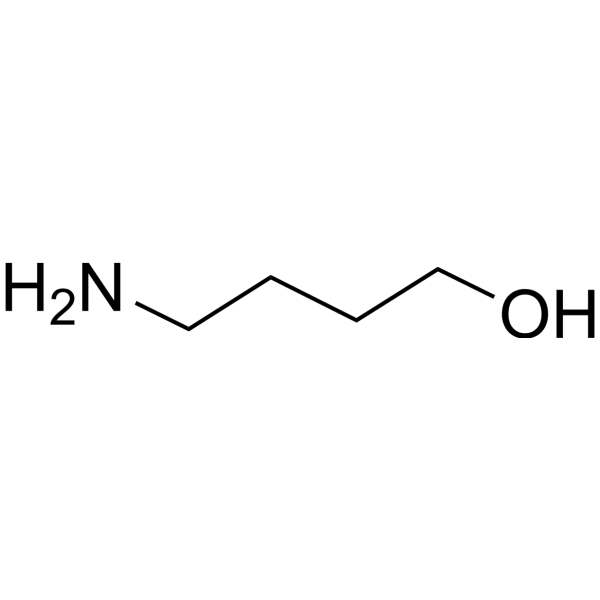
4-Aminobutan-1-ol (4-Amino-1-butanol) is a linear γ-amino alcohol bearing both a primary amino group and a primary hydroxyl group, which serves as a starting material for the synthesis of pyridine-based Schiff bases. As an important intermediate, 4-Aminobutan-1-ol can be used in the synthesis of GABA derivatives, chiral ligands and other active compounds .
loading...
    loading...
Cat. No.: HY-W041856
CAS No.: 30100-16-4
Synonyms: Boc-8-aminooctanoic acid
Target:  

PROTAC Linkers

Research Areas:  

Cancer

N-Boc-8-amino-octanoic acid (Boc-8-aminooctanoic acid) can be used as a PROTAC linker in the synthesis of PROTACs. N-Boc-8-amino-octanoic acid is an alkane chain with terminal carboxlic acid and Boc-protected amino groups. The terminal carboxylic acid can react with primary amine groups in the presence of activators (e.g. EDC, or HATU) to form a stable amide bond. The Boc group can be deprotected under mild acidic conditions to form the free amine.
loading...
    loading...
Cat. No.: HY-W105744
CAS No.: 13108-19-5
Target:  

PROTAC Linkers

Research Areas:  

Cancer

10-Aminodecanoic acid is an alkane chain with terminal carboxlic acid and amine groups. 10-Aminodecanoic acid can be used as a PROTAC linker in the synthesis of PROTACs and other conjugation applications. The amino group (NH2) is reactive with carboxylic acids, activated NHS esters, carbonyls (ketone, aldehyde) etc. The terminal carboxylic acid can react with primary amine groups of activated NHS ester to form a stable amide bond.
loading...
    loading...
Cat. No.: HY-155908
CAS No.: 474922-26-4
Synonyms: DSPE-PEG10000-NH2 ammonium
Target:  

Liposome

Research Areas:  

Others

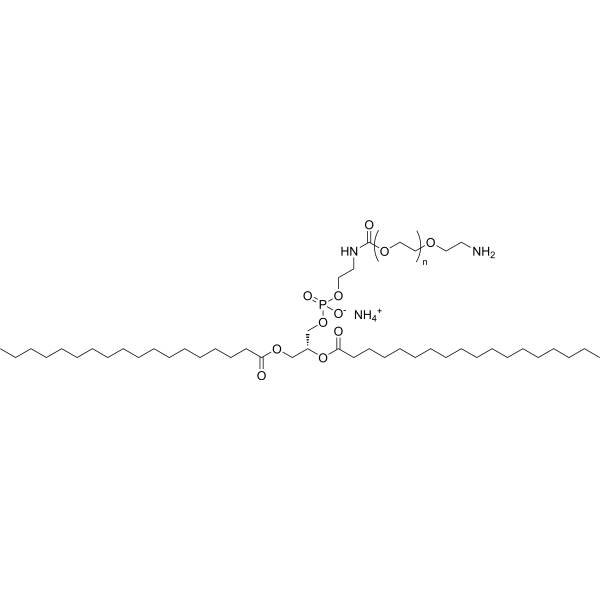
DSPE-PEG10000-Amine ammonium (DSPE-PEG10000-NH2 ammonium) is a PEGylated distearoylphosphatidylethanolamine lipid with a terminal primary amino group. DSPE-PEG10000-Amine ammonium serves as a liposome component, and its surface bears reactive primary amino groups that enable covalent conjugation via the formation of bis-aryl hydrazone bonds .
loading...
    loading...
Cat. No.: HY-W005828
CAS No.: 173435-78-4
Target:  

PROTAC Linkers

Research Areas:  

Cancer

9-(Boc-amino)nonanoic Acid is an alkane chain with terminal carboxlic acid and Boc-protected amino groups. 9-(Boc-amino)nonanoic acid can be used as a PROTAC linker in the synthesis of PROTACs. The terminal carboxylic acid can react with primary amine groups in the presence of activators (e.g. EDC, or HATU) to form a stable amide bond. The Boc group can be deprotected under mild acidic conditions to form the free amine.
loading...
    loading...
Cat. No.: HY-W009056
CAS No.: 127582-76-7
Target:  

PROTAC Linkers

Research Areas:  

Cancer

Fmoc-7-amino-heptanoic acid is an alkane chain with terminal Fmoc-protected amine and carboxylic acid groups. Fmoc-7-amino-heptanoic acid can be used as a PROTAC linker in the synthesis of PROTACs. The Fmoc group can be deprotected under basic condition to obtain the free amine which can be used for further conjugations. The terminal carboxylic acid can react with primary amine groups in the presence of activators (e.g. EDC, or HATU) to form a stable amide bond.
loading...
    loading...
Cat. No.: HY-W105727
CAS No.: 1120-12-3
Target:  

PROTAC Linkers

Research Areas:  

Cancer

9-Aminononanoic acid can be used as a PROTAC linker and other conjugation in the synthesis of PROTACs. 9-Aminononanoic acid is an alkane chain with terminal carboxlic acid and amine groups. The amino group (NH2) is reactive with carboxylic acids, activated NHS esters, carbonyls (ketone, aldehyde) etc. The terminal carboxylic acid can react with primary amine groups of activated NHS ester to form a stable amide bond.
loading...
    loading...
Cat. No.: HY-130695
CAS No.: 2093152-86-2
Purity:  99.52%
Target:  

ADC Linkers

Research Areas:  

Cancer

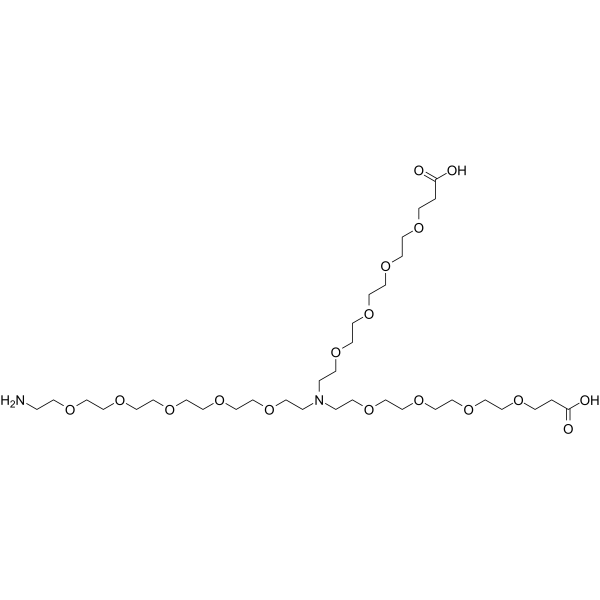
N-(Amino-PEG5)-N-bis(PEG4-acid) is a PEG derivative containing an amino group with two terminal carboxylic acids. The amino group is reactive with carboxylic acids, activated NHS esters. The terminal carboxylic acids can react with primary amine groups in the presence of activators to form a stable amide bond. N-(Amino-PEG5)-N-bis(PEG4-acid) can be useful in the development of antibody drug conjugates (ADCs) .
loading...
    loading...
Cat. No.: HY-W089232
CAS No.: 173606-50-3
Target:  

PROTAC Linkers

Research Areas:  

Cancer

Boc-10-Aminodecanoic acid can be used as a PROTAC linker in the synthesis of PROTACs and other conjugation applications. Boc-10-Aminodecanoic acid is an alkane chain with terminal carboxlic acid and Boc-protected amino groups. The terminal carboxylic acid can react with primary amine groups in the presence of activators (e.g. EDC, or HATU) to form a stable amide bond. The Boc group can be deprotected under mild acidic conditions to form the free amine.
loading...
    loading...
Cat. No.: HY-W101723
CAS No.: 18934-81-1
Target:  

PROTAC Linkers

Research Areas:  

Cancer

Boc-12-Ado-OH can be used as a PROTAC linker in the synthesis of PROTACs. Boc-12-Ado-OH is an alkane chain with terminal carboxlic acid and Boc-protected amino groups. The terminal carboxylic acid can react with primary amine groups in the presence of activators (e.g. EDC, or HATU) to form a stable amide bond. The Boc group can be deprotected under mild acidic conditions to form the free amine.
loading...
    loading...
Cat. No.: HY-W190958
CAS No.: 220431-61-8
Research Areas:  

Others

Boc-NH-Tri-(carbonylethoxymethyl)-methane is a branched PEG linker with a Boc-protected amino and three terminal carboxilic acid groups. The Boc group can be deprotected under mild acidic conditions to form the free amine. The terminal carboxylic acid groups can react with primary amine groups in the presence of activators (e.g. EDC, or HATU) to form a stable amide bond.
loading...
    loading...
Cat. No.: HY-23629
CAS No.: 17437-22-8
Target:  

PROTAC Linkers

Research Areas:  

Cancer

16-Aminohexadecanoic acid is an alkane chain with terminal carboxlic acid and amine groups. 16-Aminohexadecanoic acid can be used as a PROTAC linker in the synthesis of PROTACs. The amino group (NH2) is reactive with carboxylic acids, activated NHS esters, carbonyls (ketone, aldehyde) etc. The terminal carboxylic acid can react with primary amine groups of activated NHS ester to form a stable amide bond.
loading...
    loading...
Cat. No.: HY-W401143
CAS No.: 17437-21-7
Target:  

PROTAC Linkers

Research Areas:  

Cancer

15-Aminopentadecanoic Acid can be used as a PROTAC linker in the synthesis of PROTACs. 15-Aminopentadecanoic Acid is an alkane chain with terminal carboxlic acid and amine groups. The amino group (NH2) is reactive with carboxylic acids, activated NHS esters, carbonyls (ketone, aldehyde) etc. The terminal carboxylic acid can react with primary amine groups of activated NHS ester to form a stable amide bond.
loading...
    loading...
Cat. No.: HY-W591968
CAS No.: 1931109-55-5
Target:  

PROTAC Linkers

Research Areas:  

Cancer

14-(Fmoc-amino)-tetradecanoic acid can be used as a PROTAC linker in the synthesis of PROTACs. 14-(Fmoc-amino)-tetradecanoic acid is an alkane chain with terminal Fmoc-protected amine and carboxylic acid groups. The Fmoc group can be deprotected under basic condition to obtain the free amine which can be used for further conjugations. The terminal carboxylic acid can react with primary amine groups in the presence of activators (e.g. EDC, or HATU) to form a stable amide bond.
loading...
    loading...
Cat. No.: HY-W591982
CAS No.: 187848-68-6
Research Areas:  

Others

t-Boc-N-amido-PEG12-acid is a PEG linker containing a terminal carboxylic acid and Boc-protected amino group. The hydrophilic PEG spacer increases solubility in aqueous media. The terminal carboxylic acid can react with primary amine groups in the presence of activators (e.g. EDC, or HATU) to form a stable amide bond. The Boc group can be deprotected under mild acidic conditions to form the free amine.
loading...
    loading...
Cat. No.: HY-131772
CAS No.: 214276-80-9
Target:  

Fluorescent Dye

Research Areas:  

Others

2-AHA-cAMP is an analogue of natural signal molecule cAMP and an activator of cAMP-dependent protein kinase. 2-AHA-cAMP has a free terminal primary amino group, which can be used for coupling to gels or fluorescent dyes .
loading...
    loading...
Cat. No.: HY-W591967
CAS No.: 1661040-68-1
Target:  

PROTAC Linkers

Research Areas:  

Cancer

N-Boc-15-aminopentadecanoic acid is an alkane chain with terminal carboxlic acid and Boc-protected amino groups. N-Boc-15-aminopentadecanoic acid can be used as a PROTAC linker in the synthesis of PROTACs. The terminal carboxylic acid can react with primary amine groups in the presence of activators (e.g. EDC, or HATU) to form a stable amide bond. The Boc group can be deprotected under mild acidic conditions to form the free amine.
loading...
    loading...
Cat. No.: HY-W1052523
Target:  

Liposome

Research Areas:  

Others

DPPE-PEG2000-NH2 is a conjugate composed of DPPE, a PEG chain, and a terminal primary amino group (-NH2). The primary amino group in DPPE-PEG2000-NH2 can be covalently linked to functional groups such as carboxylic acids, NHS esters, and isocyanates for targeted modification of liposomes/nanoparticles.
loading...
    loading...
Cat. No.: HY-W1052523A
Target:  

Liposome

Research Areas:  

Others

DPPE-PEG3400-NH2 is a conjugate composed of DPPE, a PEG chain, and a terminal primary amino group (-NH2). The primary amino group in DPPE-PEG3400-NH2 can be covalently linked to functional groups such as carboxylic acids, NHS esters, and isocyanates for targeted modification of liposomes/nanoparticles.
loading...
    loading...

