7 Results for "

zwitterionic form

" in MedChemExpress (MCE) Product Catalog:
Products (7)

7 Results for "zwitterionic form" in MCE Product Catalog:

4
4 Cited Publications
Cat. No.: HY-15435
CAS No.: 75621-03-3
Purity:  99.91%
Research Areas:  

Others

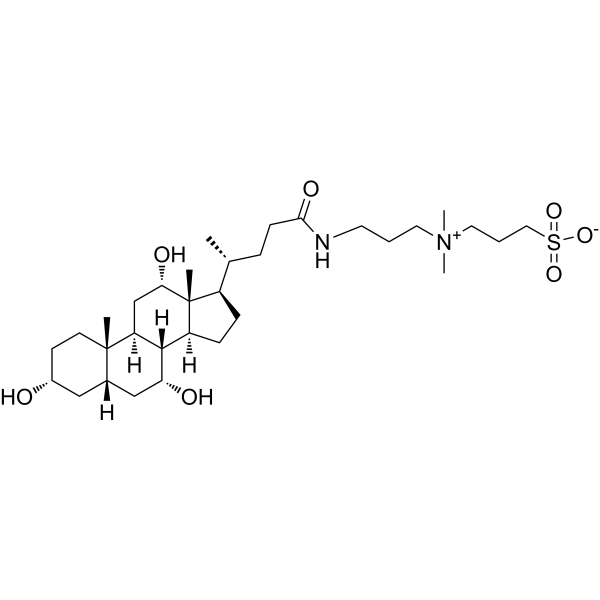
CHAPS is a cholic acid-derived, sulfobetaine-type zwitterionic detergent and micelle-forming agent. CHAPS exhibits properties of weak cationic or nonionic surfactants in different solution systems, undergoes micellization, and forms small, loose hydrophilic aggregates that are temperature-dependent. CHAPS stabilizes mononucleosomes under different ionic strengths, reduces nucleosome sequence specificity, promotes sliding of histone cores along DNA, solubilizes Tamm-Horsfall protein to reduce its interference with urinary exosome isolation, and maintains vesicle structure and the activity of related proteins at the same time. CHAPS is used to recover native folded fusion proteins, enhance the binding capacity of GST fusion proteins, and restore GST enzyme activity. However, CHAPS cannot refold proteins denatured by urea, guanidine hydrochloride or heat, nor can it construct the structure of intrinsically disordered proteins. CHAPS is commonly used in research on the separation and purification of membrane proteins .
loading...
    loading...
4
4 Cited Publications
Cat. No.: HY-15435A
CAS No.: 331717-45-4
Purity:  ≥98.0%
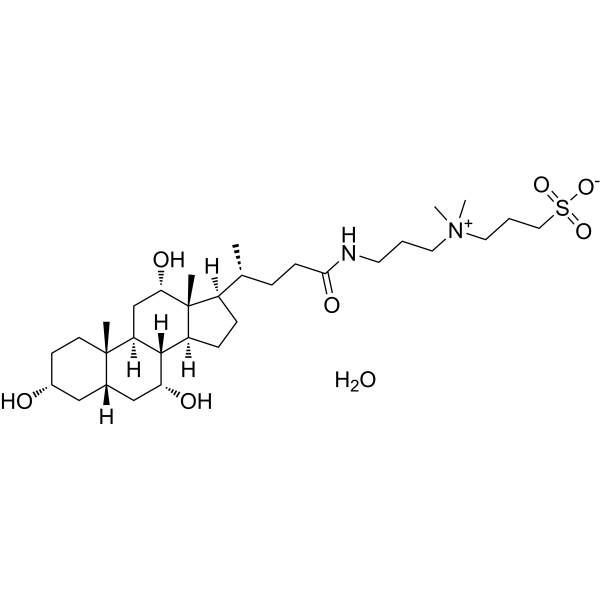
CHAPS hydrate is a cholic acid-derived, sulfobetaine-type zwitterionic detergent and micelle-forming agent. CHAPS hydrate exhibits properties of weak cationic or nonionic surfactants in different solution systems, undergoes micellization, and forms small, loose hydrophilic aggregates that are temperature-dependent. CHAPS hydrate stabilizes mononucleosomes under different ionic strengths, reduces nucleosome sequence specificity, promotes sliding of histone cores along DNA, solubilizes Tamm‑Horsfall protein to reduce its interference with urinary exosome isolation, and maintains vesicle structure and the activity of related proteins at the same time. CHAPS hydrate is used to recover native folded fusion proteins, enhance the binding capacity of GST fusion proteins, and restore GST enzyme activity. However, CHAPS hydrate cannot refold proteins denatured by urea, guanidine hydrochloride or heat, nor can it construct the structure of intrinsically disordered proteins. CHAPS hydrate is commonly used in research on the separation and purification of membrane proteins .
loading...
    loading...
Cat. No.: HY-D0874
CAS No.: 68399-78-0
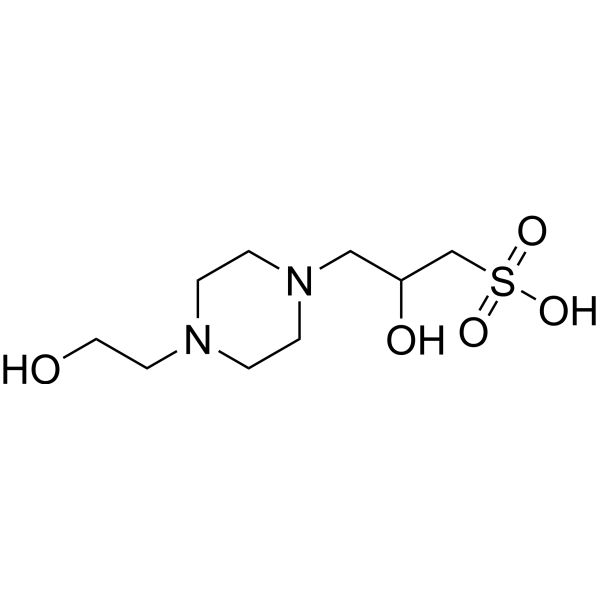
HEPPSO is a zwitterionic Good's buffer suitable for physiological pH conditions. HEPPSO forms high-order oligomers in aqueous solutions and can form a 1:1 complex with Cu 2+ via its hydroxyalkyl and tertiary amine groups. However, HEPPSO contains a structurally similar trace impurity lacking an alkanesulfonic acid side chain. The complex formed by this impurity and Cu 2+ has a very low Ka; therefore, HEPPSO may interfere with studies on copper speciation analysis in natural water bodies .
loading...
    loading...
Cat. No.: HY-W012908
CAS No.: 609-36-9
Research Areas:  

Infection Cancer

DL-Proline is a racemic mixture of D-Proline and L-Proline, belonging to cyclic imino acids with a five-membered ring structure. DL-Proline serves as a key structural unit in peptide synthesis. DL-Proline stabilizes β-turn conformations and affects the secondary structure of peptide segments. DL-Proline exhibits biological activities such as regulating peptide segment conformations and enhancing cyclic peptide stability. DL-Proline can be used in research on diseases related to peptide structure and function, including cancer and bacterial infections .
loading...
    loading...
Cat. No.: HY-W012908S
CAS No.: 65807-21-8
DL-Proline-d7 is the deuterated-labeled DL-Proline (HY-W012908). DL-Proline is a racemic mixture of D-Proline and L-Proline, belonging to cyclic imino acids with a five-membered ring structure. DL-Proline serves as a key structural unit in peptide synthesis. DL-Proline stabilizes β-turn conformations and affects the secondary structure of peptide segments. DL-Proline exhibits biological activities such as regulating peptide segment conformations and enhancing cyclic peptide stability. DL-Proline can be used in research on diseases related to peptide structure and function, including cancer and bacterial infections .
loading...
    loading...
Cat. No.: HY-W012908S2
CAS No.: 784086-28-8
DL-Proline-d3 is the deuterated-labeled DL-Proline (HY-W012908). DL-Proline is a racemic mixture of D-Proline and L-Proline, belonging to cyclic imino acids with a five-membered ring structure. DL-Proline serves as a key structural unit in peptide synthesis. DL-Proline stabilizes β-turn conformations and affects the secondary structure of peptide segments. DL-Proline exhibits biological activities such as regulating peptide segment conformations and enhancing cyclic peptide stability. DL-Proline can be used in research on diseases related to peptide structure and function, including cancer and bacterial infections .
loading...
    loading...
Cat. No.: HY-W012908S1
CAS No.: 282729-06-0
DL-Proline-2-d1 is the deuterated-labeled DL-Proline (HY-W012908). DL-Proline is a racemic mixture of D-Proline and L-Proline, belonging to cyclic imino acids with a five-membered ring structure. DL-Proline serves as a key structural unit in peptide synthesis. DL-Proline stabilizes β-turn conformations and affects the secondary structure of peptide segments. DL-Proline exhibits biological activities such as regulating peptide segment conformations and enhancing cyclic peptide stability. DL-Proline can be used in research on diseases related to peptide structure and function, including cancer and bacterial infections .
loading...
    loading...

