



SID 7969543 (Standard)
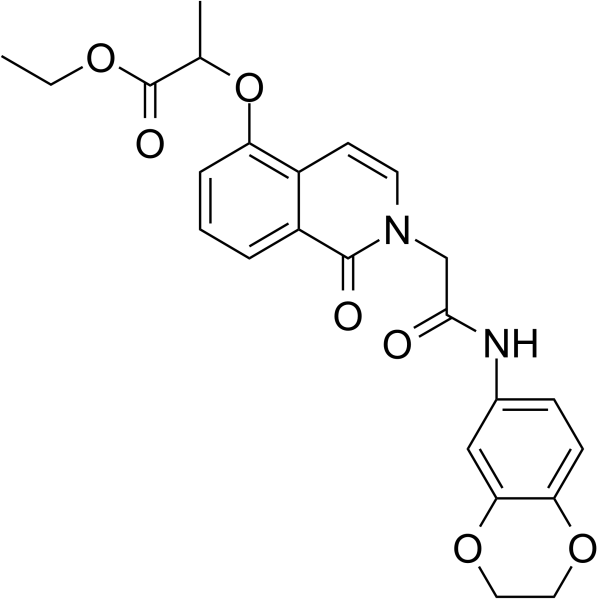
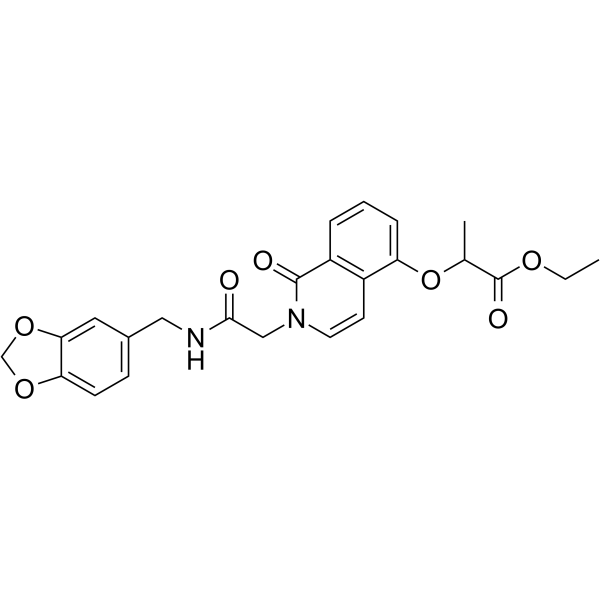
SID 7969543 (Standard) is the analytical standard of SID 7969543 (HY-107404). This product is intended for research and analytical applications. SID 7969543 is a selective SF-1 (steroidogenic factor 1, NR5A1) inhibitor with an IC50 of 760 nM. SID 7969543 inhibits SF-1-triggered luciferase expression with IC50 of 30 nM. SF-1 is a transcription factor belonging to the nuclear receptor superfamily.
For research use only. We do not sell to patients.
- CAS No.: 868224-64-0
- Formula: C24H24N2O7
- Molecular Weight:452.46
-
Storage:
Please store the product under the recommended conditions in the Certificate of Analysis.


To place orders, for customer services and technical support, please contact: MedChemExpress USA
Tel: 609-228-6898 E-mail: [email protected] [email protected]


-
 Biological Activity
-
Chemical Information
- Protocols
- Purity & Documentation
- References
-
 Help & FAQs





Biological Activity
Description


Chemical Information
-
CAS No. 868224-64-0
-
Molecular Weight 452.46
-
Formula C24H24N2O7
-
SMILES
CCOC(C(C)OC1=C2C(C(N(CC(NC3=CC=C(OCCO4)C4=C3)=O)C=C2)=O)=CC=C1)=O
-
Shipping
Room temperature in continental US; may vary elsewhere.
-
Storage
Please store the product under the recommended conditions in the Certificate of Analysis.

Protocols
-
Nuclear Protein Extraction (High-Salt/Hypotonic Fractionation)
The high-salt/hypotonic fractionation method for nuclear protein extraction is based on the differential solubility of cellular components. Cytoplasmic proteins are extracted first using a hypotonic buffer that causes cell swelling and membrane rupture, followed by centrifugation to separate the cytoplasmic supernatant from the nuclear pellet. The nuclear pellet is then subjected to high-salt extraction (e. g. , 0. 4 M (NH4)2SO4 or 1 M NaCl) to solubilize tightly bound nuclear matrix proteins, including transcription factors, histones, and structural proteins associated with chromatin and the nuclear scaffold. This approach allows for the isolation of both soluble cytoplasmic proteins and salt-resistant nuclear proteins while minimizing cross-contamination.
-
RNA extraction experimental
By lysing cells, releasing RNA, and removing impurities such as proteins and DNA, high-purity RNA products are finally obtained. The commonly used traditional method is the guanidine isothiocyanate/phenol/chloroform method (Trizol), which is suitable for a variety of animal materials including animal tissues, microorganisms, cultured cells, etc., and most plant materials.
-
Cell Cytotoxicity Assay
Cytotoxicity assays are usually based on the assessment of cell membrane damage, which can also be indirectly detected by measuring cell viability. Detection methods include MTT assay, CKK-8 assay, LDH assay and ATP assay, etc.


Purity & Documentation
References
[1]. Madoux F, et al. Potent, selective and cell penetrant inhibitors of SF-1 by functional ultra-high-throughput screening. Mol Pharmacol. 2008;73(6):1776-1784. [Content Brief]
[2]. Roth J, et al. Synthesis of small molecule inhibitors of the orphan nuclear receptor steroidogenic factor-1 (NR5A1) based on isoquinolinone scaffolds. Bioorg Med Chem Lett. 2008;18(8):2628-2632. [Content Brief]

Calculators
Concentration (start) × Volume (start) = Concentration (final) × Volume (final)


SID 7969543 (Standard) Related Classifications
HY-107404R Related Classifications
 Powered by Bioz