



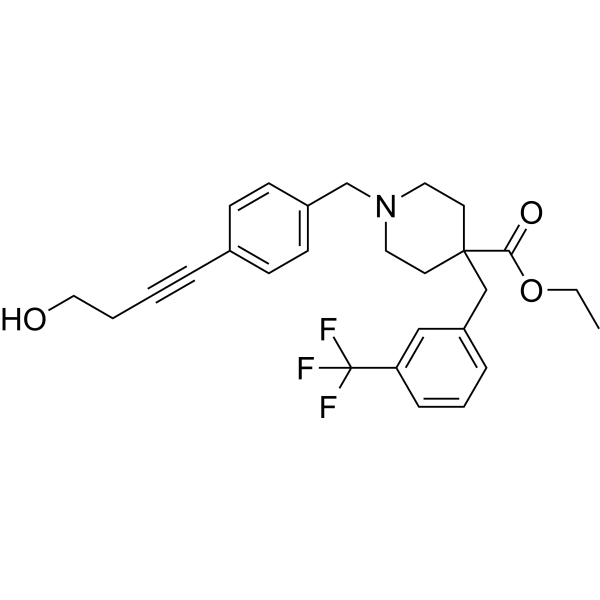
Soporidine
Soporidine is an antagonist of germination of the parasitic plant Striga hermonthica. Soporidine specifically inhibits a S. hermonthica strigolactone receptor and inhibits the parasite's germination. Soporidine is a click chemistry reagent, it contains an Alkyne group and can undergo copper-catalyzed azide-alkyne cycloaddition (CuAAc) with molecules containing Azide groups.
Nur für Forschungszwecke. Wir verkaufen nicht an Patienten.
- CAS. Nr.: 1060376-43-3
- Formel: C27H30F3NO3
- Molecular Weight:473.53
-
Speicherung:
Please store the product under the recommended conditions in the Certificate of Analysis.

To place orders, for customer services and technical support, please contact: MedChemExpress USA
Tel: 609-228-6898 E-mail: [email protected] [email protected]


-
 Biologische Aktivität
-
Chemical Information
- Protokoll
- Reinheit & Dokumentation
- Verweise
-
 Help & FAQs


Alle Parasite Isoform-spezifische Produkte anzeigen
More

Biologische Aktivität
Beschreibung
In Vitro
Soporidine binds to the AtHTL receptor and to a key Strigolactone (SL) receptor in S. hermonthica, inhibiting Striga germination in the presence of SLs. Soporidine could serve as the basis for the development of Strigolactone (SL) antagonist to combat Striga infestations. Soporidine is a potent antagonist in GR24-dependent Arabidopsis germination assay and shows no enhancement of SL signaling mutant phenotypes[1].
MedChemExpress (MCE) has not independently confirmed the accuracy of these methods. They are for reference only.
Clinical Trial
| NCT Number | Sponsor | Condition | Start Date |
Phase

|
|---|---|---|---|---|
| NCT01329991 | 2011-05 | PHASE1 |


Chemical Information
-
CAS. Nr. 1060376-43-3
-
Molecular Weight 473.53
-
Formel C27H30F3NO3
-
SMILES
O=C(OCC)C1(CCN(CC1)CC2=CC=C(C=C2)C#CCCO)CC3=CC=CC(C(F)(F)F)=C3
-
Synonyms
RG4; SOP
-
Versand
Room temperature in continental US; may vary elsewhere.
-
Speicherung
Please store the product under the recommended conditions in the Certificate of Analysis.


Reinheit & Dokumentation
Verweise

Calculators
Konzentration (Stammlösung) × Volumen (Stammlösung) = Konzentration (Ziellösung) × Volumen (Ziellösung)


Soporidine Related Classifications
HY-114800 Related Classifications
 Powered by Bioz