



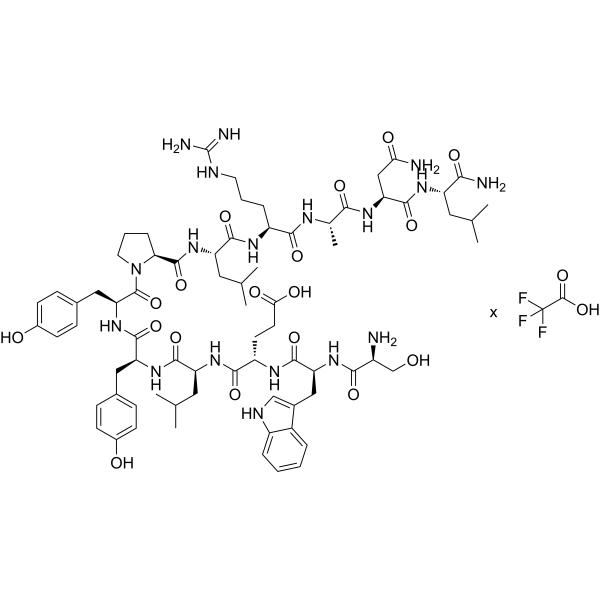
SWELYYPLRANL-NH2 TFA
SWELYYPLRANL-NH2 TFA is an E-cadherin and N-cadherin antagonist. SWELYYPLRANL-NH2 TFA inhibits phage clone binding to E- or N-cad/Fc chimeric protein (IC50: 0.7 and 0.09 μM respectively). SWELYYPLRANL-NH2 TFA inhibits cell aggregation. SWELYYPLRANL-NH2 can be used to promote drug delivery through epithelial and endothelial permeability barriers.
For research use only. We do not sell to patients.
- Formula: C73H106N18O18.xC2HF3O2
- Molecular Weight:1523.73 (free acid)
-
Storage:
Please store the product under the recommended conditions in the Certificate of Analysis.

To place orders, for customer services and technical support, please contact: MedChemExpress USA
Tel: 609-228-6898 E-mail: [email protected] [email protected]


-
 Biological Activity
-
Chemical Information
- Protocols
- Purity & Documentation
- References
-
 Help & FAQs




Biological Activity
Description


Chemical Information
-
Molecular Weight 1523.73 (free acid)
-
Formula C73H106N18O18.xC2HF3O2
-
Sequence
Ser-Trp-Glu-Leu-Tyr-Tyr-Pro-Leu-Arg-Ala-Asn-Leu-NH2
-
Sequence Shortening
SWELYYPLRANL-NH2
-
Shipping
Room temperature in continental US; may vary elsewhere.
-
Storage
Please store the product under the recommended conditions in the Certificate of Analysis.

Protocols
-
Cell Cytotoxicity Assay
Cytotoxicity assays are usually based on the assessment of cell membrane damage, which can also be indirectly detected by measuring cell viability. Detection methods include MTT assay, CKK-8 assay, LDH assay and ATP assay, etc.
-
Suspension Spheroid Formation (Low-Adhesion/Forced Aggregation)
Suspension spheroid formation by low-adhesion or forced aggregation is a scaffold-free 3D culture method in which cells are prevented from attaching to plastic and are guided to interact with each other, forming compact multicellular aggregates through cell-cell adhesion, gravity-driven settling, microwell confinement, or centrifugation-assisted aggregation. The method detects the capacity of a cell population to self-assemble into spheroids, and the main readouts are spheroid formation efficiency, morphology, compactness, projected area or diameter, circularity, viability, proliferation, and experimental responses such as drug sensitivity. Classic implementations include hanging drops, agarose or hydrogel microwells, ultra-low-attachment round-bottom wells, and centrifugation-assisted aggregation in non-adherent wells. Low-adhesion culture shifts the system away from cell-substrate adhesion and toward cell-cell adhesion, while round-bottom or microwell geometry concentrates cells into
-
Transepithelial/transendothelial electrical resistance assay
TEER measures electrical resistance across epithelial or endothelial monolayers cultured on permeable supports, and the readout reflects ionic conductance through the cell barrier, especially the paracellular pathway regulated by junctional integrity. TEER can be measured without destroying the monolayer and is commonly used before or during transport, permeability, barrier-disruption, and barrier-maturation experiments. TEER values are influenced by biological maturation and technical conditions; reported factors include temperature, medium formulation, passage number, electrode geometry, membrane properties, and junctional length during early monolayer maturation. Therefore, TEER should be interpreted with blank-insert subtraction, area normalization, repeated readings, and, when possible, orthogonal barrier readouts such as FITC-dextran flux or tight-junction staining.
-
Hanging Drop Spheroid Culture
Hanging drop spheroid culture is a scaffold-free 3D culture method in which a small droplet of cell suspension is inverted so that suspended cells sediment by gravity toward the lowest point of the drop, aggregate, and form a multicellular spheroid with direct cell-cell contact. Spheroids generated by this method are used to study 3D cell cohesion, cell-ECM interactions, drug response, co-culture organization, and tumor-like microenvironmental behavior. The primary readouts are spheroid formation efficiency, spheroid size, circularity or compactness, viability, and treatment response; these can be measured by bright-field microscopy, fluorescence viability staining, ATP-, fluorescence-, or colorimetric-based assays, and image-based diameter or volume calculations.


Purity & Documentation
References

Calculators
Concentration (start) × Volume (start) = Concentration (final) × Volume (final)


SWELYYPLRANL-NH2 TFA Related Classifications
HY-P5755A Related Classifications
 Powered by Bioz