



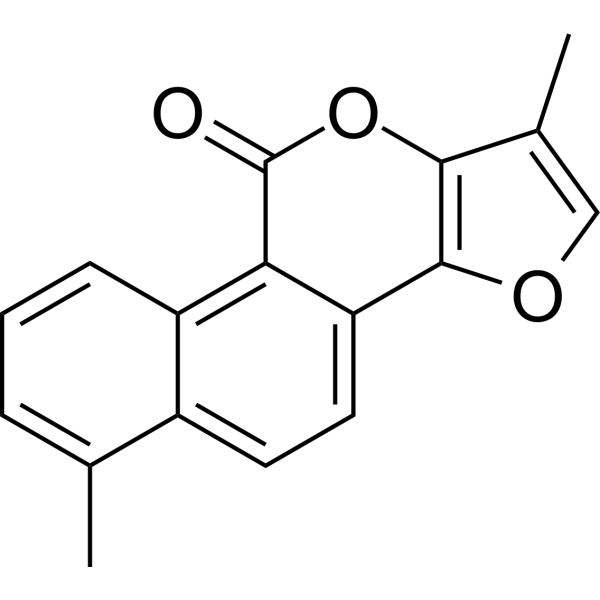
Tanshinlactone
Tanshinlactone is a compound found in Salvia miltiorrhiza with anti-coronavirus (CoV) and anti-tumor activities. Tanshinlactone induces methuocytic cell death (methuosis) by activating the NRF2 pathway, and selectively kills ER+, HER2+/EGFR+ breast cancer cells. Tanshinlactone is applicable to research related to breast cancer and coronavirus infections.
Para uso exclusivo en investigación. No vendemos a pacientes.
- No. CAS: 105351-70-0
- Fòrmula: C17H12O3
- Peso molecular:264.28
-
Almacenamiento:
Please store the product under the recommended conditions in the Certificate of Analysis.

To place orders, for customer services and technical support, please contact: MedChemExpress USA
Tel: 609-228-6898 E-mail: [email protected] [email protected]


-
 Actividad biológica
-
Chemical Information
- Protocolo
- Pureza y Documentación
- Referencias
-
 Help & FAQs




Actividad biológica
Descripciòn
In Vitro
Tanshinlactone (0.1-10 μM; 72 h) selectively inhibits the proliferation of ER+, HER2+ and EGFR+ human breast cancer cells, but shows no activity against triple-negative breast cancer cells, normal cells or other types of cancer cells[2].
Tanshinlactone (0-2 μM; 7-14 days) reduces the colony-forming ability of ER+, HER2+ and EGFR+ human breast cancer cells in a dose-dependent manner, but exerts no effect on the colony formation of triple-negative breast cancer cells[2].
Tanshinlactone (0-6.32 μM; 0-64 h) induces dose- and time-dependent cytoplasmic vacuolization in ER+ and HER2+ human breast cancer cells, which further leads to cell rupture, but exerts no such effect in triple-negative breast cancer cells[2].
Treatment of human breast cancer cells SK-BR-3 and ZR-75-1 with Tanshinlactone (6.32 μM; 24 h) upregulates the mRNA expression of genes that promote macropinocytosis, while downregulating the mRNA expression of genes involved in the transport of macropinosomes to lysosomes and the plasma membrane[2].
Tanshinlactone (6.32 μM; 24-48 h) induces vesicular cell death (a non-apoptotic, non-ferroptotic, non-necrotic form of cell death) in human breast cancer cell lines SK-BR-3 and ZR-75-1, and this process depends on macropinocytosis[2].
Tanshinlactone (0-20 μM; 48 h) induces vacuolar cell death in human breast cancer cell lines SK-BR-3 and ZR-75-1 by activating the NRF2 signaling pathway[2].
MedChemExpress (MCE) has not independently confirmed the accuracy of these methods. They are for reference only.
-
Cell Line:human ER+, HER2+, EGFR+ breast cancer cells, normal cells, other cancer cells
-
Concentration:0.1, 1, 10 μM
-
Incubation Time:72 h
-
Result:Inhibited growth of HER2+ (SK-BR-3: IC50 1.91 μM), HER2+/ER+ (BT-474: IC50 5.50 μM), ER+ (ZR-75-1: IC50 6.92 μM; MCF7: IC50 1.51 μM; T-47D: IC50 3.98 μM), and EGFR+ (MDA-MB-468: IC50 4.47 μM) breast cancer cells in a dose-dependent manner.
Did not affect triple-negative breast cancer cells (MDA-MB-231, BT-549, HCC1937: IC50 >20.0 μM), normal cells (MCF10A, WPMY-1, CCD841CoN, HUVECs), or other cancer cell lines.
-
Cell Line:human HER2+ (SK-BR-3) and ER+ (ZR-75-1) breast cancer cells
-
Concentration:6.32 μM
-
Incubation Time:24 h
-
Result:Significantly upregulated mRNA levels of macropinocytosis-related genes including RAB5, RAB7, RAC1, CDC42, EGF, EPGN, AREG, HBEGF, EGFR, PIK3CA, PAK1, NHE1, and SDC1 in SK-BR-3 and ZR-75-1 cells.
Downregulated mRNA levels of SEPT6 and ARF6 in these cells.


Chemical Information
-
No. CAS 105351-70-0
-
Peso molecular 264.28
-
Fòrmula C17H12O3
-
SMILES
O=C1C2=C3C=CC=C(C)C3=CC=C2C(OC=C4C)=C4O1
-
Structure Classification
-
Initial Source
-
Envío
Room temperature in continental US; may vary elsewhere.
-
Almacenamiento
Please store the product under the recommended conditions in the Certificate of Analysis.


Pureza y Documentación
Referencias
[1]. Lin W, et al. Tanshinlactone triggers methuosis in breast cancer cells via NRF2 activation. Front Pharmacol. 2025;15:1534217. Published 2025 Jan 21. [Content Brief]
[2]. Rodrigues GCS, et al. Ligand and Structure-based Virtual Screening of Lamiaceae Diterpenes with Potential Activity against a Novel Coronavirus (2019-nCoV). Curr Top Med Chem. 2020;20(24):2126-2145. [Content Brief]

Calculators
Concentration (start) × Volume (start) = Concentration (final) × Volume (final)


Tanshinlactone Related Classifications
HY-N1180 Related Classifications
 Powered by Bioz