



Ethyl cellulose (viscosity 100 cP)

Based on 1 Customer Validation
Ethyl cellulose (viscosity 100 cP) is a non-toxic cellulose derivative with unique properties including oil gel formation, active ingredient delivery and film-forming ability. Ethyl cellulose (viscosity 100 cP) can serve as a pharmaceutical excipient, such as a coating agent, flavoring agent, tablet filler, etc..
For research use only. We do not sell to patients.
- CAS No.: 9004-57-3
-
Storage:Powder -20°C, 3 years , 4°C, 2 years ; In solvent -80°C, 6 months , -20°C, 1 month

To place orders, for customer services and technical support, please contact: MedChemExpress USA
Tel: 609-228-6898 E-mail: [email protected] [email protected]


-
 Biological Activity
-
Chemical Information
-
Solvent & Solubility
- Purity & Documentation
- References
-
 Help & FAQs


-
HY-Y0703
Sodium carboxymethyl cellulose (Viscosity:800-1200 mPa.s)Biochemical Assay Reagent -
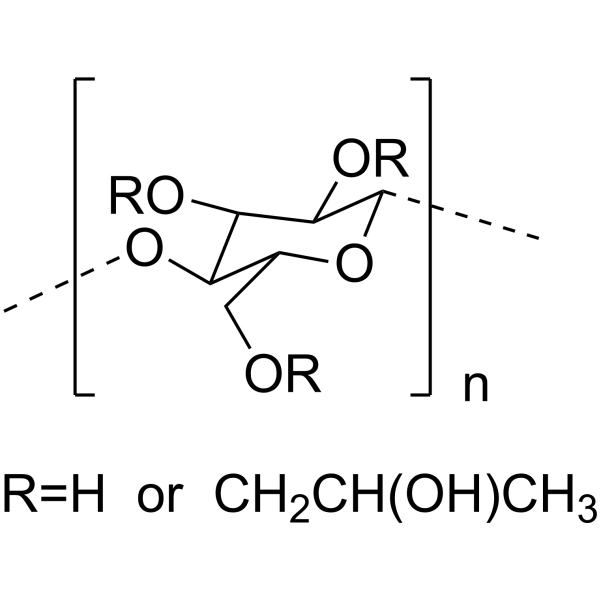
HY-100557
Hydroxypropyl CellulosePharmaceutical Excipient -
HY-Y0703C
Sodium carboxymethyl cellulose (Viscosity:300-800mpa.s)Biochemical Assay Reagent -

HY-B2221B1
Hydroxyethyl cellulose, Viscosity(2%):150mPa.sBiochemical Assay Reagents -
HY-Y1889A
Sodium carboxymethyl cellulose (MW 250000)Anti-adhesion agent -
HY-125861
Methyl cellulose(Viscosity:100000mPa.s)Polymer -
HY-Y0703A
Sodium carboxymethyl cellulose (Viscosity:1200-1400 mPa.s)Biochemical Assay Reagent -
HY-Y0703D
Sodium carboxymethyl cellulose (average Mw 90000)Biochemical Assay Reagent -
HY-Y1889
Sodium carboxymethyl cellulose (Viscosity:5000-15000 mPa.s) -

HY-125861E
Methyl cellulose(Viscosity:4000mPa.s)Polymer -
HY-125861B
Methyl cellulose(Viscosity:400mPa.s)Polymer -
HY-125861A
Methyl cellulose(Viscosity:15mPa.s)Polymer


Biological Activity
Description
In Vitro
Ethyl cellulose-stabilized silver nanoparticles (AgNPs-EC) have an inhibitory effect on TNF-α mRNA and protein expression levels in MCF-7 cells[3].
Ethyl cellulose is used to prepare nanoparticles showing anti-H. pylori activity[4].
MedChemExpress (MCE) has not independently confirmed the accuracy of these methods. They are for reference only.
In Vivo
MedChemExpress (MCE) has not independently confirmed the accuracy of these methods. They are for reference only.


Chemical Information
-
CAS No. 9004-57-3
-
Appearance Solid
-
Color White to off-white
-
SMILES
[Ethyl Cellulose (viscosity 100 cP)
-
Synonyms
Ethyl cellulose N-100
-
Shipping
Room temperature in continental US; may vary elsewhere.
-
Storage
Powder -20°C 3 years 4°C 2 years In solvent -80°C 6 months -20°C 1 month


Solvent & Solubility
In Vitro:
Ethanol : 16.67 mg/mL (ultrasonic and warming and heat to 60°C)
In Vivo:
Select the appropriate dissolution method based on your experimental animal and administration route.
- For the following dissolution methods, please ensure to first prepare a clear stock solution using an In Vitro approach and then sequentially add co-solvents:
- To ensure reliable experimental results, the clarified stock solution can be appropriately stored based on storage conditions. As for the working solution for In Vivo experiments, it is recommended to prepare freshly and use it on the same day.
- The percentages shown for the solvents indicate their volumetric ratio in the final prepared solution. If precipitation or phase separation occurs during preparation, heat and/or sonication can be used to aid dissolution.
Add each solvent one by one: 10% EtOH 90% Corn Oil
Solubility: ≥ 1.67 mg/mL; Clear solution
This protocol yields a clear solution of ≥ 1.67 mg/mL (saturation unknown). If the continuous dosing period exceeds half a month, please choose this protocol carefully.
Taking 1 mL working solution as an example, add 100 μL EtOH stock solution (16.7 mg/mL) to 900 μL Corn oil, and mix evenly.
In Vivo Dissolution Calculator
Please enter the basic information of animal experiments:
-
-
-
-
Recommended: Prepare an additional quantity of animals to account for potential losses during experiments.
Working solution concentration: 0.22 mg/mL


Purity & Documentation
-
Data Sheet (275 KB)
-
SDS (394 KB)
- English - EN (394 KB)
- Français - FR (394 KB)
- Deutsch - DE (394 KB)
- Norwegian - NO (394 KB)
- Español - ES (394 KB)
- Swedish - SV (394 KB)
- Italian - IT (394 KB)
- Korean - KR (394 KB)
- Portuguese - PT (394 KB)
-
Handling Instructions (2659 KB)
References
[2]. Elder DP, et al. Pharmaceutical excipients - quality, regulatory and biopharmaceutical considerations. Eur J Pharm Sci. 2016 May 25;87:88-99. [Content Brief]
[3]. Abdellatif AAH, et al. Silver Nanoparticle-Coated Ethyl Cellulose Inhibits Tumor Necrosis Factor-α of Breast Cancer Cells. Drug Des Devel Ther. 2021 May 13;15:2035-2046. [Content Brief]
[4]. Pan-In P, et al. Ethyl cellulose nanoparticles: clarithomycin encapsulation and eradication of H. pylori. Carbohydr Polym. 2014 Aug 30;109:22-7. [Content Brief]

Calculators
Concentration (start) × Volume (start) = Concentration (final) × Volume (final)


Ethyl cellulose (viscosity 100 cP) Related Classifications
HY-W115746 Related Classifications
 Powered by Bioz
Keywords
- Ethyl cellulose (viscosity 100 cP)
- 9004-57-3
- Ethyl cellulose N-100
- Ethyl cellulose N100
- Ethyl cellulose N 100
- Biochemical Assay Reagents
- pharmaceutical excipient
- pharmaceutical auxiliarie
- pharmaceutical ingredients
- inactive ingredients
- stability
- solubility
- processability
- absorption
- distribution
- metabolism
- and elimination (ADME)
- Inhibitor
- inhibitor
- inhibit