



Vasicinone

Based on 1 Customer Validation
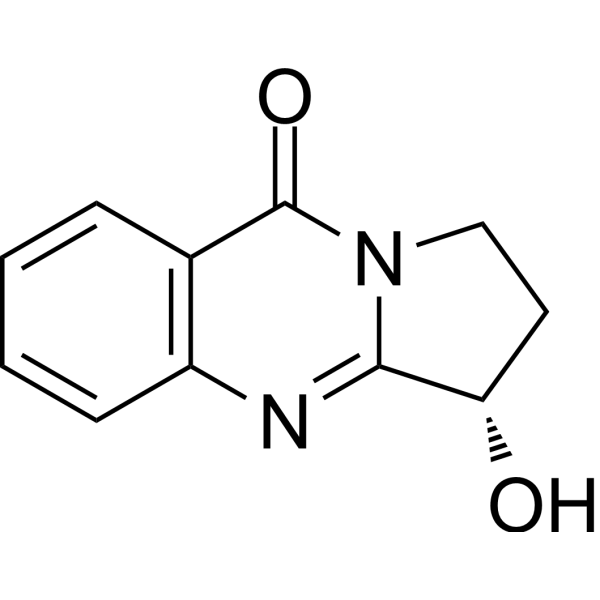
Vasicinone is a quinazoline alkaloid isolated from the Adhatoda vasica. Vasicinone is a potential agent for Parkinson's disease and possibly other oxidative stress-related neurodegenerative disorders.
For research use only. We do not sell to patients.
- Purity : 99.89%
- CAS No.: 486-64-6
- Formula: C11H10N2O2
- Molecular Weight:202.21
-
Storage:
-20°C, protect from light
* In solvent : -80°C, 6 months; -20°C, 1 month (protect from light)

To place orders, for customer services and technical support, please contact: MedChemExpress USA
Tel: 609-228-6898 E-mail: [email protected] [email protected]


-
 Biological Activity
-
Chemical Information
-
Solvent & Solubility
- Protocols
- Purity & Documentation
- References
-
 Help & FAQs




Biological Activity
Description
Cellular Effect
|
Cell Line

|
Type | Value | Description | References |
|---|---|---|---|---|
| HL-60 | IC50 |
67.77 μM
Compound: 9b
|
Cytotoxicity against human HL60 cells assessed as reduction in cell viability by trypan blue method
Cytotoxicity against human HL60 cells assessed as reduction in cell viability by trypan blue method
|
[PMID: 29229205] |
| MGC-803 | IC50 |
94.5 μM
Compound: 39
|
Antiproliferative activity against human MGC-803 cells assessed as reduction in cell viability by MTT assay
Antiproliferative activity against human MGC-803 cells assessed as reduction in cell viability by MTT assay
|
[PMID: 36375335] |
In Vitro
Vasicinone (1~30 μM; 24 hours; SH-SY5Y cells) significantly reverses the paraquat-induced reduction in cell viability[1].
Vasicinone (10 and 15 μM; 24 hours; SH-SY5Y cells) abates the paraquat-induced injury of SH-SY5Y cells by suppressing the MAPK signaling pathway, dose-dependently reduces the percentage of apoptotic cells and is capable of rescuing paraquat-induced apoptotic death[1].
Vasicinone (10 and 15 μM; SH-SY5Y cells) attenuates the paraquat-induced accumulation of reactive oxygen species (ROS) and attenuates the paraquat-induced expression of apoptotic proteins[1].
MedChemExpress (MCE) has not independently confirmed the accuracy of these methods. They are for reference only. Further protocols information, click here.
-
Cell Line:SH-SY5Y cells
-
Concentration:1~30 µM
-
Incubation Time:24 hours
-
Result:Significantly reversed the paraquat-induced reduction in cell viability.
-
Cell Line:SH-SY5Y cells
-
Concentration:10 and 15 µM
-
Incubation Time:24 hours
-
Result:Abated the paraquat-induced injury of SH-SY5Y cells by suppressing the MAPK signaling pathway.
-
Cell Line:SH-SY5Y cells
-
Concentration:10 and 15 µM
-
Incubation Time:24 hours
-
Result:Dose-dependently reduced the percentage of apoptotic cells.


Chemical Information
-
CAS No. 486-64-6
-
Appearance Solid
-
Molecular Weight 202.21
-
Formula C11H10N2O2
-
Color White to off-white
-
SMILES
O=C1N2C([C@@H](O)CC2)=NC3=C1C=CC=C3
-
Synonyms
(-)-Vasicinone
-
Structure Classification
-
Shipping
Room temperature in continental US; may vary elsewhere.
-
Storage
-20°C, protect from light
* In solvent : -80°C, 6 months; -20°C, 1 month (protect from light)


Solvent & Solubility
In Vitro:
DMSO : 50 mg/mL (247.27 mM; Need ultrasonic; Hygroscopic DMSO has a significant impact on the solubility of product, please use newly opened DMSO)
Please refer to the solubility information to select the appropriate solvent. Once prepared, please aliquot and store the solution to prevent product inactivation from repeated freeze-thaw cycles.
Storage method and period of stock solution: -80°C, 6 months; -20°C, 1 month (protect from light). When stored at -80°C, please use it within 6 months. When stored at -20°C, please use it within 1 month.
Please refer to the solubility information to select the appropriate solvent. Once prepared, please aliquot and store the solution to prevent product inactivation from repeated freeze-thaw cycles.
Storage method and period of stock solution: -80°C, 6 months; -20°C, 1 month (protect from light). When stored at -80°C, please use it within 6 months. When stored at -20°C, please use it within 1 month.
Concentration (start) × Volume (start) = Concentration (final) × Volume (final)

Protocols
-
ROS/oxidative-stress fluorescent staining
ROS/oxidative-stress fluorescent staining uses cell-permeant fluorogenic probes that become fluorescent after oxidation inside cells or tissues; commonly used examples include DCFH-DA/DCFDA for broad cellular oxidant detection, DHE for superoxide-related signal detection, MitoSOX for mitochondrial superoxide-related signal detection, and CellROX probes for oxidative-stress-associated fluorescence readouts. The assay detects probe oxidation rather than a single ROS species unless the probe and analysis method have been chemically validated for that species. DCFH-DA enters cells, is deacetylated by intracellular esterases to DCFH, and produces fluorescent DCF after oxidation, so the readout is used as an operational measure of total cellular oxidative stress rather than a species-specific ROS measurement. DHE and MitoSOX can report superoxide-related oxidation, but red fluorescence alone can include non-specific ethidium-like oxidation products; HPLC or optimized spectral approaches are
-
Human pluripotent stem cell midbrain dopaminergic neuron differentiation
Human pluripotent stem cells are directed toward midbrain dopaminergic neurons by first inducing a neural floor-plate-like progenitor state, then patterning cells with ventralizing SHH signaling and midbrain/WNT-FGF cues, and finally maturing progenitors into neurons expressing dopaminergic markers such as TH, NURR1/NR4A2, PITX3, DAT/SLC6A3, VMAT2/SLC18A2, GIRK2/KCNJ6, FOXA2, LMX1A, and EN1. The main readouts are loss of pluripotency, acquisition of FOXA2+/LMX1A+ midbrain floor-plate progenitors, emergence of βIII-tubulin+/MAP2+ neurons, and production of TH+ dopaminergic neurons with molecular, dopamine-release, and electrophysiological features of midbrain dopaminergic identity.


Purity & Documentation
-
Data Sheet (277 KB)
-
SDS (392 KB)
- English - EN (392 KB)
- Français - FR (392 KB)
- Deutsch - DE (392 KB)
- Norwegian - NO (392 KB)
- Español - ES (392 KB)
- Swedish - SV (392 KB)
- Italian - IT (392 KB)
- Korean - KR (392 KB)
- Portuguese - PT (392 KB)
-
Handling Instructions (2659 KB)
References


Complete Stock Solution Preparation Table
Please refer to the solubility information to select the appropriate solvent. Once prepared, please aliquot and store the solution to prevent product inactivation from repeated freeze-thaw cycles.
Storage method and period of stock solution: -80°C, 6 months; -20°C, 1 month (protect from light). When stored at -80°C, please use it within 6 months. When stored at -20°C, please use it within 1 month.
| Optional Solvent | Concentration Solvent Mass | 1 mg | 5 mg | 10 mg | 25 mg |
|---|---|---|---|---|---|
| DMSO | 1 mM | 4.9454 mL | 24.7268 mL | 49.4535 mL | 123.6338 mL |
| 5 mM | 0.9891 mL | 4.9454 mL | 9.8907 mL | 24.7268 mL | |
| 10 mM | 0.4945 mL | 2.4727 mL | 4.9454 mL | 12.3634 mL | |
| 15 mM | 0.3297 mL | 1.6485 mL | 3.2969 mL | 8.2423 mL | |
| 20 mM | 0.2473 mL | 1.2363 mL | 2.4727 mL | 6.1817 mL | |
| 25 mM | 0.1978 mL | 0.9891 mL | 1.9781 mL | 4.9454 mL | |
| 30 mM | 0.1648 mL | 0.8242 mL | 1.6485 mL | 4.1211 mL | |
| 40 mM | 0.1236 mL | 0.6182 mL | 1.2363 mL | 3.0908 mL | |
| 50 mM | 0.0989 mL | 0.4945 mL | 0.9891 mL | 2.4727 mL | |
| 60 mM | 0.0824 mL | 0.4121 mL | 0.8242 mL | 2.0606 mL | |
| 80 mM | 0.0618 mL | 0.3091 mL | 0.6182 mL | 1.5454 mL | |
| 100 mM | 0.0495 mL | 0.2473 mL | 0.4945 mL | 1.2363 mL |


Vasicinone Related Classifications
HY-N1100 Related Classifications
 Powered by Bioz