



Wychimicin A
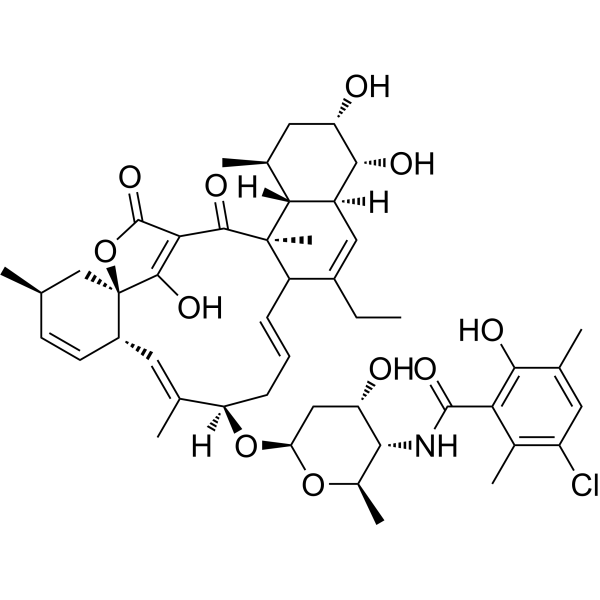
Wychimicin A is a spirotetronate polyketide, can be isolated from the rare actinomycete Actinocrispum wychmicini strain MI503-AF4. Wychimicin A shows strong antibacterial activity against methicillin-resistant Staphylococcus. aureus (IC50=0.125-0.5 μg/mL) and Enterococcus. faecalis/faecium (IC50=0.125-0.25 μg/mL).
Nos produits utilisent uniquement pour la recherche. Nous ne vendons pas aux patients.
- Formule: C47H60ClNO11
- Masse moléculaire:850.43
-
Stockage:
Please store the product under the recommended conditions in the Certificate of Analysis.

To place orders, for customer services and technical support, please contact: MedChemExpress USA
Tel: 609-228-6898 E-mail: [email protected] [email protected]


-
 Activité biologique
-
Chemical Information
- Protocole
- Pureté et documentation
- Références
-
 Help & FAQs




Activité biologique
Description


Chemical Information
-
Masse moléculaire 850.43
-
Formule C47H60ClNO11
-
SMILES
CC1=CC(Cl)=C(C(C(N[C@@H]2[C@H](O[C@H](C[C@@H]2O)O[C@]([H])(C/C=C/C3[C@@]4([C@]5([C@]([H])(C=C3CC)[C@H]([C@H](C[C@@H]5C)O)O)[H])C)/C(C)=C/[C@H]6[C@]7(C[C@@H](C=C6)C)C(O)=C(C(O7)=O)C4=O)C)=O)=C1O)C
-
Structure Classification
-
Initial Source
Actinocrispum wychmicini
-
Livraison
Room temperature in continental US; may vary elsewhere.
-
Stockage
Please store the product under the recommended conditions in the Certificate of Analysis.


Pureté et documentation
Références
[1]. Kimura T, et al. Wychimicins, a new class of spirotetronate polyketides from Actinocrispum wychmicini MI503-A4. J Antibiot (Tokyo). 2022 Oct;75(10):535-541. [Content Brief]
[2]. Hatano M, et al. Actinocrispum wychmicini gen. nov., sp. nov., a novel member of the family Pseudonocardiaceae, isolated from soil. Int J Syst Evol Microbiol. 2016 Nov;66(11):4779-4784. [Content Brief]

Calculators
Concentration (start) × Volume (start) = Concentration (final) × Volume (final)


Wychimicin A Related Classifications
HY-N10561 Related Classifications
 Powered by Bioz