



β-catenin-IN-3
Based on 1 publication(s) in Google Scholar
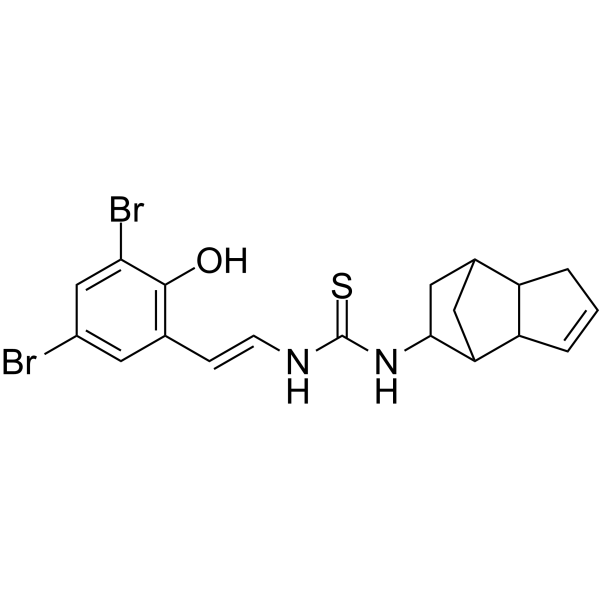
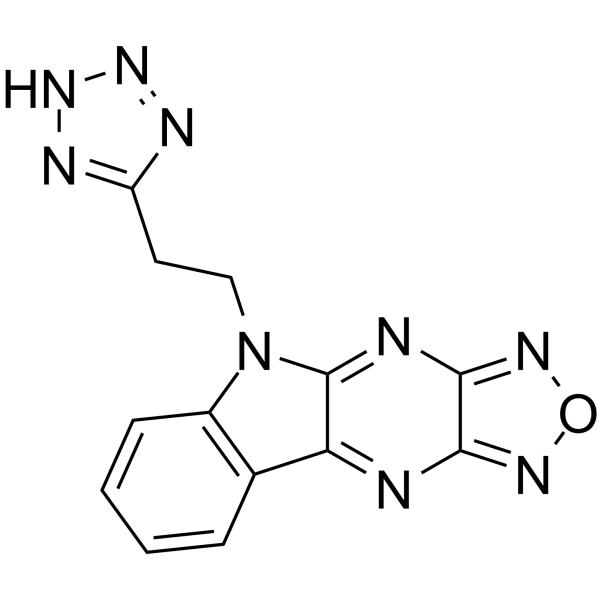
β-catenin-IN-3 (Compound C2) is a selective β-catenin inhibitor. β-catenin-IN-3 binds to allosteric site on the surface of β-catenin with K D calculated at 54.96 nM. β-catenin-IN-3 selectively inhibits β-catenin via targeting a cryptic allosteric modulation site, lowers its cellular load. β-catenin-IN-3 significantly reduces viability of β-catenin driven cancer cells, and triggers β-catenin degradation via proteasome system in β-catenin-overexpressing cancer cells.
For research use only. We do not sell to patients.
- Purity : 95.64%
- CAS No.: 1005288-15-2
- Formula: C19H20Br2N2OS
- Molecular Weight:484.25
-
Storage:
-20°C, protect from light, stored under nitrogen
* In solvent : -80°C, 6 months; -20°C, 1 month (protect from light, stored under nitrogen)

To place orders, for customer services and technical support, please contact: MedChemExpress USA
Tel: 609-228-6898 E-mail: [email protected] [email protected]


-
 Biological Activity
-
Chemical Information
-
Solvent & Solubility
- Protocols
- Purity & Documentation
- References
-
 Help & FAQs



Publications Citing Use of MedChemExpress (MCE) β-catenin-IN-3
More

Biological Activity
Description
IC50 & Target
[1]|
Cdk4/cyclin D1 |
Cellular Effect
|
Cell Line

|
Type | Value | Description | References |
|---|---|---|---|---|
| SW480 | IC50 |
1.35 μM
Compound: 65; C2
|
Antiproliferative activity against human SW480 cells assessed as inhibition of cell growth incubated for 72 hrs by alamar blue assay
Antiproliferative activity against human SW480 cells assessed as inhibition of cell growth incubated for 72 hrs by alamar blue assay
|
[PMID: 36183504] |
In Vitro
β-catenin-IN-3 (24 h) reduces viability of DLD1, SW480, HCT116,SW48, MCF10A and H460 cells in dose-dependent manner with IC50s of 0.85 μM, 1.35 μM, 5.35 μM, 3.45 μM, and above 20μM[1].
β-catenin-IN-3 (1, 3 μM, 7 days) inhibits the colony forming ability of DLD1 and SW48 cells[1].
β-catenin-IN-3 (0, 1, 5μM, 24 h) selectively inhibits levels of β-catenin, Axin1, CyclinD1 and TCF4 in dose-dependent manner in DLD1 and SW480 cells [1].
β-catenin-IN-3 (1 μM, 3 h) triggers degradation of β-catenin in DLD1 cells through ubiquitin-proteasome machinery, presumably via recruitment of the APC-mediated destruction complex [1].
β-catenin-IN-3 (1 μM, 1-24 h) increases phosphorylation of β-catenin in DLD1 cells [1].
β-catenin-IN-3 (1, 5 μM, 24 h) reduces β-cateninin in the nuclear and cytoplasmic fractions to 45%, 40%, 85% and 55%, respectively[1].
β-catenin-IN-3 (3, 5μM, 4 days) inhibits APC-deficient organoid clonogenicity viability around 70% and 55%, on the contrary, viability of wild-type organoids is 90%. [1].
MedChemExpress (MCE) has not independently confirmed the accuracy of these methods. They are for reference only. Further protocols information, click here.
-
Cell Line:DLD1,SW4808, HCT116, SW48, MCF10A, H460 cells
-
Concentration:10 nM-100 μM
-
Incubation Time:24 h
-
Result:Reduced viability of DLD1 and SW480 cells in dose-dependent manner with IC50s of 0.85 μM and 1.35 μM.
Reduced viability of HCT116 and SW48 cells in dose-dependent manner with IC50s of 5.35 μM and 3.45 μM.
Impacted two WNT-independent cell lines, MCF10A and H460, with IC50 above 20μM.
-
Cell Line:DLD1 cells
-
Concentration:1μM
-
Incubation Time:1,3,6,12,24 h
-
Result:Phosphorylated β-catenin starting at 1 hour point, which was further amplified to 2-2.5-fold at 12 and 24 hour points, and can be blocked by CHIR99021 (HY-10182).
Levels of active β-catenin markedly reduced at these time points, and can be arrested by MG132 (HY-13259).
-
Cell Line:DLD1 cells
-
Concentration:1 μM
-
Incubation Time:24 h
-
Result:Reduced β-catenin that co-localized with nucleic acids inside the nucleus by 55-60% (co-localization dropped from 0.62 to 0.25).
In Vivo
MedChemExpress (MCE) has not independently confirmed the accuracy of these methods. They are for reference only.
-
Animal Model:6-week-old female NSG (NOD-SCID) mice were injected with 3 *106 DLD1 cells[1].
-
Dosage:25 mg/kg
-
Administration:i.p., 35 days
-
Result:Mice Did not display any signs of acute toxicity and body weight loss.
Inhibition of tumor growth by β-catenin-IN-3 was noted after 20 days of treatment, after which the tumor volume of β-catenin-IN-3 treated mice did not increase exponentially.
At day 35, the calculated tumor growth inhibition by β-catenin-IN-3 was 50% as compared to the vehicle.


Chemical Information
-
CAS No. 1005288-15-2
-
Appearance Solid
-
Molecular Weight 484.25
-
Formula C19H20Br2N2OS
-
Color White to off-white
-
SMILES
S=C(N/C=C/C(C=C1Br)=C(C(Br)=C1)O)NC(C2)C3C(C=CC4)C4C2C3
-
Shipping
Room temperature in continental US; may vary elsewhere.
-
Storage
-20°C, protect from light, stored under nitrogen
* In solvent : -80°C, 6 months; -20°C, 1 month (protect from light, stored under nitrogen)


Publications (1)
-
Journal Impact Factor
-
Most Recent
-
J Pharm Pharmacol
Aucubin inhibits the activity of lung cancer stem-like cells by targeting degradation of β-catenin. [Abstract]2025 Sep 10:rgaf081. PMID: 40928458


Solvent & Solubility
In Vitro:
DMSO : 100 mg/mL (206.50 mM; Need ultrasonic; Hygroscopic DMSO has a significant impact on the solubility of product, please use newly opened DMSO)
Please refer to the solubility information to select the appropriate solvent. Once prepared, please aliquot and store the solution to prevent product inactivation from repeated freeze-thaw cycles.
Storage method and period of stock solution: -80°C, 6 months; -20°C, 1 month (protect from light, stored under nitrogen). When stored at -80°C, please use it within 6 months. When stored at -20°C, please use it within 1 month.
Please refer to the solubility information to select the appropriate solvent. Once prepared, please aliquot and store the solution to prevent product inactivation from repeated freeze-thaw cycles.
Storage method and period of stock solution: -80°C, 6 months; -20°C, 1 month (protect from light, stored under nitrogen). When stored at -80°C, please use it within 6 months. When stored at -20°C, please use it within 1 month.
Concentration (start) × Volume (start) = Concentration (final) × Volume (final)
In Vivo:
Select the appropriate dissolution method based on your experimental animal and administration route.
- For the following dissolution methods, please ensure to first prepare a clear stock solution using an In Vitro approach and then sequentially add co-solvents:
- To ensure reliable experimental results, the clarified stock solution can be appropriately stored based on storage conditions. As for the working solution for In Vivo experiments, it is recommended to prepare freshly and use it on the same day.
- The percentages shown for the solvents indicate their volumetric ratio in the final prepared solution. If precipitation or phase separation occurs during preparation, heat and/or sonication can be used to aid dissolution.
Add each solvent one by one: 10% DMSO 40% PEG300 5% Tween-80 45% Saline
Solubility: ≥ 2.5 mg/mL (5.16 mM); Clear solution
This protocol yields a clear solution of ≥ 2.5 mg/mL (saturation unknown).
Taking 1 mL working solution as an example, add 100 μL DMSO stock solution (25.0 mg/mL) to 400 μL PEG300, and mix evenly; then add 50 μL Tween-80 and mix evenly; then add 450 μL Saline to adjust the volume to 1 mL.
Preparation of Saline: Dissolve 0.9 g sodium chloride in ddH₂O and dilute to 100 mL to obtain a clear Saline solution.
Add each solvent one by one: 10% DMSO 90% (20% SBE-β-CD in Saline)
Solubility: ≥ 2.5 mg/mL (5.16 mM); Clear solution
This protocol yields a clear solution of ≥ 2.5 mg/mL (saturation unknown).
Taking 1 mL working solution as an example, add 100 μL DMSO stock solution (25.0 mg/mL) to 900 μL 20% SBE-β-CD in Saline, and mix evenly.
Preparation of 20% SBE-β-CD in Saline (4°C, storage for one week): 2 g SBE-β-CD powder is dissolved in 10 mL Saline, completely dissolve until clear.
In Vivo Dissolution Calculator
Please enter the basic information of animal experiments:
-
-
-
-
Recommended: Prepare an additional quantity of animals to account for potential losses during experiments.
Please enter your animal formula composition:
-
%DMSO +
Recommended: Keep the proportion of DMSO in working solution below 2% if your animal is weak.
-
%+
-
+%Tween-80 + +
-
%Saline +
The co-solvents required include: DMSO, . All of co-solvents are available by MedChemExpress (MCE). , Tween 80. All of co-solvents are available by MedChemExpress (MCE).
Working solution concentration: 0.22 mg/mL
Method for preparing stock solution: mg drug dissolved in μL DMSO. Stock solution concentration: mg/mL. * In solvent : -80°C, 6 months; -20°C, 1 month (protect from light, stored under nitrogen)
1. Take μL DMSO stock solution;
2. Add μL .
μL , mix evenly;
3. Then add μL Tween 80, mix evenly;
4. Then add μL
Please ensure that the stock solution in the first step is dissolved to a clear state, and add co-solvents in sequence. You can use ultrasonic heating (ultrasonic cleaner, recommended frequency 20-40 kHz), vortexing, etc. to assist dissolution.

Protocols
-
Cell Viability Determination by MTT Colorimetric Assay
The following protocol uses the MTT colorimetric assay as a classic literature-established method for assessing cell viability/metabolic activity in cultured mammalian cells. MTT[3-(4,5-dimethylthiazol-2-yl)-2,5-diphenyltetrazolium bromide] is reduced by metabolically active cells to a colored formazan product; the amount of formazan is quantified spectrophotometrically and provides an indirect measure of metabolically active viable cells. Importantly, MTT reduction reflects cellular oxidoreductase/metabolic activity rather than an absolute direct count of living cells, so changes in cellular metabolism can alter the signal independently of cell number.


Purity & Documentation
-
Data Sheet (279 KB)
-
SDS (252 KB)
- English - EN (252 KB)
- Français - FR (252 KB)
- Deutsch - DE (252 KB)
- Norwegian - NO (252 KB)
- Español - ES (252 KB)
- Swedish - SV (252 KB)
- Italian - IT (252 KB)
- Korean - KR (252 KB)
- Portuguese - PT (252 KB)
-
Handling Instructions (2659 KB)
References


Complete Stock Solution Preparation Table
Please refer to the solubility information to select the appropriate solvent. Once prepared, please aliquot and store the solution to prevent product inactivation from repeated freeze-thaw cycles.
Storage method and period of stock solution: -80°C, 6 months; -20°C, 1 month (protect from light, stored under nitrogen). When stored at -80°C, please use it within 6 months. When stored at -20°C, please use it within 1 month.
| Optional Solvent | Concentration Solvent Mass | 1 mg | 5 mg | 10 mg | 25 mg |
|---|---|---|---|---|---|
| DMSO | 1 mM | 2.0650 mL | 10.3252 mL | 20.6505 mL | 51.6262 mL |
| 5 mM | 0.4130 mL | 2.0650 mL | 4.1301 mL | 10.3252 mL | |
| 10 mM | 0.2065 mL | 1.0325 mL | 2.0650 mL | 5.1626 mL | |
| 15 mM | 0.1377 mL | 0.6883 mL | 1.3767 mL | 3.4417 mL | |
| 20 mM | 0.1033 mL | 0.5163 mL | 1.0325 mL | 2.5813 mL | |
| 25 mM | 0.0826 mL | 0.4130 mL | 0.8260 mL | 2.0650 mL | |
| 30 mM | 0.0688 mL | 0.3442 mL | 0.6883 mL | 1.7209 mL | |
| 40 mM | 0.0516 mL | 0.2581 mL | 0.5163 mL | 1.2907 mL | |
| 50 mM | 0.0413 mL | 0.2065 mL | 0.4130 mL | 1.0325 mL | |
| 60 mM | 0.0344 mL | 0.1721 mL | 0.3442 mL | 0.8604 mL | |
| 80 mM | 0.0258 mL | 0.1291 mL | 0.2581 mL | 0.6453 mL | |
| 100 mM | 0.0207 mL | 0.1033 mL | 0.2065 mL | 0.5163 mL |


β-catenin-IN-3 Related Classifications
HY-147007 Related Classifications
 Powered by Bioz