



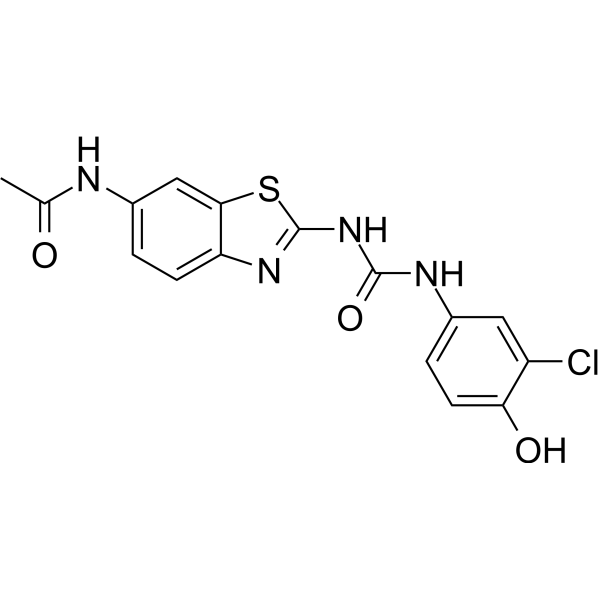
17β-HSD10-IN-1

Based on 1 Customer Validation
17β-HSD10-IN-1 (compound 9) is an orally active inhibitor of 17β-hydroxysteroid dehydrogenase type 10 (17β-HSD10) with blood-brain permeability. 17β-HSD10-IN-1 doesn't result additional effects for mitochondrial off-targets and cytotoxic or neurotoxic effects.
For research use only. We do not sell to patients.
- Purity : 97.42%
- CAS No.: 2316765-78-1
- Formula: C16H13ClN4O3S
- Molecular Weight:376.82
-
Storage:Powder -20°C, 3 years , 4°C, 2 years ; In solvent -80°C, 6 months , -20°C, 1 month

To place orders, for customer services and technical support, please contact: MedChemExpress USA
Tel: 609-228-6898 E-mail: [email protected] [email protected]


-
 Biological Activity
-
Chemical Information
-
Solvent & Solubility
- Protocols
- Purity & Documentation
- References
-
 Help & FAQs


All 17β-HSD Isoforms
More

Biological Activity
Description
IC50 & Target
17β-HSD10[1]


Chemical Information
-
CAS No. 2316765-78-1
-
Appearance Solid
-
Molecular Weight 376.82
-
Formula C16H13ClN4O3S
-
Color Pale purple to purple
-
SMILES
O=C(NC1=CC=C(C(Cl)=C1)O)NC(SC2=C3)=NC2=CC=C3NC(C)=O
-
Shipping
Room temperature in continental US; may vary elsewhere.
-
Storage
Powder -20°C 3 years 4°C 2 years In solvent -80°C 6 months -20°C 1 month


Solvent & Solubility
In Vitro:
DMSO : 25 mg/mL (66.34 mM; Need ultrasonic; Hygroscopic DMSO has a significant impact on the solubility of product, please use newly opened DMSO)
Please refer to the solubility information to select the appropriate solvent. Once prepared, please aliquot and store the solution to prevent product inactivation from repeated freeze-thaw cycles.
Storage method and period of stock solution: -80°C, 6 months; -20°C, 1 month. When stored at -80°C, please use it within 6 months. When stored at -20°C, please use it within 1 month.
Please refer to the solubility information to select the appropriate solvent. Once prepared, please aliquot and store the solution to prevent product inactivation from repeated freeze-thaw cycles.
Storage method and period of stock solution: -80°C, 6 months; -20°C, 1 month. When stored at -80°C, please use it within 6 months. When stored at -20°C, please use it within 1 month.
Concentration (start) × Volume (start) = Concentration (final) × Volume (final)

Protocols
-
Neurotoxicity Study
This protocol assesses in vitro neurotoxicity by combining neuronal viability, mitochondrial/metabolic activity, neurite outgrowth, and optional neuronal network function readouts. Calcein-AM or resazurin/PrestoBlue readouts estimate viable or metabolically active cells; βIII-tubulin immunofluorescence detects neuronal morphology and neurite networks; TMRE detects mitochondrial membrane potential; and MEA recordings detect functional changes in neuronal network activity.
-
Transepithelial/transendothelial electrical resistance assay
TEER measures electrical resistance across epithelial or endothelial monolayers cultured on permeable supports, and the readout reflects ionic conductance through the cell barrier, especially the paracellular pathway regulated by junctional integrity. TEER can be measured without destroying the monolayer and is commonly used before or during transport, permeability, barrier-disruption, and barrier-maturation experiments. TEER values are influenced by biological maturation and technical conditions; reported factors include temperature, medium formulation, passage number, electrode geometry, membrane properties, and junctional length during early monolayer maturation. Therefore, TEER should be interpreted with blank-insert subtraction, area normalization, repeated readings, and, when possible, orthogonal barrier readouts such as FITC-dextran flux or tight-junction staining.
-
Cell Viability Determination by MTT Colorimetric Assay
The following protocol uses the MTT colorimetric assay as a classic literature-established method for assessing cell viability/metabolic activity in cultured mammalian cells. MTT[3-(4,5-dimethylthiazol-2-yl)-2,5-diphenyltetrazolium bromide] is reduced by metabolically active cells to a colored formazan product; the amount of formazan is quantified spectrophotometrically and provides an indirect measure of metabolically active viable cells. Importantly, MTT reduction reflects cellular oxidoreductase/metabolic activity rather than an absolute direct count of living cells, so changes in cellular metabolism can alter the signal independently of cell number.


Purity & Documentation
-
Data Sheet (270 KB)
-
SDS (252 KB)
- English - EN (252 KB)
- Français - FR (252 KB)
- Deutsch - DE (252 KB)
- Norwegian - NO (252 KB)
- Español - ES (252 KB)
- Swedish - SV (252 KB)
- Italian - IT (252 KB)
- Korean - KR (252 KB)
- Portuguese - PT (252 KB)
-
Handling Instructions (2659 KB)
References


Complete Stock Solution Preparation Table
Please refer to the solubility information to select the appropriate solvent. Once prepared, please aliquot and store the solution to prevent product inactivation from repeated freeze-thaw cycles.
Storage method and period of stock solution: -80°C, 6 months; -20°C, 1 month. When stored at -80°C, please use it within 6 months. When stored at -20°C, please use it within 1 month.
| Optional Solvent | Concentration Solvent Mass | 1 mg | 5 mg | 10 mg | 25 mg |
|---|---|---|---|---|---|
| DMSO | 1 mM | 2.6538 mL | 13.2689 mL | 26.5379 mL | 66.3447 mL |
| 5 mM | 0.5308 mL | 2.6538 mL | 5.3076 mL | 13.2689 mL | |
| 10 mM | 0.2654 mL | 1.3269 mL | 2.6538 mL | 6.6345 mL | |
| 15 mM | 0.1769 mL | 0.8846 mL | 1.7692 mL | 4.4230 mL | |
| 20 mM | 0.1327 mL | 0.6634 mL | 1.3269 mL | 3.3172 mL | |
| 25 mM | 0.1062 mL | 0.5308 mL | 1.0615 mL | 2.6538 mL | |
| 30 mM | 0.0885 mL | 0.4423 mL | 0.8846 mL | 2.2115 mL | |
| 40 mM | 0.0663 mL | 0.3317 mL | 0.6634 mL | 1.6586 mL | |
| 50 mM | 0.0531 mL | 0.2654 mL | 0.5308 mL | 1.3269 mL | |
| 60 mM | 0.0442 mL | 0.2211 mL | 0.4423 mL | 1.1057 mL |


17β-HSD10-IN-1 Related Classifications
HY-155534 Related Classifications
 Powered by Bioz