



2-Methylquinoxaline

Based on 1 Customer Validation
2-Methylquinoxaline is a detection marker of Methylglyoxal (HY-106634) and can be used for quantitative Methylglyoxal. 2-Methylquinoxaline can be used for the researches of type 2 diabetes and Alzheimer's disease.
For research use only. We do not sell to patients.
- CAS No.: 7251-61-8
- Formula: C9H8N2
- Molecular Weight:144.18
-
Storage:
Store at room temperature 3 years.
In solvent -80°C, 2 years , -20°C, 1 year


To place orders, for customer services and technical support, please contact: MedChemExpress USA
Tel: 609-228-6898 E-mail: [email protected] [email protected]


-
 Biological Activity
-
Chemical Information
- Protocols
- Purity & Documentation
- References
-
 Help & FAQs


-
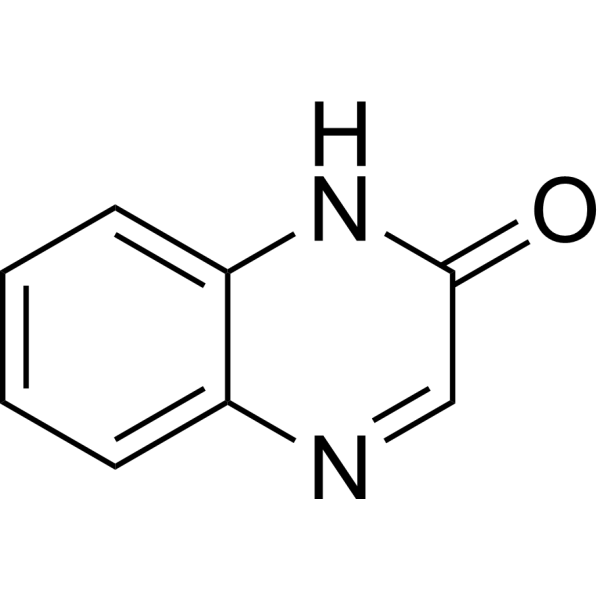
HY-W017519
2-QuinoxalinolQuinoline Derivative -

HY-W002071
2-Quinoxalinecarboxylic acidAntibacterial Agent -

HY-W017534
Brimonidine impurity 7Drug Impurity -

HY-W041703
6-Amino-5-bromoquinoxaline -

HY-W017519R
2-Quinoxalinol (Standard)Quinoline Derivative -

HY-W017534R
Quinoxalin-6-amine (Standard) -

HY-W041533
5,6,7,8-TetrahydroquinoxalineFlavor Enhancer -
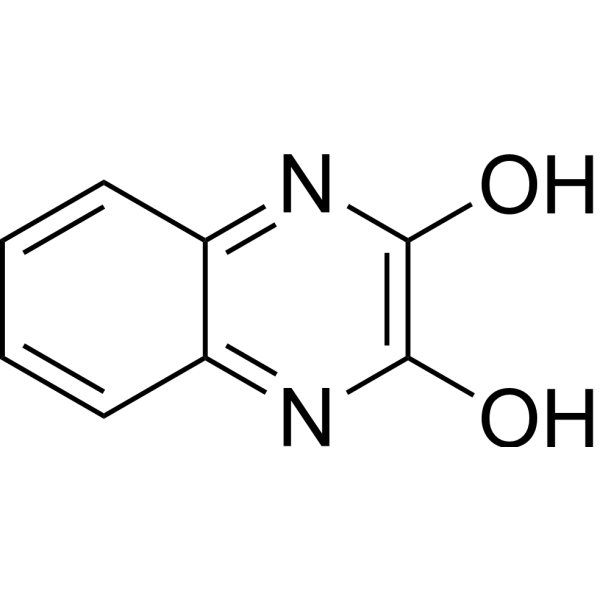
HY-20803
2,3-DihydroxyquinoxalineFluorescent Reagent -
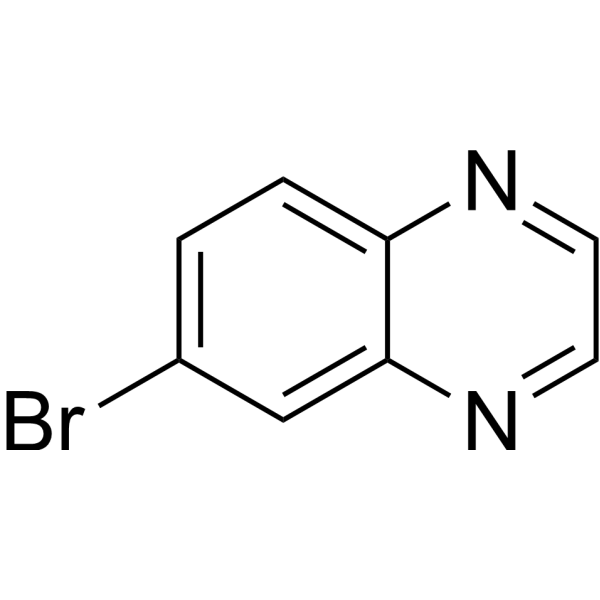
HY-69094
6-BromoquinoxalineBiochemical Reagent


Biological Activity
Description
Cellular Effect
|
Cell Line

|
Type | Value | Description | References |
|---|---|---|---|---|
| HepG2 | CC50 |
>500 μM
Compound: 5b
|
Cytotoxicity against human HepG2 cells after 72 hrs by MTT assay
Cytotoxicity against human HepG2 cells after 72 hrs by MTT assay
|
[PMID: 24946216] |
| HepG2 | CC50 |
500 μM
Compound: 5b
|
Cytotoxicity against human HepG2 cells after 72 hrs by MTT assay
Cytotoxicity against human HepG2 cells after 72 hrs by MTT assay
|
[PMID: 24946216] |


Chemical Information
-
CAS No. 7251-61-8
-
Appearance Liquid (Density: 1.118 g/cm3)
-
Molecular Weight 144.18
-
Formula C9H8N2
-
Color Brown to red
-
SMILES
N1=CC(=NC2=CC=CC=C12)C
-
Shipping
Room temperature in continental US; may vary elsewhere.
-
Storage
Store at room temperature 3 years
In solvent -80°C 2 years -20°C 1 year

Protocols
-
Research Protocol for Metabolic Diseases
AMP-activated protein kinase, AMPK, is a conserved cellular energy sensor that responds to reduced cellular energy status and coordinates metabolism by increasing ATP-generating catabolic pathways while suppressing ATP-consuming anabolic processes. In metabolic disease research, the AMPK pathway is experimentally relevant because it regulates hepatic lipid synthesis, fatty acid oxidation, glucose production, skeletal-muscle glucose disposal, mTORC1-linked biosynthesis, autophagy, mitochondrial homeostasis, and whole-body energy balance. The central pathway logic is that energy stress, metformin, exercise-like stimulation, or direct AMPK activators increase AMPKα Thr172 phosphorylation and downstream substrate phosphorylation, including ACC and RAPTOR. Phosphorylation of ACC suppresses lipogenesis and supports fatty acid oxidation, whereas phosphorylation of RAPTOR suppresses mTORC1 signaling and links cellular energy status to growth and protein synthesis control. The pathway is linked
-
Alzheimer’s Disease Modeling
Alzheimer’s Disease (AD) is a neurodegenerative disorder characterized by a progressive decline in cognitive functions and loss of specific types of neurons and synapses. Alzheimer's symptoms can be simulated in mice by injecting drugs (such as Aβ) or genetically modified.


Purity & Documentation
-
Data Sheet (268 KB)
-
SDS (393 KB)
- English - EN (393 KB)
- Français - FR (393 KB)
- Deutsch - DE (393 KB)
- Norwegian - NO (393 KB)
- Español - ES (393 KB)
- Swedish - SV (393 KB)
- Italian - IT (393 KB)
- Korean - KR (393 KB)
- Portuguese - PT (393 KB)
-
Handling Instructions (2659 KB)
References

Calculators
Concentration (start) × Volume (start) = Concentration (final) × Volume (final)


2-Methylquinoxaline Related Classifications
HY-W015672 Related Classifications
 Powered by Bioz