



21-Deacetoxy deflazacort
21-Deacetoxy deflazacort is a dehydrogenated derivative of Deflazacort (HY-13609), a glucocorticoid, an inactive precursor that is rapidly converted to the active metabolite 21-Desacetyldeflazacort. Deflazacort acts as an anti-inflammatory and immunosuppressant.
Nos produits utilisent uniquement pour la recherche. Nous ne vendons pas aux patients.
- CAS No.: 13649-88-2
- Formule: C23H29NO4
- Masse moléculaire:383.48
-
Stockage:
Please store the product under the recommended conditions in the Certificate of Analysis.


To place orders, for customer services and technical support, please contact: MedChemExpress USA
Tel: 609-228-6898 E-mail: [email protected] [email protected]


-
 Activité biologique
-
Chemical Information
- Protocole
- Pureté et documentation
- Références
-
 Help & FAQs


-
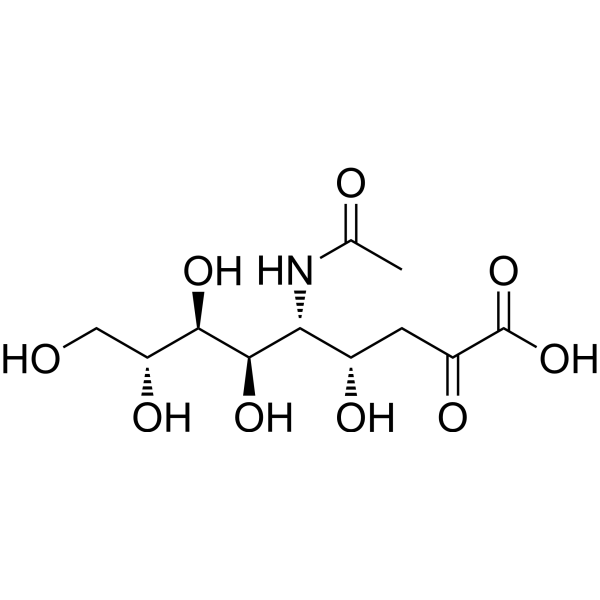
HY-I0400
N-Acetylneuraminic acidSialic Acid Monosaccharide; Tyrosinase Inhibitior -

HY-134520R
21-Deacetoxy deflazacort (Standard) -

HY-I0400R
N-Acetylneuraminic acid (Standard)Sialic Acid Monosaccharide; Tyrosinase Inhibitior -
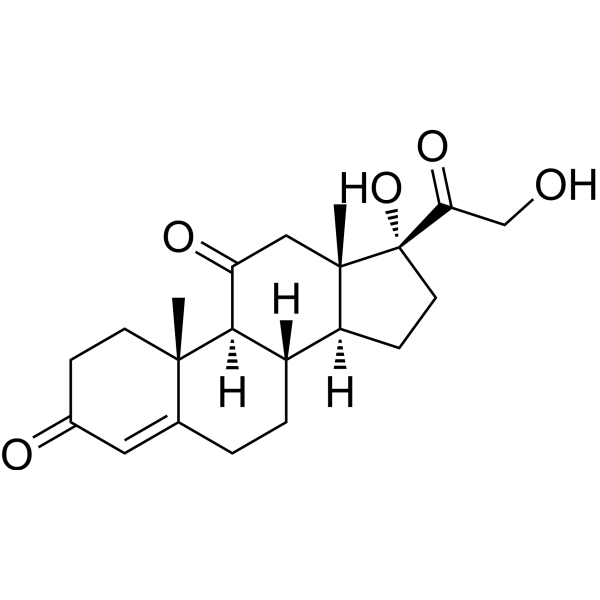
HY-17461
CortisoneGlucocorticoid Receptor Agonist -
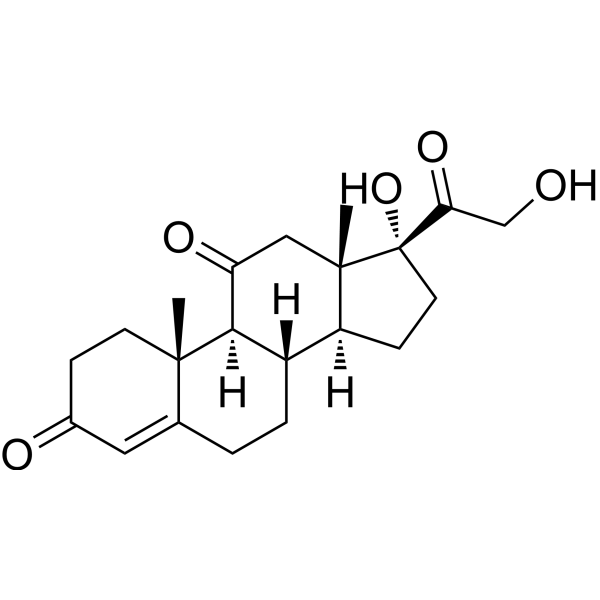
HY-17461R
Cortisone (Standard)


Activité biologique
Description


Chemical Information
-
CAS No. 13649-88-2
-
Masse moléculaire 383.48
-
Formule C23H29NO4
-
SMILES
O=C1C=C[C@@]2(C)C(CC[C@]3([H])[C@]2([H])[C@@H](O)C[C@@]4(C)[C@@]3([H])C[C@]5([H])[C@@]4(C(C)=O)N=C(C)O5)=C1
-
Livraison
Room temperature in continental US; may vary elsewhere.
-
Stockage
Please store the product under the recommended conditions in the Certificate of Analysis.

Protocole
-
Research Protocol for Endocrine Diseases
Endocrine diseases often arise from disrupted hormone production, hormone signaling, or target-tissue responsiveness; for diabetes-focused endocrine disease models, insulin signaling regulates glucose uptake, hepatic glucose output, lipid metabolism, and β-cell compensation. Type 2 diabetes develops through interacting defects in insulin resistance, β-cell dysfunction, adipose inflammation, hepatic glucose overproduction, altered incretin signaling, and ectopic lipid metabolism. A major unresolved question is whether endocrine dysfunction is driven primarily by target-tissue insulin resistance, intrinsic β-cell failure, immune/inflammatory stress, or combined multi-organ failure that differs by disease stage.
-
Research Protocol for Inflammation-related Diseases
The NLRP3 inflammasome is a cytosolic innate immune signaling platform that integrates priming signals and danger-signal activation to promote caspase-1 activation, maturation of IL-1β and IL-18, and gasdermin D-mediated pyroptotic cell death. The core experimental logic is to determine whether inflammatory disease phenotypes are driven by increased NLRP3 expression, ASC-containing inflammasome assembly, caspase-1 cleavage, GSDMD cleavage, and extracellular release of IL-1β/IL-18 rather than by nonspecific cell injury alone. The pathway is strongly linked to inflammation-related disease phenotypes because monosodium urate crystals activate NALP3/NLRP3 inflammasome signaling in gout-like crystal inflammation, cholesterol crystals activate NLRP3 inflammasomes in atherogenesis models, and DSS-induced intestinal inflammation has been reported to involve NLRP3 inflammasome activity. However, experimental colitis studies also show context-dependent protective effects of NLRP3 inflammasome co


Pureté et documentation
Références

Calculators
Concentration (start) × Volume (start) = Concentration (final) × Volume (final)


21-Deacetoxy deflazacort Related Classifications
HY-134520 Related Classifications
 Powered by Bioz