



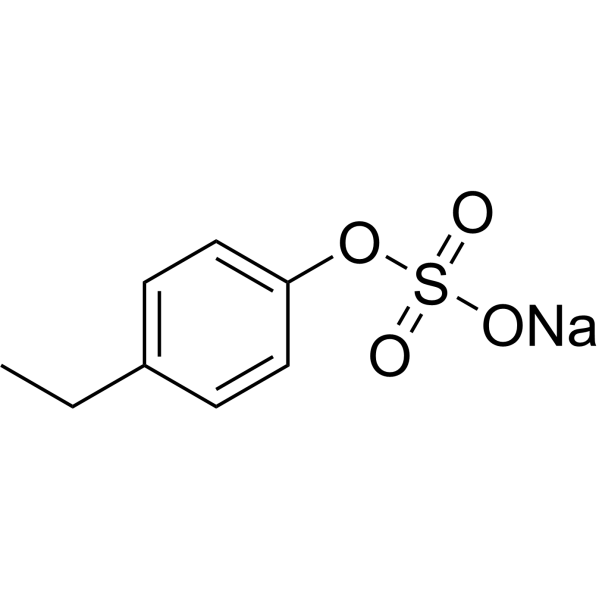
4-Ethylphenyl sulfate sodium
4-Ethylphenyl sulfate sodium is an orally active and brain-penetrant gut microbial metabolite. 4-Ethylphenyl sulfate sodium downregulates Bcl2 expression, upregulates Bax expression, and induces cancer cell apoptosis via the endogenous apoptotic pathway. 4-Ethylphenyl sulfate sodium induces G2/M cell cycle arrest and reactive oxygen species (ROS) production. 4-Ethylphenyl sulfate sodium impairs oligodendrocyte maturation, reduces oligodendrocyte-neuron interactions, decreases axonal myelination levels, and shifts the oligodendrocyte population toward immature precursor cells. 4-Ethylphenyl sulfate sodium alters brain region-specific neural activity and functional connectivity in mice, and correlates with anxiety-like behaviors in mice.
For research use only. We do not sell to patients.
- Formula: C8H9NaO4S
- Molecular Weight:224.21
-
Storage:
Please store the product under the recommended conditions in the Certificate of Analysis.

To place orders, for customer services and technical support, please contact: MedChemExpress USA
Tel: 609-228-6898 E-mail: [email protected] [email protected]


-
 Biological Activity
-
Chemical Information
- Purity & Documentation
- References
-
 Help & FAQs


All Endogenous Metabolite Isoforms
More

Biological Activity
Description
In Vitro
4-Ethylphenyl sulfate (0.25-10 mM; 24-72 h) sodium reduces the viability of HCT-116 human colorectal adenocarcinoma cells in a time- and dose-dependent manner, with 10 mM reducing viability to 7% after 72 h[1].
4-Ethylphenyl sulfate (0.25-10 mM; 24-72 h) sodium reduces intracellular ATP levels and impairs metabolic activity in HCT-116 human colorectal adenocarcinoma cells in a time- and dose-dependent manner[1].
4-Ethylphenyl sulfate (2.5-10 mM; 24-72 h) sodium induces dose- and time-dependent morphological changes characteristic of cell death in HCT-116 human colorectal adenocarcinoma cells[1].
4-Ethylphenyl sulfate (0.25-10 mM; 10 days) sodium suppresses the colony-forming ability of HCT-116 human colorectal adenocarcinoma cells in a dose-dependent manner[1].
4-Ethylphenyl sulfate (1.25-10 mM; 48 h) sodium induces apoptosis and induces G2/M phase cell cycle arrest in HCT-116 human colorectal adenocarcinoma cells in a dose-dependent manner[1].
4-Ethylphenyl sulfate (1.25-10 mM; 48 h) sodium increases superoxide (ROS) production in HCT-116 human colorectal adenocarcinoma cells in a dose-dependent manner[1].
4-Ethylphenyl sulfate (5 mM; 48 h) sodium increases the Bax/Bcl-2 ratio in HCT-116 human colorectal adenocarcinoma cells in a dose-dependent manner, activating the intrinsic apoptotic pathway[1].
4-Ethylphenyl sulfate (0.25-10 mM; 24-72 h) sodium exhibits minimal to no toxicity toward CCD 841 CoN normal colon epithelial cells, with only a minor viability reduction at 10 mM after 72 h, confirming selective anticancer activity[1].
4-Ethylphenyl sulfate sodium binds to HDAC1, HDAC2, HDAC6, and HDAC8 histone deacetylase isoforms, with the highest binding affinity to HDAC1 (-6.3 kcal/mol), suggesting potential epigenetic modulation[1].
4-Ethylphenyl sulfate (10 μM; 10 days) sodium impairs oligodendrocyte maturation, reduces axon myelination, and alters expression of oligodendrocyte lineage markers in ex vivo organotypic mouse brain slices[2].
MedChemExpress (MCE) has not independently confirmed the accuracy of these methods. They are for reference only.
-
Cell Line:HCT-116 human colorectal adenocarcinoma cells
-
Concentration:0.25, 0.5, 0.75, 1, 1.25, 2.5, 5, 10 mM
-
Incubation Time:24, 48, 72 h
-
Result:Reduced HCT-116 cell viability in a time- and dose-dependent manner.
Reduced cell viability to 55%, 24%, and 7% after 24, 48, and 72 h of 10 mM treatment, respectively, compared to untreated controls set at 100% viability.
Reduced intracellular ATP levels (a marker of metabolic activity) in HCT-116 cells in a time- and dose-dependent manner, indicating impaired cellular metabolism.
In Vivo
MedChemExpress (MCE) has not independently confirmed the accuracy of these methods. They are for reference only.
-
Animal Model:Colonized mice (6 weeks)[2]
-
Dosage:Colonized mice (6 weeks)[2]
-
Administration:p.o.; free intake in drinking water continued until endpoint
-
Result:Increased anxiety-like behaviours and reduced oligodendrocyte maturation.


Chemical Information
-
Molecular Weight 224.21
-
Formula C8H9NaO4S
-
SMILES
O=S(OC1=CC=C(CC)C=C1)(O[Na])=O
-
Structure Classification
-
Initial Source
goat urine
-
Shipping
Room temperature in continental US; may vary elsewhere.
-
Storage
Please store the product under the recommended conditions in the Certificate of Analysis.


Purity & Documentation
References
[2]. Jaiswal J, et al. Gut Microbial Metabolite 4-Ethylphenylsulfate Is Selectively Deleterious and Anticancer to Colon Cancer Cells. J Med Chem. 2025;68(10):10425-10438. [Content Brief]
[3]. Needham BD, et al. A gut-derived metabolite alters brain activity and anxiety behaviour in mice. Nature. 2022;602(7898):647-653. [Content Brief]

Calculators
Concentration (start) × Volume (start) = Concentration (final) × Volume (final)


4-Ethylphenyl sulfate sodium Related Classifications
HY-W674241A Related Classifications
 Powered by Bioz