



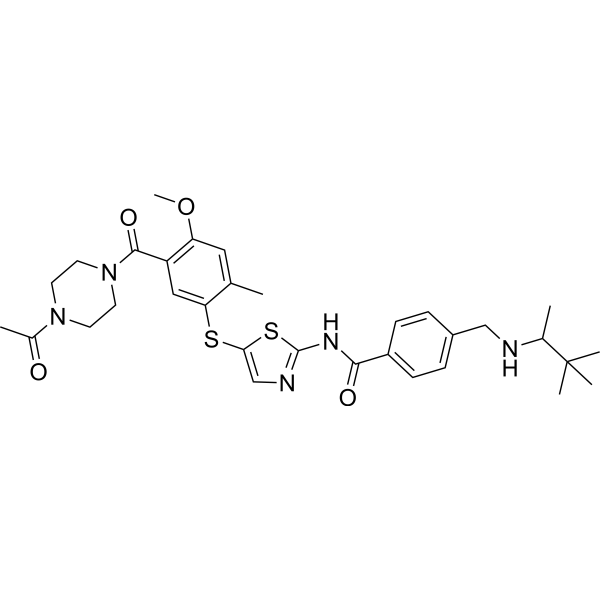
BMS-509744
Based on 5 publication(s) in Google Scholar
BMS-509744 is a potent, selective and ATP competitive Itk inhibitor with an IC50 of 19 nM.
Nos produits utilisent uniquement pour la recherche. Nous ne vendons pas aux patients.
- Pureté : 98.05%
- CAS No.: 439575-02-7
- Formule: C32H41N5O4S2
- Masse moléculaire:623.83
-
Stockage:Powder -20°C, 3 years , 4°C, 2 years ; In solvent -80°C, 1 year , -20°C, 6 months

To place orders, for customer services and technical support, please contact: MedChemExpress USA
Tel: 609-228-6898 E-mail: [email protected] [email protected]


-
 Activité biologique
-
Chemical Information
-
Solvant et solubilité
- Pureté et documentation
- Références
-
 Help & FAQs


-
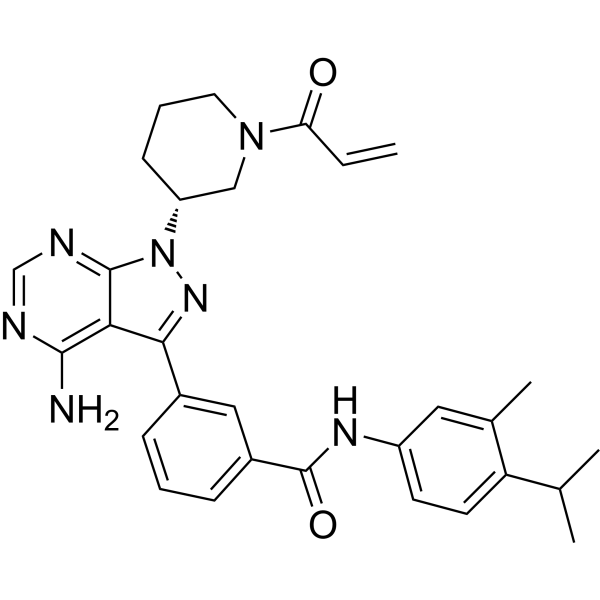
HY-108691
PF-06465469ITK Inhibitor -
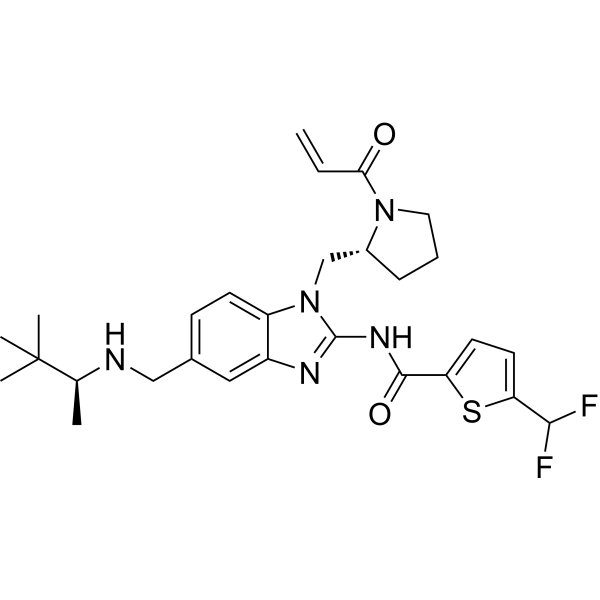
HY-12680
PRN694ITK/RLK Inhibitor -
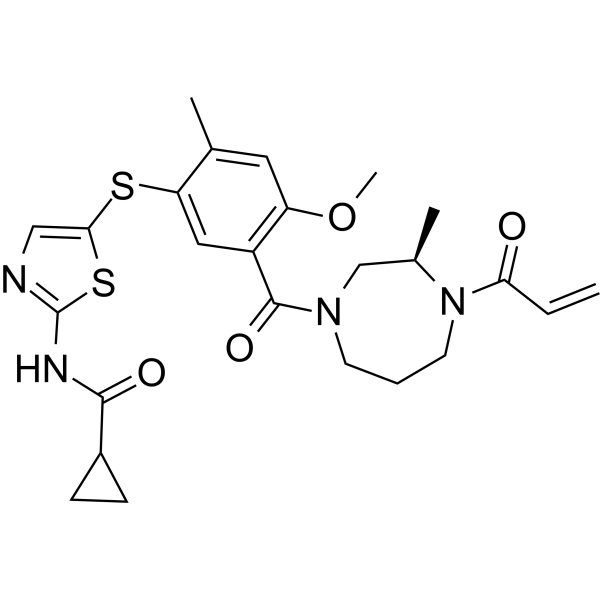
HY-150298
SoquelitinibITK Inhibitor -
HY-10997
IbrutinibBtk Inhibitor -
HY-128726
ITK inhibitor 2ITK Inhibitor -
HY-12410
GNE-9822ITK Inhibitor -
HY-10181
DasatinibSrc/Bcr-Abl Inhibitor -
HY-Y0320
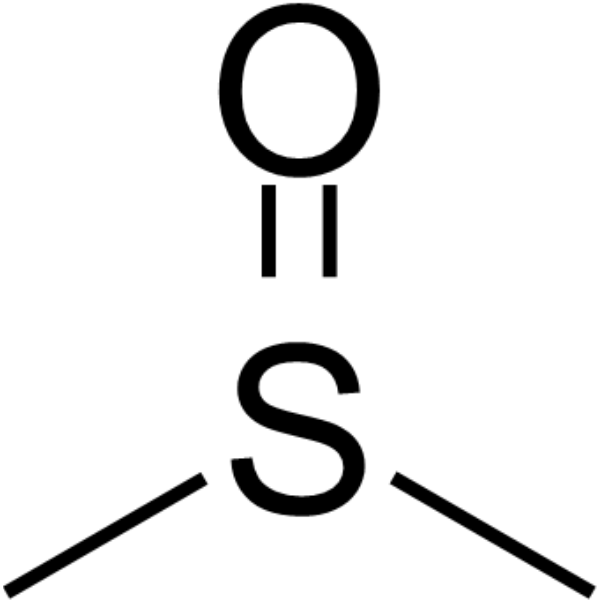
Dimethyl sulfoxide, meets analytical specification of Ch.P.Aprotic Solvent -
HY-10343
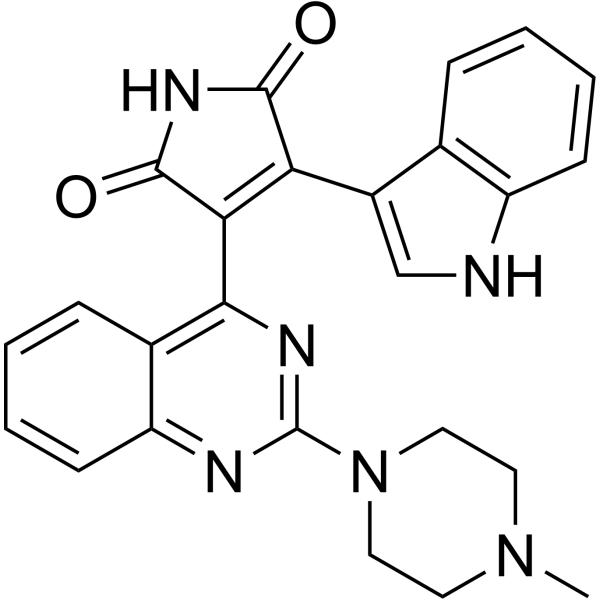
SotrastaurinPan-PKC Inhibitor -
HY-15307
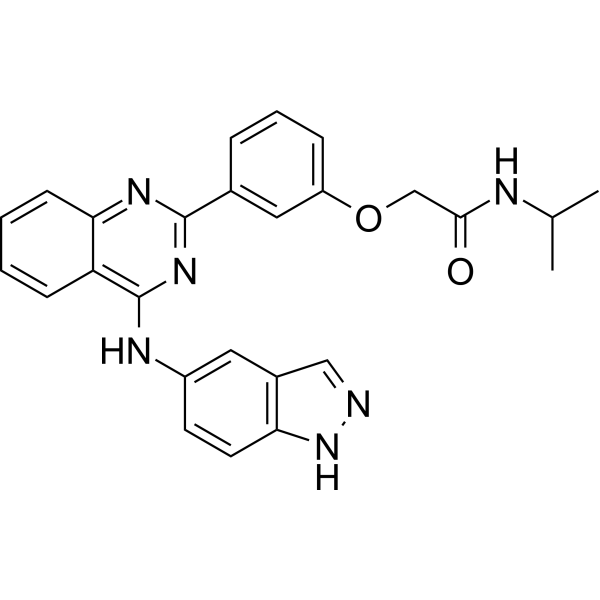
BelumosudilROCK2 Inhibitor -
HY-17031
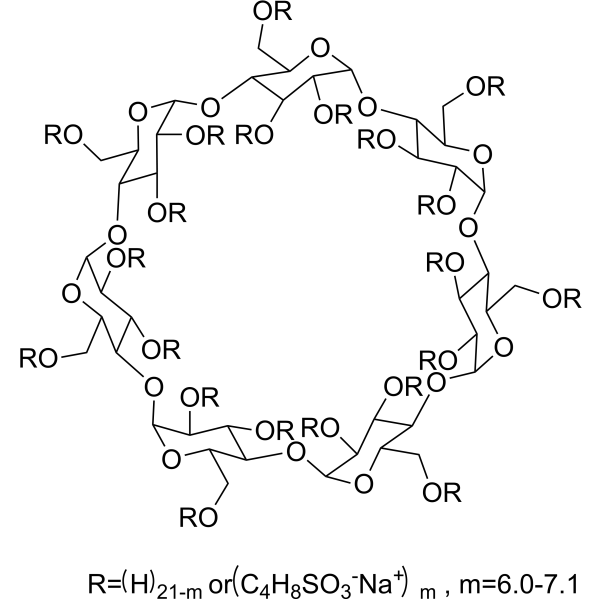
SBE-β-CDExcipient -
HY-17044
DuvelisibPI3Kδ Inhibitor
Publications Citing Use of MedChemExpress (MCE) BMS-509744
More Customer Validation & Images

-
WB


Activité biologique
Description
IC50 & Target
IC50: 19 nM (Itk)[1]
Cellular Effect
|
Cell Line

|
Type | Value | Description | References |
|---|---|---|---|---|
| EL4 | IC50 |
0.07 μM
Compound: 3
|
Inhibition of anti CD3-induced IL2 secretion in mouse EL4 cells
Inhibition of anti CD3-induced IL2 secretion in mouse EL4 cells
|
[PMID: 16682193] |
| Jurkat | IC50 |
0.25 μM
Compound: 3
|
Inhibition of anti CD3-induced IL2 secretion in human Jurkat T cells
Inhibition of anti CD3-induced IL2 secretion in human Jurkat T cells
|
[PMID: 16682193] |
| Jurkat | IC50 |
250 nM
Compound: 3
|
Inhibition of IL2 production in Jurkat T cells
Inhibition of IL2 production in Jurkat T cells
|
[PMID: 16682193] |
| PBMC | IC50 |
0.39 μM
Compound: 3
|
Inhibition of anti CD3-induced IL2 secretion in human PBMC
Inhibition of anti CD3-induced IL2 secretion in human PBMC
|
[PMID: 16682193] |
| Splenocyte | IC50 |
0.38 μM
Compound: 3
|
Inhibition of anti CD3-induced IL2 secretion in mouse splenocytes
Inhibition of anti CD3-induced IL2 secretion in mouse splenocytes
|
[PMID: 16682193] |
| T-cell | IC50 |
0.43 μM
Compound: Chemical probe: BMS-509744
|
Anti-proliferative activity against irradiated APC induced human T cell incubated for 3 days
Anti-proliferative activity against irradiated APC induced human T cell incubated for 3 days
|
[PMID: 15323564] |
In Vitro
BMS-509744 reduces T-cell receptor-induced functions including PLCγ1 tyrosine phosphorylation, calcium mobilization, IL-2 secretion, and T-cell proliferation in vitro in both human and mouse cells. BMS-488516 and BMS-509744 potently inhibit Itk in vitro with IC50 values of 96 and 19 nM, respectively. Both compounds exhibit competitive kinetics with respect to ATP, suggesting that they bind to the ATP binding site of the Itk kinase domain[1].
MedChemExpress (MCE) has not independently confirmed the accuracy of these methods. They are for reference only.
In Vivo
MedChemExpress (MCE) has not independently confirmed the accuracy of these methods. They are for reference only.


Chemical Information
-
CAS No. 439575-02-7
-
Appearance Solid
-
Masse moléculaire 623.83
-
Formule C32H41N5O4S2
-
Color White to light yellow
-
SMILES
CC(C(C)(C)C)NCC1=CC=C(C(NC2=NC=C(SC3=CC(C(N4CCN(C(C)=O)CC4)=O)=C(OC)C=C3C)S2)=O)C=C1
-
Livraison
Room temperature in continental US; may vary elsewhere.
-
Stockage
Powder -20°C 3 years 4°C 2 years In solvent -80°C 1 year -20°C 6 months


Publications (5)
-
Journal Impact Factor
-
Most Recent
-
Cancer Lett
Interleukin-2-inducible T-cell kinase inhibition to block NF-κB signaling exerts anti-tumor effects and enhances chemotherapy in NK/T-cell lymphoma. [Abstract]2025 May 28:618:217602. PMID: 40054659 -
J Exp Med
2024 Mar 4;221(3):e20230683. PMID: 38324068 -
Proc Natl Acad Sci U S A
Endocytosis triggers V-ATPase-SYK-mediated priming of cGAS activation and innate immune response. [Abstract]2022 Oct 25;119(43):e2207280119. PMID: 36252040 -
Cancer Cell Int
ITK inhibition induced in vitro and in vivo anti-tumor activity through downregulating TCR signaling pathway in malignant T cell lymphoma. [Abstract]2019 Feb 14:19:32. PMID: 30814910
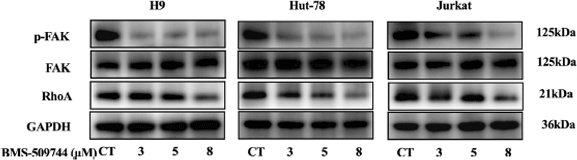
BMS-509744 purchased from MedChemExpress. Usage Cited in: Cancer Cell Int. 2019 Feb 14:19:32. [Abstract]
Cells are treated with indicated concentrations of BMS-509744 for 24 h, then whole cell lysates are detected by western blot for phosphorylated FAK and total RhoA.
-
Sci Rep
Overcoming immune checkpoint blockade resistance in solid tumors with intermittent ITK inhibition. [Abstract]2023 Sep 21;13(1):15678. PMID: 37735204


Solvant et solubilité
In Vitro:
DMSO : 66.67 mg/mL (106.87 mM; Need ultrasonic; Hygroscopic DMSO has a significant impact on the solubility of product, please use newly opened DMSO)
Please refer to the solubility information to select the appropriate solvent. Once prepared, please aliquot and store the solution to prevent product inactivation from repeated freeze-thaw cycles.
Storage method and period of stock solution: -80°C, 1 year; -20°C, 6 months. When stored at -80°C, please use it within 1 year. When stored at -20°C, please use it within 6 months.
Please refer to the solubility information to select the appropriate solvent. Once prepared, please aliquot and store the solution to prevent product inactivation from repeated freeze-thaw cycles.
Storage method and period of stock solution: -80°C, 1 year; -20°C, 6 months. When stored at -80°C, please use it within 1 year. When stored at -20°C, please use it within 6 months.
Concentration (start) × Volume (start) = Concentration (final) × Volume (final)
In Vivo:
Select the appropriate dissolution method based on your experimental animal and administration route.
- For the following dissolution methods, please ensure to first prepare a clear stock solution using an In Vitro approach and then sequentially add co-solvents:
- To ensure reliable experimental results, the clarified stock solution can be appropriately stored based on storage conditions. As for the working solution for In Vivo experiments, it is recommended to prepare freshly and use it on the same day.
- The percentages shown for the solvents indicate their volumetric ratio in the final prepared solution. If precipitation or phase separation occurs during preparation, heat and/or sonication can be used to aid dissolution.
Add each solvent one by one: 10% DMSO 40% PEG300 5% Tween-80 45% Saline
Solubility: ≥ 2.5 mg/mL (4.01 mM); Clear solution
This protocol yields a clear solution of ≥ 2.5 mg/mL (saturation unknown).
Taking 1 mL working solution as an example, add 100 μL DMSO stock solution (25.0 mg/mL) to 400 μL PEG300, and mix evenly; then add 50 μL Tween-80 and mix evenly; then add 450 μL Saline to adjust the volume to 1 mL.
Preparation of Saline: Dissolve 0.9 g sodium chloride in ddH₂O and dilute to 100 mL to obtain a clear Saline solution.
Add each solvent one by one: 10% DMSO 90% (20% SBE-β-CD in Saline)
Solubility: ≥ 2.5 mg/mL (4.01 mM); Clear solution
This protocol yields a clear solution of ≥ 2.5 mg/mL (saturation unknown).
Taking 1 mL working solution as an example, add 100 μL DMSO stock solution (25.0 mg/mL) to 900 μL 20% SBE-β-CD in Saline, and mix evenly.
Preparation of 20% SBE-β-CD in Saline (4°C, storage for one week): 2 g SBE-β-CD powder is dissolved in 10 mL Saline, completely dissolve until clear.
In Vivo Dissolution Calculator
Please enter the basic information of animal experiments:
-
-
-
-
Recommended: Prepare an additional quantity of animals to account for potential losses during experiments.
Please enter your animal formula composition:
-
%DMSO +
Recommended: Keep the proportion of DMSO in working solution below 2% if your animal is weak.
-
%+
-
+%Tween-80 + +
-
%Saline +
The co-solvents required include: DMSO, . All of co-solvents are available by MedChemExpress (MCE). , Tween 80. All of co-solvents are available by MedChemExpress (MCE).
Working solution concentration: 0.22 mg/mL
Method for preparing stock solution: mg drug dissolved in μL DMSO. Stock solution concentration: mg/mL.
1. Take μL DMSO stock solution;
2. Add μL .
μL , mix evenly;
3. Then add μL Tween 80, mix evenly;
4. Then add μL
Please ensure that the stock solution in the first step is dissolved to a clear state, and add co-solvents in sequence. You can use ultrasonic heating (ultrasonic cleaner, recommended frequency 20-40 kHz), vortexing, etc. to assist dissolution.


Pureté et documentation
-
Fiche technique (274 KB)
-
SDS (251 KB)
- English - EN (251 KB)
- Français - FR (251 KB)
- Deutsch - DE (251 KB)
- Norwegian - NO (251 KB)
- Español - ES (251 KB)
- Swedish - SV (251 KB)
- Italian - IT (251 KB)
- Korean - KR (251 KB)
- Portuguese - PT (251 KB)
-
Instruction de manipulation (2659 KB)
Références


Complete Stock Solution Preparation Table
Please refer to the solubility information to select the appropriate solvent. Once prepared, please aliquot and store the solution to prevent product inactivation from repeated freeze-thaw cycles.
Storage method and period of stock solution: -80°C, 1 year; -20°C, 6 months. When stored at -80°C, please use it within 1 year. When stored at -20°C, please use it within 6 months.
| Optional Solvent | Concentration Solvent Mass | 1 mg | 5 mg | 10 mg | 25 mg |
|---|---|---|---|---|---|
| DMSO | 1 mM | 1.6030 mL | 8.0150 mL | 16.0300 mL | 40.0750 mL |
| 5 mM | 0.3206 mL | 1.6030 mL | 3.2060 mL | 8.0150 mL | |
| 10 mM | 0.1603 mL | 0.8015 mL | 1.6030 mL | 4.0075 mL | |
| 15 mM | 0.1069 mL | 0.5343 mL | 1.0687 mL | 2.6717 mL | |
| 20 mM | 0.0802 mL | 0.4008 mL | 0.8015 mL | 2.0038 mL | |
| 25 mM | 0.0641 mL | 0.3206 mL | 0.6412 mL | 1.6030 mL | |
| 30 mM | 0.0534 mL | 0.2672 mL | 0.5343 mL | 1.3358 mL | |
| 40 mM | 0.0401 mL | 0.2004 mL | 0.4008 mL | 1.0019 mL | |
| 50 mM | 0.0321 mL | 0.1603 mL | 0.3206 mL | 0.8015 mL | |
| 60 mM | 0.0267 mL | 0.1336 mL | 0.2672 mL | 0.6679 mL | |
| 80 mM | 0.0200 mL | 0.1002 mL | 0.2004 mL | 0.5009 mL | |
| 100 mM | 0.0160 mL | 0.0802 mL | 0.1603 mL | 0.4008 mL |


BMS-509744 Related Classifications
HY-11092 Related Classifications
 Powered by Bioz