



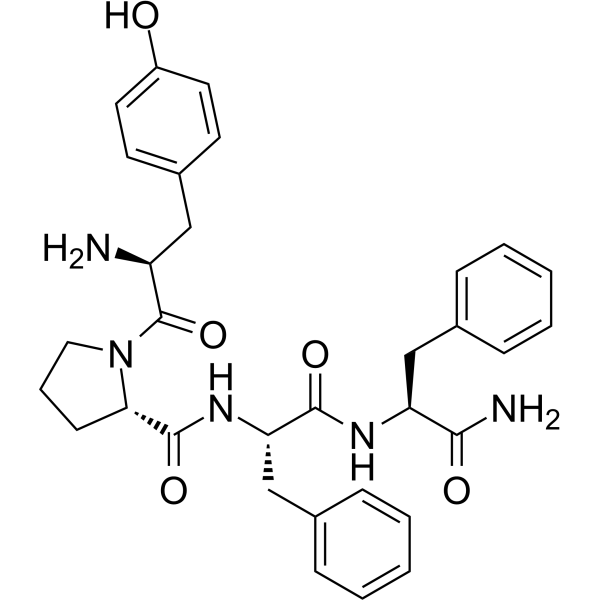
Endomorphin 2
Endomorphin 2, a high affinity, highly selective agonist of the μ-opioid receptor, displays reasonable affinities for kappa3 binding sites, with Ki value between 20 and 30 nM.
For research use only. We do not sell to patients.
- CAS No.: 141801-26-5
- Formula: C32H37N5O5
- Molecular Weight:571.67
-
Storage:
Please store the product under the recommended conditions in the Certificate of Analysis.

To place orders, for customer services and technical support, please contact: MedChemExpress USA
Tel: 609-228-6898 E-mail: [email protected] [email protected]


-
 Biological Activity
-
Chemical Information
-
Solvent & Solubility
- Purity & Documentation
- References
-
 Help & FAQs


-
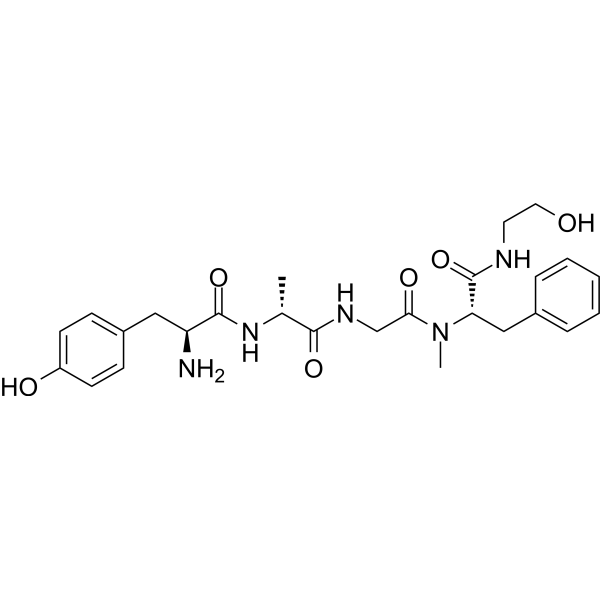
HY-P0210
DAMGOμ-OPR Agonist -
![[Leu5]-Enkephalin](https://file.medchemexpress.com/product_pic/hy-p0288.gif)
HY-P0288
[Leu5]-EnkephalinEndogenous Metabolite -
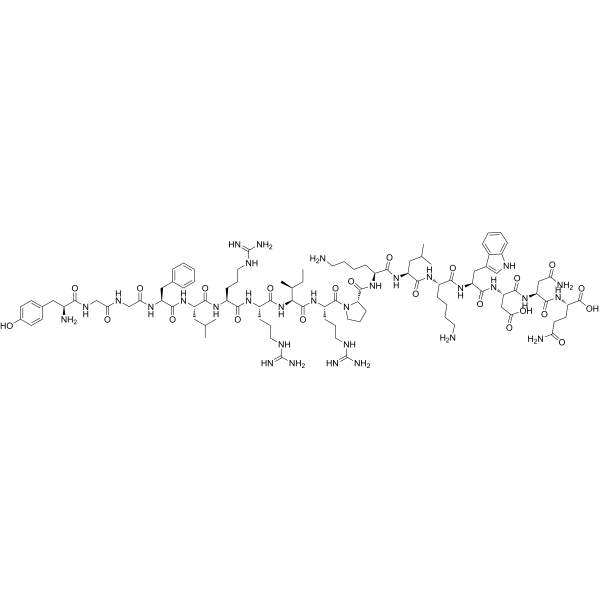
HY-P1333
Dynorphin AKOR Agonist -

HY-P1337
Dynorphin B (1-13)Kappa Opioid Receptor Agonist -
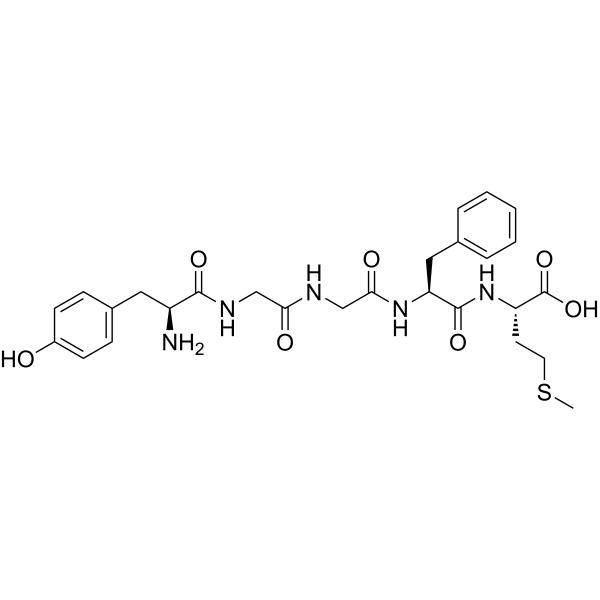
HY-P0073
Tyr-Gly-Gly-Phe-Met-OHOpioid Receptor Activator -
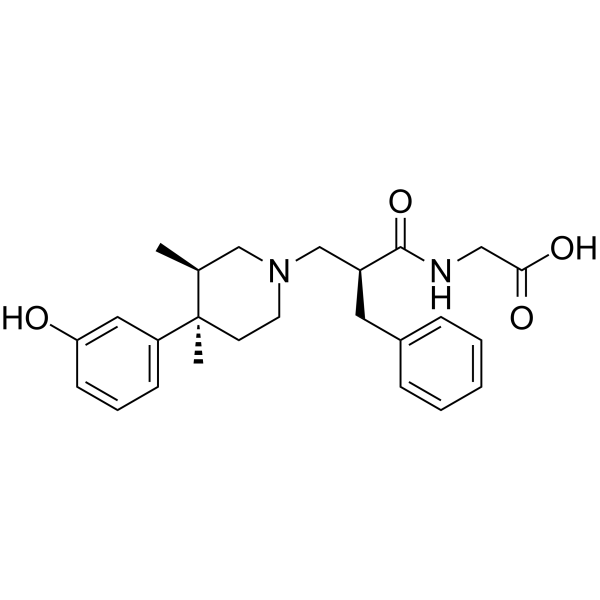
HY-13243
Alvimopanμ-opioid Receptor Antagonist -
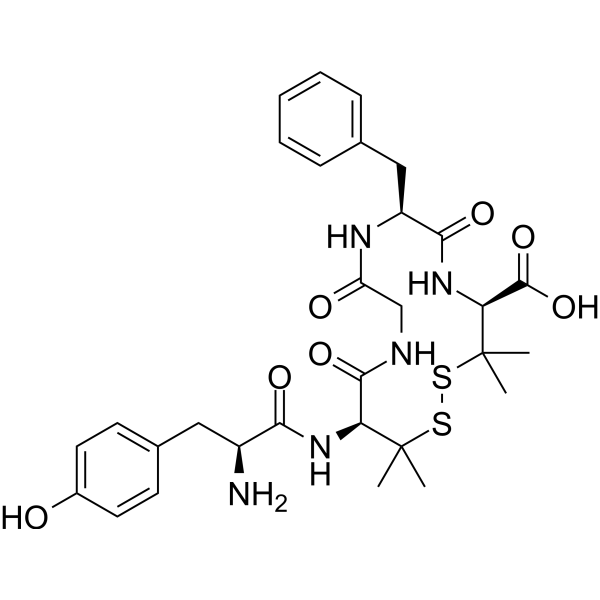
HY-P1334
DPDPEDOR Agonist -
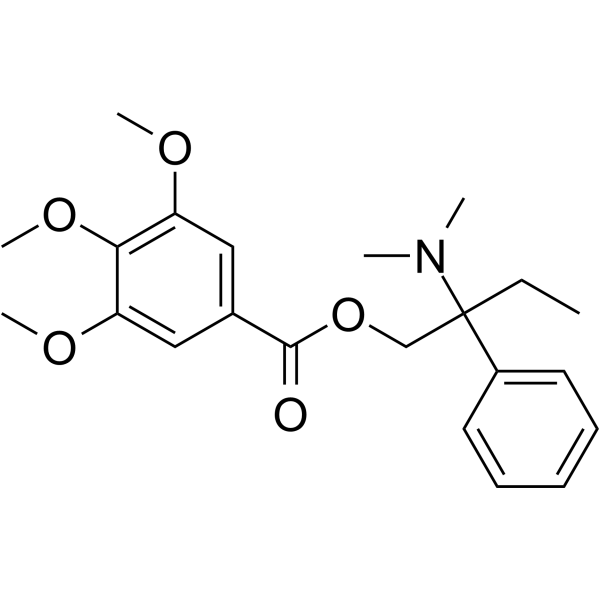
HY-B0380
TrimebutineOpioid Receptor Agonist -
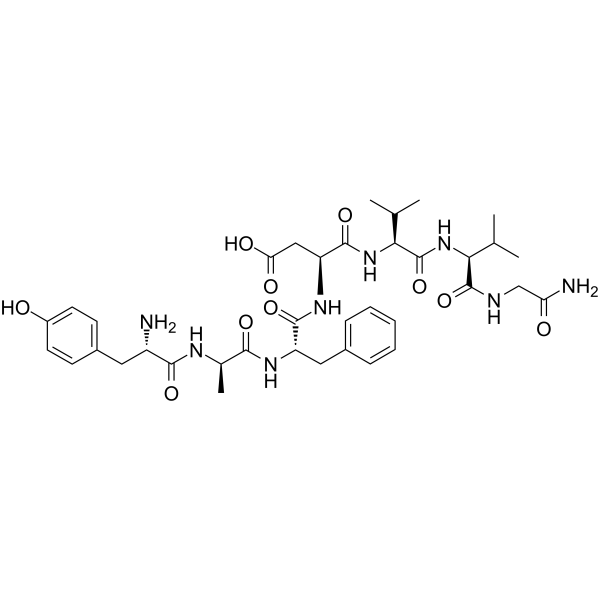
HY-P1336
Deltorphin Iδ-Opioid Receptor Agonist -

HY-P1331
BAM-22POpioid Receptor Agonist -
HY-P1335
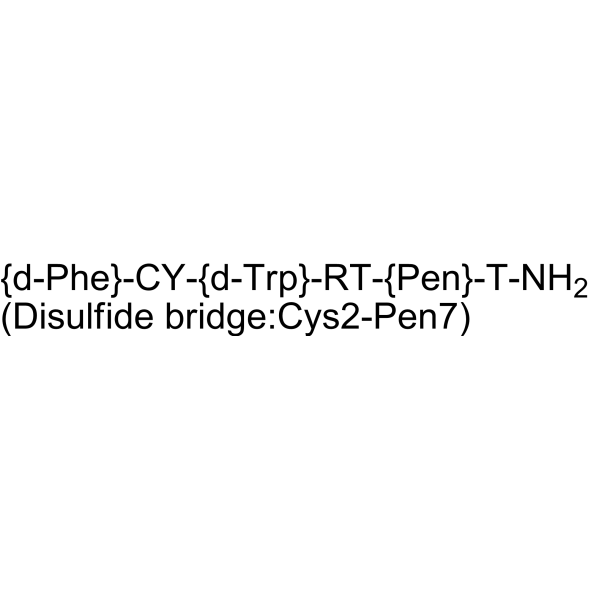
CTAPμ Opioid Receptor Antagonist -
HY-101202
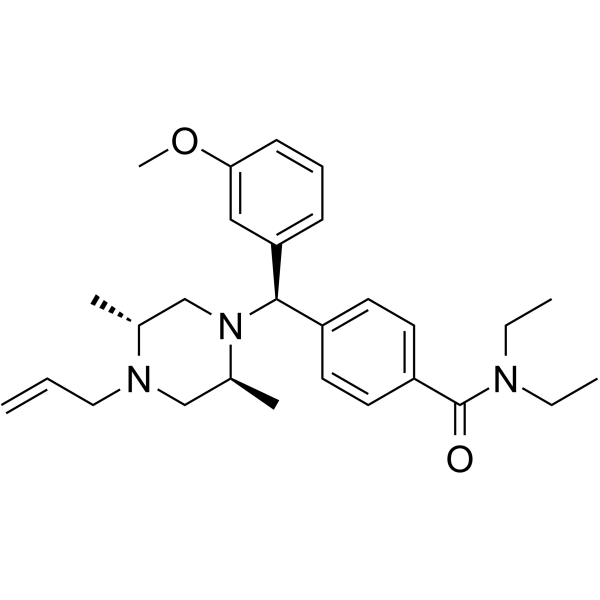
SNC80δ-opioid Receptor Agonist
All Opioid Receptor Isoforms
More

Biological Activity
Description
IC50 & Target
|
μ Opioid Receptor/MOR |
Cellular Effect
|
Cell Line

|
Type | Value | Description | References |
|---|---|---|---|---|
| CHO | EC50 |
0.04 nM
Compound: 6, Endomorphin-2
|
Activity at mu opioid receptor assessed as increase in calcium level in CHO cells by aequorin luminescence based calcium assay
Activity at mu opioid receptor assessed as increase in calcium level in CHO cells by aequorin luminescence based calcium assay
|
[PMID: 17266203] |
| CHO | EC50 |
>1000 nM
Compound: 6, Endomorphin-2
|
Activity at delta opioid receptor assessed as increase in calcium level in CHO cells by aequorin luminescence based calcium assay
Activity at delta opioid receptor assessed as increase in calcium level in CHO cells by aequorin luminescence based calcium assay
|
[PMID: 17266203] |
| CHO | EC50 |
0.04 nM
Compound: 1, endomorphin-2
|
Antagonist activity at mu opioid receptor expressed in CHO cells assessed as release of intracellular calcium ions by aequorin luminescence-based calcium assay
Antagonist activity at mu opioid receptor expressed in CHO cells assessed as release of intracellular calcium ions by aequorin luminescence-based calcium assay
|
[PMID: 18207400] |
| CHO | EC50 |
>1000 nM
Compound: 1, endomorphin-2
|
Antagonist activity at delta opioid receptor expressed in CHO cells assessed as release of intracellular calcium ions by aequorin luminescence-based calcium assay
Antagonist activity at delta opioid receptor expressed in CHO cells assessed as release of intracellular calcium ions by aequorin luminescence-based calcium assay
|
[PMID: 18207400] |
| HEK293 | EC50 |
11.8 nM
Compound: 2, EM-2
|
Agonist activity at mu opioid receptor expressed in HEK293 cells assessed as inhibition of forskolin-induced cAMP accumulation after 30 mins by liquid scintillation counter
Agonist activity at mu opioid receptor expressed in HEK293 cells assessed as inhibition of forskolin-induced cAMP accumulation after 30 mins by liquid scintillation counter
|
[PMID: 22724433] |
| HEK293 | EC50 |
55.5 nM
Compound: EM-2
|
Agonist activity at mu opioid receptor (unknown origin) expressed in human HEK293 cells assessed as increase in cAMP accumulation using [3H]-cAMP as substrate measured after 30mins by liquid scintillation counting method
Agonist activity at mu opioid receptor (unknown origin) expressed in human HEK293 cells assessed as increase in cAMP accumulation using [3H]-cAMP as substrate measured after 30mins by liquid scintillation counting method
|
[PMID: 32199689] |
In Vitro
Endomorphin 2 is an endogenous opioid peptide and one of the two Endomorphins. It is a high affinity, highly selective agonist of the μ-opioid receptor, and along with Endomorphin 1 (EM-2). The two Endomorphins display reasonable affinities for kappa3 binding sites, with Ki values between 20 and 30 nM. Endomorphin 1 and Endomorphin 2 compete both μ1 and μ2 receptor sites quite potently. Endomorphins have little appreciable affinity for either delta or kappa1 binding sites, with Ki values greater than 500 nM[1].
MedChemExpress (MCE) has not independently confirmed the accuracy of these methods. They are for reference only.
In Vivo
MedChemExpress (MCE) has not independently confirmed the accuracy of these methods. They are for reference only.


Chemical Information
-
CAS No. 141801-26-5
-
Molecular Weight 571.67
-
Formula C32H37N5O5
-
Sequence
Tyr-Pro-Phe-Phe-NH2
-
Sequence Shortening
YPFF-NH2
-
Shipping
Room temperature in continental US; may vary elsewhere.
-
Storage
Please store the product under the recommended conditions in the Certificate of Analysis.


Solvent & Solubility
In Vitro
H2O
Peptide Solubility and Storage Guidelines:
1. Calculate the length of the peptide.
2. Calculate the overall charge of the entire peptide according to the following table:
| Contents | Assign value | |
|---|---|---|
| Acidic amino acid | Asp (D), Glu (E), and the C-terminal -COOH. | -1 |
| Basic amino acid | Arg (R), Lys (K), His (H), and the N-terminal -NH2 | +1 |
| Neutral amino acid | Gly (G), Ala (A), Leu (L), Ile (I), Val (V), Cys (C), Met (M), Thr (T), Ser (S), Phe (F), Tyr (Y), Trp (W), Pro (P), Asn (N), Gln (Q) | 0 |
3. Recommended solution:
| Overall charge of peptide | Details |
|---|---|
| Negative (<0) |
1. Try to dissolve the peptide in water first. 2. If water fails, add NH4OH (<50 μL). 3. If the peptide still does not dissolve, add DMSO (50-100 μL) to solubilize the peptide. |
| Positive (>0) |
1. Try to dissolve the peptide in water first. 2. If water fails, try dissolving the peptide in a 10%-30% acetic acid solution. 3. If the peptide still does not dissolve, try dissolving the peptide in a small amount of DMSO. |
| Zero (=0) |
1. Try to dissolve the peptide in organic solvent (acetonitrile, methanol, etc.) first. 2. For very hydrophobic peptides, try dissolving the peptide in a small amount of DMSO, and then dilute the solution with water to the desired concentration. |


Purity & Documentation
References

Calculators
Concentration (start) × Volume (start) = Concentration (final) × Volume (final)


Endomorphin 2 Related Classifications
HY-P0186 Related Classifications
 Powered by Bioz