



Spastazoline
Based on 4 publication(s) in Google Scholar
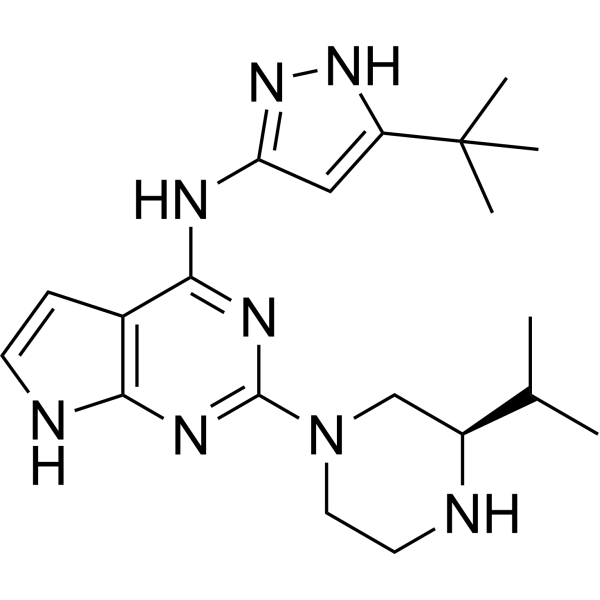
Spastazoline is a selective spastin (a microtubule-severing AAA protein) inhibitor, with an IC50 of 99 nM for Human spastin. Spastazoline can be used for cell division- and intracellular vesicle transport-related research.
For research use only. We do not sell to patients.
- Purity : 98.50%
- CAS No.: 2351882-11-4
- Formula: C20H30N8
- Molecular Weight:382.51
-
Storage:Powder -20°C, 3 years , 4°C, 2 years ; In solvent -80°C, 2 years , -20°C, 1 year

To place orders, for customer services and technical support, please contact: MedChemExpress USA
Tel: 609-228-6898 E-mail: [email protected] [email protected]


-
 Biological Activity
-
Chemical Information
-
Solvent & Solubility
- Protocols
- Purity & Documentation
- References
-
 Help & FAQs


-
HY-100947
VH-298VHL:HIF-α Interaction Inhibitor -
HY-107425
MZ 1PROTAC BRD4 Degrader -
HY-120217
VH032VHL Ligand -
HY-145319
FPFT-2216IKZF1 IKZF3 CK-1α PDE6D CRBN Degrader -

HY-B1506A
Acepromazine maleateAlpha-Adrenoceptor Antagonist -
HY-132296
GSK215PROTAC FAK Degrader -
HY-18340A
(R)-CR8 trihydrochloride -
HY-123109
(S,R,S)-AHPC-Boc
Publications Citing Use of MedChemExpress (MCE) Spastazoline
More

Biological Activity
Description
IC50 & Target
IC50: 99 nM (Human spastin)[1]
In Vitro
Spastazoline (10 μM; 4.5 h) affects division of HeLa cells by increasing the number of HeLa cells with intercellular bridges[1].
MedChemExpress (MCE) has not independently confirmed the accuracy of these methods. They are for reference only. Further protocols information, click here.


Chemical Information
-
CAS No. 2351882-11-4
-
Appearance Solid
-
Molecular Weight 382.51
-
Formula C20H30N8
-
Color Off-white to gray
-
SMILES
CC(C)(C)C1=CC(NC2=NC(N3CCN[C@H](C(C)C)C3)=NC4=C2C=CN4)=NN1
-
Shipping
Room temperature in continental US; may vary elsewhere.
-
Storage
Powder -20°C 3 years 4°C 2 years In solvent -80°C 2 years -20°C 1 year


Publications (4)
-
Journal Impact Factor
-
Most Recent
-
Eur J Neurol
New cellular imaging-based method to distinguish SPG4 subtype of Hereditary Spastic Paraplegia. [Abstract]2023 Jun;30(6):1734-1744. PMID: 36815539 -
Life Sci Alliance
Reticulon-1 synthesis controls outgrowth and microtubule dynamics in injured cortical axons. [Abstract]2026 Jan 16;9(4):e202503571. PMID: 41545196 -
-


Solvent & Solubility
In Vitro:
DMSO : 100 mg/mL (261.43 mM; Need ultrasonic; Hygroscopic DMSO has a significant impact on the solubility of product, please use newly opened DMSO)
Please refer to the solubility information to select the appropriate solvent. Once prepared, please aliquot and store the solution to prevent product inactivation from repeated freeze-thaw cycles.
Storage method and period of stock solution: -80°C, 2 years; -20°C, 1 year. When stored at -80°C, please use it within 2 years. When stored at -20°C, please use it within 1 year.
Please refer to the solubility information to select the appropriate solvent. Once prepared, please aliquot and store the solution to prevent product inactivation from repeated freeze-thaw cycles.
Storage method and period of stock solution: -80°C, 2 years; -20°C, 1 year. When stored at -80°C, please use it within 2 years. When stored at -20°C, please use it within 1 year.
Concentration (start) × Volume (start) = Concentration (final) × Volume (final)
In Vivo:
Select the appropriate dissolution method based on your experimental animal and administration route.
- For the following dissolution methods, please ensure to first prepare a clear stock solution using an In Vitro approach and then sequentially add co-solvents:
- To ensure reliable experimental results, the clarified stock solution can be appropriately stored based on storage conditions. As for the working solution for In Vivo experiments, it is recommended to prepare freshly and use it on the same day.
- The percentages shown for the solvents indicate their volumetric ratio in the final prepared solution. If precipitation or phase separation occurs during preparation, heat and/or sonication can be used to aid dissolution.
Add each solvent one by one: 10% DMSO 40% PEG300 5% Tween-80 45% Saline
Solubility: ≥ 5.25 mg/mL (13.73 mM); Clear solution
This protocol yields a clear solution of ≥ 5.25 mg/mL (saturation unknown).
Taking 1 mL working solution as an example, add 100 μL DMSO stock solution (52.5 mg/mL) to 400 μL PEG300, and mix evenly; then add 50 μL Tween-80 and mix evenly; then add 450 μL Saline to adjust the volume to 1 mL.
Preparation of Saline: Dissolve 0.9 g sodium chloride in ddH₂O and dilute to 100 mL to obtain a clear Saline solution.
Add each solvent one by one: 10% DMSO 90% (20% SBE-β-CD in Saline)
Solubility: ≥ 5.25 mg/mL (13.73 mM); Clear solution
This protocol yields a clear solution of ≥ 5.25 mg/mL (saturation unknown).
Taking 1 mL working solution as an example, add 100 μL DMSO stock solution (52.5 mg/mL) to 900 μL 20% SBE-β-CD in Saline, and mix evenly.
Preparation of 20% SBE-β-CD in Saline (4°C, storage for one week): 2 g SBE-β-CD powder is dissolved in 10 mL Saline, completely dissolve until clear.
In Vivo Dissolution Calculator
Please enter the basic information of animal experiments:
-
-
-
-
Recommended: Prepare an additional quantity of animals to account for potential losses during experiments.
Please enter your animal formula composition:
-
%DMSO +
Recommended: Keep the proportion of DMSO in working solution below 2% if your animal is weak.
-
%+
-
+%Tween-80 + +
-
%Saline +
The co-solvents required include: DMSO, . All of co-solvents are available by MedChemExpress (MCE). , Tween 80. All of co-solvents are available by MedChemExpress (MCE).
Working solution concentration: 0.22 mg/mL
Method for preparing stock solution: mg drug dissolved in μL DMSO. Stock solution concentration: mg/mL.
1. Take μL DMSO stock solution;
2. Add μL .
μL , mix evenly;
3. Then add μL Tween 80, mix evenly;
4. Then add μL
Please ensure that the stock solution in the first step is dissolved to a clear state, and add co-solvents in sequence. You can use ultrasonic heating (ultrasonic cleaner, recommended frequency 20-40 kHz), vortexing, etc. to assist dissolution.

Protocols
-
Cell Cytotoxicity Assay
Cytotoxicity assays are usually based on the assessment of cell membrane damage, which can also be indirectly detected by measuring cell viability. Detection methods include MTT assay, CKK-8 assay, LDH assay and ATP assay, etc.
-
CFSE Dye Dilution Proliferation Assay
The CFSE (carboxyfluorescein diacetate succinimidyl ester) dye dilution proliferation assay is based on the covalent labeling of intracellular proteins by a cell-permeant fluorescent dye that becomes fluorescent upon intracellular ester cleavage and then is stably retained within cells. As labeled cells divide, the dye is partitioned equally between daughter cells, resulting in a stepwise halving of fluorescence intensity that can be quantified by flow cytometry to determine the number of cell divisions undergone by each cell population. This fluorescence dilution approach enables quantitative tracking of lymphocyte proliferation at the single-cell level over multiple rounds of division. CFSE-based proliferation analysis has been widely applied to measure antigen-driven lymphocyte expansion in vitro, where discrete fluorescence peaks correspond to successive cell divisions and allow reconstruction of proliferative history within heterogeneous populations.
-
Dye-dilution cell tracking and proliferation staining
Dye-dilution cell tracking assays quantify cell proliferation by covalently labeling intracellular proteins with a stable fluorescent dye that is equally partitioned between daughter cells during mitosis, resulting in stepwise halving of fluorescence intensity with each cell division as measured by flow cytometry histograms. Carboxyfluorescein diacetate succinimidyl ester (CFSE) is a prototypical dye that diffuses into cells, is enzymatically converted into a fluorescent compound, and then covalently binds intracellular amine groups, producing long-lived fluorescence suitable for tracking multiple rounds of division in vitro and in vivo. Successive generations of dividing cells form discrete peaks of decreasing fluorescence intensity, enabling estimation of proliferation history, precursor frequency, and division index within heterogeneous populations. Alternative dyes such as CellTrace Violet (CTV) and far-red membrane dyes (e. g. , PKH26) follow the same dilution principle but differ


Purity & Documentation
-
Data Sheet (277 KB)
-
SDS (393 KB)
- English - EN (393 KB)
- Français - FR (393 KB)
- Deutsch - DE (393 KB)
- Norwegian - NO (393 KB)
- Español - ES (393 KB)
- Swedish - SV (393 KB)
- Italian - IT (393 KB)
- Korean - KR (393 KB)
- Portuguese - PT (393 KB)
-
Handling Instructions (2659 KB)
References


Complete Stock Solution Preparation Table
Please refer to the solubility information to select the appropriate solvent. Once prepared, please aliquot and store the solution to prevent product inactivation from repeated freeze-thaw cycles.
Storage method and period of stock solution: -80°C, 2 years; -20°C, 1 year. When stored at -80°C, please use it within 2 years. When stored at -20°C, please use it within 1 year.
| Optional Solvent | Concentration Solvent Mass | 1 mg | 5 mg | 10 mg | 25 mg |
|---|---|---|---|---|---|
| DMSO | 1 mM | 2.6143 mL | 13.0716 mL | 26.1431 mL | 65.3578 mL |
| 5 mM | 0.5229 mL | 2.6143 mL | 5.2286 mL | 13.0716 mL | |
| 10 mM | 0.2614 mL | 1.3072 mL | 2.6143 mL | 6.5358 mL | |
| 15 mM | 0.1743 mL | 0.8714 mL | 1.7429 mL | 4.3572 mL | |
| 20 mM | 0.1307 mL | 0.6536 mL | 1.3072 mL | 3.2679 mL | |
| 25 mM | 0.1046 mL | 0.5229 mL | 1.0457 mL | 2.6143 mL | |
| 30 mM | 0.0871 mL | 0.4357 mL | 0.8714 mL | 2.1786 mL | |
| 40 mM | 0.0654 mL | 0.3268 mL | 0.6536 mL | 1.6339 mL | |
| 50 mM | 0.0523 mL | 0.2614 mL | 0.5229 mL | 1.3072 mL | |
| 60 mM | 0.0436 mL | 0.2179 mL | 0.4357 mL | 1.0893 mL | |
| 80 mM | 0.0327 mL | 0.1634 mL | 0.3268 mL | 0.8170 mL | |
| 100 mM | 0.0261 mL | 0.1307 mL | 0.2614 mL | 0.6536 mL |


Spastazoline Related Classifications
HY-111548 Related Classifications
 Powered by Bioz