



Speract
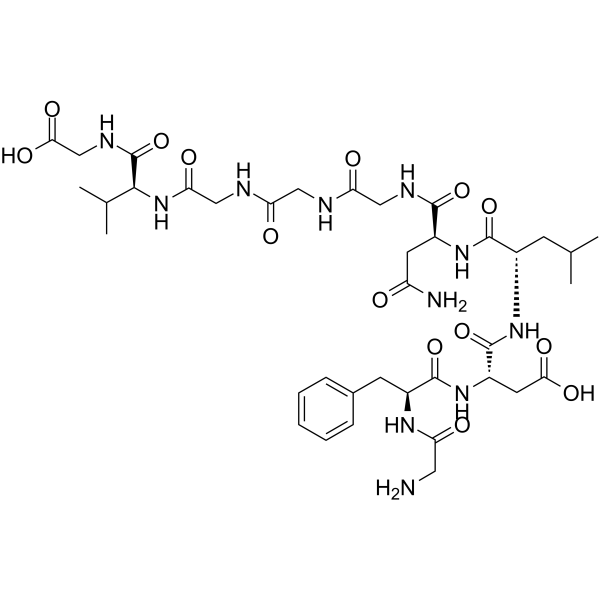
Speract, a sea urchin egg peptide that regulates sperm motility, also stimulates sperm mitochondrial metabolism.
For research use only. We do not sell to patients.
- CAS No.: 76901-59-2
- Formula: C38H57N11O14
- Molecular Weight:891.92
-
Storage:
Please store the product under the recommended conditions in the Certificate of Analysis.

To place orders, for customer services and technical support, please contact: MedChemExpress USA
Tel: 609-228-6898 E-mail: [email protected] [email protected]


-
 Biological Activity
-
Chemical Information
- Protocols
- Purity & Documentation
- References
-
 Help & FAQs




Biological Activity
Description
In Vitro
Speract is a decapeptide from the outer jelly layer of theStrongylocentrotus purpuratus egg that upon binding to its receptor in the sperm, stimulates sperm motility, respiration and ion fluxes, among other physiological events. Speract increases NADH levels and depolarizes the sea urchin sperm mitochondrion[1].
MedChemExpress (MCE) has not independently confirmed the accuracy of these methods. They are for reference only. Further protocols information, click here.


Chemical Information
-
CAS No. 76901-59-2
-
Molecular Weight 891.92
-
Formula C38H57N11O14
-
Sequence
Gly-Phe-Asp-Leu-Asn-Gly-Gly-Gly-Val-Gly
-
Sequence Shortening
GFDLNGGGVG
-
Shipping
Room temperature in continental US; may vary elsewhere.
-
Storage
Please store the product under the recommended conditions in the Certificate of Analysis.

Protocols
-
Sperm Thawing for Functional Recovery
Sperm thawing for functional recovery is a post-cryopreservation procedure designed to restore and measure sperm motility, viability, membrane/acrosome integrity, DNA integrity, and usable motile sperm yield after freezing-induced injury; published human studies show that cryopreservation reduces motility and viability and can damage the plasmalemma, acrosome, tail, and DNA integrity. The experimental readout is generated by comparing post-thaw motility recovery, viability, acrosomal status, DNA integrity, and recovered motile sperm after thawing and optional sperm-selection steps; thawing at 40°C improved motility recovery compared with 20-37°C without significant differences in viability, ATP content, acrosomal status, or DNA integrity in one human donor-semen study.


Purity & Documentation
References

Calculators
Concentration (start) × Volume (start) = Concentration (final) × Volume (final)


Speract Related Classifications
HY-P0245 Related Classifications
 Powered by Bioz