



EAAT
Excitatory amino acid transporter ; Glutamate transporter;
Excitatory amino acid transporters or EAATs are the major transport mechanism for extracellular glutamate in the nervous system. This family of five carriers (EAAT1-5 ) not only displays an impressive ability to regulate ambient extracellular glu concentrations but also regulate the temporal and spatial profile of glu after vesicular release. This dynamic form of regulation mediates several characteristic of synaptic, perisynaptic, and spillover activation of ionotropic and metabotropic receptors. EAATs function through a secondary active, electrogenic process but also possess a thermodynamically uncoupled ligand gated anion channel activity, both of which have been demonstrated to play a role in regulation of cellular activity.
The glial glutamate transporter EAAT2 plays a major role in glutamate clearance. EAAT2 can be upregulated by transcriptional or translational activation.EAAT2 is a potential target for the prevention of excitotoxicity.
EAAT Isoform Specific Products
All Product Categories
-
EAAT Related Products (51)
Related Products (51)

-
Antibodies (3)
-
EAAT Isoform Comparison
-
QBS10072S dihydrochloride
 0 ImagesCat. No.: HY-164401ACAS No.: 1802735-31-4QBS10072S dihydrochloride is a LAT1-selective substrate with blood-brain barrier permeability that inhibits tumor growth. QBS10072S dihydrochloride enters LAT1-expressing tumor cells via LAT1-mediated active transport, induces interstrand DNA cross-linking and cell apoptosis, and reduces leptomeningeal dissemination. QBS10072S dihydrochloride can be used in studies related to glioblastoma multiforme, diffuse intrinsic pontine glioma, triple-negative breast cancer brain metastases, and aggressive T-cell lymphoma.
-
(±)-threo-3-Methylglutamic acid
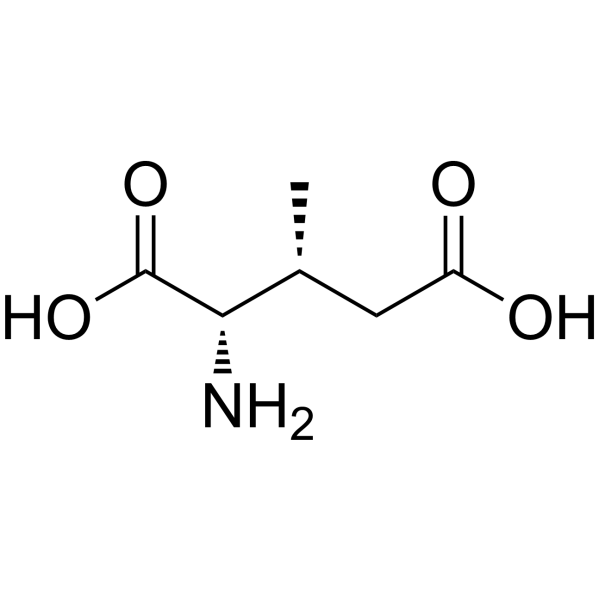 0 ImagesCat. No.: HY-101227CAS No.: 63088-04-0(±)-threo-3-Methylglutamic acid is a potent EAAT2/4 inhibitor. (±)-threo-3-Methylglutamic acid also is an ionotropic glutamate receptor agonist. (±)-threo-3-Methylglutamic acid inhibits glutamate uptake by rod outer segments.
-
Anti-Mouse Delta-like protein 1/DLL1 Antibody (HMD1-5)
 0 ImagesCat. No.: HY-P990253Anti-Mouse Delta-like protein 1/DLL1 Antibody (HMD1-5) is an anti-mouse Delta-like protein 1/DLL1 IgG monoclonal antibody. Anti-Mouse Delta-like protein 1/DLL1 Antibody (HMD1-5) can reverse the inhibition of Treg cells. Anti-Mouse Delta-like protein 1/DLL1 Antibody (HMD1-5) can inhibit the upregulation of GLT-1 expression induced by endothelial cells. Anti-Mouse Delta-like protein 1/DLL1 Antibody (HMD1-5) reduces autoimmune response by reducing B cell activation. Anti-Mouse Delta-like protein 1/DLL1 Antibody (HMD1-5) can be used for research on inflammation conditions such as lupus nephritis.
-
Dihydrokainic acid (Standard)
 0 ImagesCat. No.: HY-100784RCAS No.: 52497-36-6Dihydrokainic acid (Standard) is the analytical standard of Dihydrokainic acid. This product is intended for research and analytical applications. Dihydrokainic acid (DHK) is a glutamate transporter GLT1 (EAAT2) inhibitor. Dihydrokainic acid impairs novel object recognition (NOR) memory performance in mice. Dihydrokainic acid also shows epileptogenic effects.
-
(±)-HIP-A
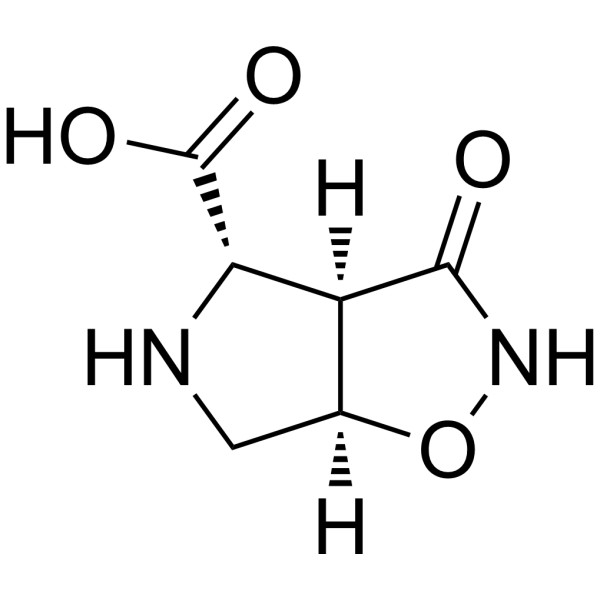 0 ImagesCat. No.: HY-107525CAS No.: 227619-64-9(±)-HIP-A is a non-competitive excitatory amino acid transporter (EAAT) blocker that effectively blocks Glu uptake (IC50=17-18 μM). (±)-HIP-A is also a lead compound against ischemia-induced neuronal degeneration. (±)-HIP-A can be used in the study of neurological diseases.
-
UCPH-101 (Standard)
 0 ImagesCat. No.: HY-10914RCAS No.: 1118460-77-7
-
EAAT2 activator 2
 0 ImagesCat. No.: HY-175296EAAT2 activator 2 (Compound 4(SF-2)) is a brain-penetrant excitatory amino acid transporter 2 (EAAT2) modulator (Ki=28.7 nM). EAAT2 activator 2 enhances EAAT2-mediated glutamate uptake, improving synaptic glutamate clearance. EAAT2 activator 2 is promising for research of neurodegenerative diseases (e.g., ALS, Alzheimer’s disease) .
-
Cefadroxil-13C6
 0 ImagesCat. No.: HY-B1190S2Synonyms: BL-S 578-13C6Cefadroxil-13C6 (BL-S 578-13C6) is 13C labeled Cefadroxil (HY-B1190). Cefadroxil is an orally active broad-spectrum cephalosporin antibiotic. Cefadroxil inhibits bacterial cell wall synthesis and enhances the expression of glutamate transporter-1. Cefadroxil is dependent on the intestinal peptide transporter PepT1 for small intestinal absorption. Cefadroxil has inhibitory and bactericidal activity against a variety of Gram-positive and Gram-negative bacteria and has analgesic effects on neuropathic pain.
-
WAY-213613 hydrochloride (Standard)
 0 ImagesCat. No.: HY-107523ARCAS No.: 2450268-84-3WAY-213613 hydrochloride (Standard) is the analytical standard of WAY-213613 (hydrochloride) (HY-107523A). This product is intended for research and analytical applications. WAY-213613 (hydrochloride) is a potent and selective human EAAT2 inhibitor. WAY-213613 has potent EAAT2 inhibitory activity with an IC50 value of 85 nM. WAY-213613 can be used for the research of central nervous system.
-
TAOA AM Ester trimethyl lock
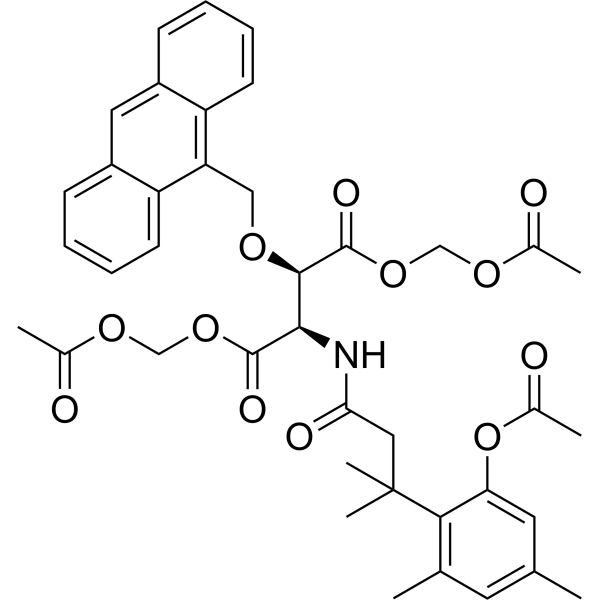 0 ImagesCat. No.: HY-161062TAOA AM Ester trimethyl lock is a high-affinity fluorescent prodrug-like inhibitor of the excitatory amino acid transporter (EAAT). It can penetrate the cell membrane and be activated by hydrolysis by endogenous cell esterases to form active EAAT inhibitors. TAOA AM Ester trimethyl lock can be used to study neurodegeneration and neuronal cell death.
-
SYM 2081 (Standard)
 0 ImagesCat. No.: HY-101310RCAS No.: 31137-74-3SYM 2081 (Standard) is the analytical standard of SYM 2081 (HY-101310). This product is intended for research and analytical applications. SYM 2081 is a kainate receptor agonist. SYM 2081 is a substrate of EAAT1 (Km of 54 μM). SYM 2081 inhibits EAAT2-mediated glutamate transport (Kb is 3.4 μM in Xenopus oocytes), modulates Apoptotic signaling pathways (increases Bcl-2 and decreases Bax/caspase-3 expression). SYM 2081 exhibits neuroprotective activity. SYM 2081 can be used in the study of hypoxic-ischemic brain damage and inflammatory or neuropathic pain.




