



HIV
Human immunodeficiency virus
HIV (Human immunodeficiency virus) is a lentivirus (a subgroup of retrovirus) that causes the acquired immunodeficiency syndrome (AIDS), a condition in humans in which progressive failure of the immune system allows life-threatening opportunistic infections and cancers to thrive. Infection with HIV occurs by the transfer of blood, semen, vaginal fluid, pre-ejaculate, or breast milk. Within these bodily fluids, HIV is present as both free virus particles and virus within infected immune cells. HIV infects vital cells in the human immune system such as helper T cells (specifically CD4+ T cells), macrophages, and dendritic cells. HIV infection leads to low levels of CD4+ T cells through a number of mechanisms, including apoptosis of uninfected bystander cells, direct viral killing of infected cells, and killing of infected CD4+ T cells by CD8 cytotoxic lymphocytes that recognize infected cells. When CD4+ T cell numbers decline below a critical level, cell-mediated immunity is lost, and the body becomes progressively more susceptible to opportunistic infections.
HIV Isoform Specific Products
All Product Categories
-
HIV Inhibitors
(1218)
View all products
-
HIV Antagonists
(4)
View all products
-
HIV Activators
(19)
View all products
-
HIV Modulator
(1)
View all products
-
HIV Inducers
(2)
View all products
-
HIV Degrader
(1)
View all products
-
HIV Controls
(4)
View all products
-
HIV Ligand
(1)
View all products
-
HIV Proteins
(27)
View all products
-
HIV Related Products (1390)
Related Products (1390)

-
Recombinant Proteins (27)
-
Antibodies (6)
-
HIV Isoform Comparison
-
HIV-IN petide
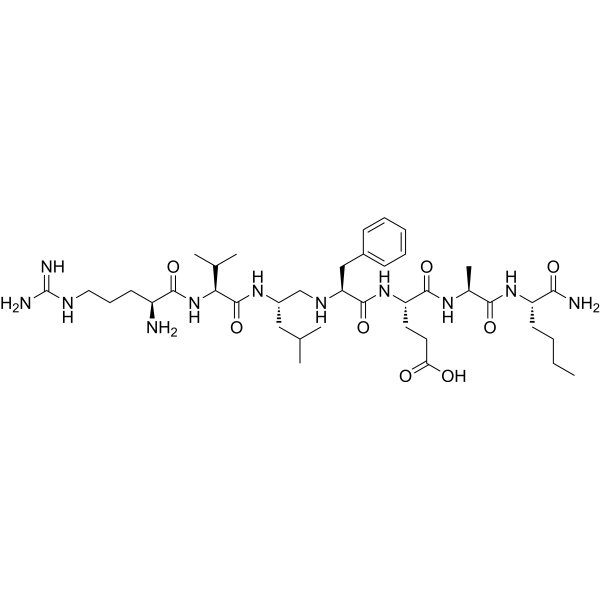 0 ImagesCat. No.: HY-P4543CAS No.: 167875-35-6
-
HIV-1-IN-94
 0 ImagesCat. No.: HY-184700CAS No.: 3124729-94-5HIV-1-IN-94 is a dual inhibitor of HIV-1 integrase (INST) and reverse transcriptase RNase H, with IC50 values of 12 μM and 0.11 μM, respectively. HIV-1-IN-94 inhibits HIV-1 replication with low cytotoxicity. HIV-1-IN-94 can be used in studies related to HIV-1 infection.

-
Droxinavir
 0 ImagesCat. No.: HY-125494ACAS No.: 159910-86-8Synonyms: SC-55389A free baseDroxinavir (SC-55389A free base) is an HIV-1 protease inhibitor. Droxinavir binds to the S2 and S2' subsites of HIV-1 protease, and this interaction is regulated by protease amino acid residue 88, where the N88S mutation confers viral resistance. Droxinavir can be used in studies related to human immunodeficiency virus type 1 infection.
-
Trigonelline-d3-1 chloride
 0 ImagesCat. No.: HY-N0415S1Synonyms: Trigonelline-d3-1 hydrochlorideTrigonelline-d3-1 chloride (Trigonelline-d3-1 hydrochloride) is the deuterium labeled Trigonelline chloride (HY-N0415). Trigonelline chloride is an alkaloid with potential antidiabetic activity that can be isolated from Trigonella foenum-graecum L or Leonurus artemisia. Trigonelline chloride is a potent Nrf2 inhibitor that blocks Nrf2-dependent proteasome activity, thereby enhancing apoptosis in pancreatic cancer cells. Trigonelline chloride also has anti-HSV-1, antibacterial, and antifungal activity, and induces ferroptosis.
-
KRL74
 0 ImagesCat. No.: HY-P10845CAS No.: 2423969-43-9KRL74 is a cyclic peptide inhibitor for interaction between the p6 domain of the HIV Gag protein and the UEV domain of the human TSG101 protein(p6/UEV) with an IC50 of 5.44 μM and a Kd of 11.9 μM. KRL74 inhibits the budding process of HIV from host cells with an IC50 of 2 μM in virus-like particle (VLP) budding assay.
-
Etravirine-13C3
 0 ImagesCat. No.: HY-W777351CAS No.: 1189671-48-4Synonyms: R165335-13C3; TMC125-13C3Etravirine-13C3 (R165335-13C3) is the 13C-labeled Etravirine (HY-90005). Etravirine (R165335; TMC125) is a non-nucleoside reverse transcriptase inhibitor (NNRTI) used for the treatment of HIV.
-
L-739594
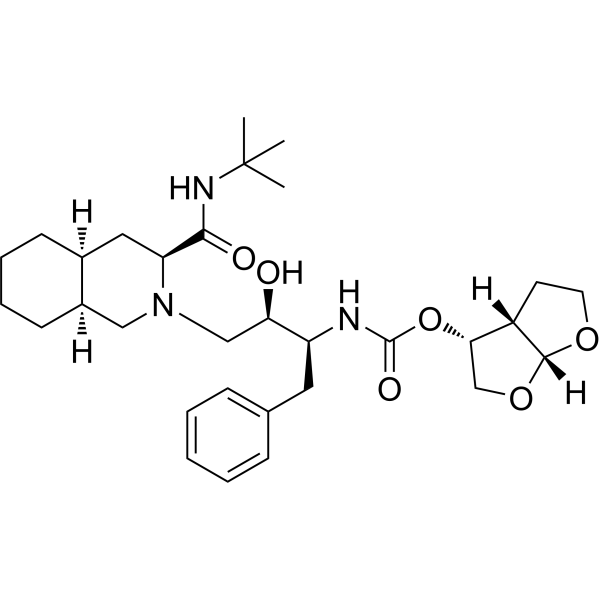 0 ImagesCat. No.: HY-118057CAS No.: 156879-13-9L-739594 is a HIV-1 protease inhibitor, with an IC50 of 1.8 nM.
-
a-D-Galactose-1,2-13C2 1-phosphate potassium
 0 ImagesCat. No.: HY-W768245a-D-Galactose-1,2-13C2 1-phosphate potassium is the 13C- and 15N-labeled a-D-Galactose (HY-121370). α-D-Galactose is a non-starch polysaccharide found in the bulb tissues of Lilium davidii var. unicolor Salisb. α-D-Galactose has anti-oxidation properties, anti-tumour activities, immunomodulatory effects and anti-HIV functions.
-
Dioxolane T
 0 ImagesCat. No.: HY-107082CAS No.: 136982-89-3Dioxolane T is a nucleoside analogue. Dioxolane T exhibits anti-HIV activity.
-
Dapivirine-d11
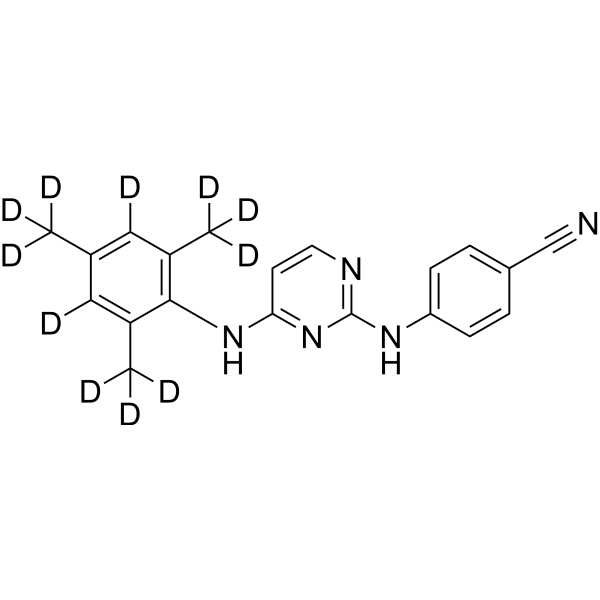 0 ImagesCat. No.: HY-14266SCAS No.: 1329613-10-6Synonyms: TMC120-d11; R147681-d11Dapivirine-d11 is the deuterium labeled Dapivirine. Dapivirine (TMC120), the prototype of diarylpyrimidines (DAPY), is an orally active and nonnucleoside reverse transcriptase inhibitor (NRTI). Dapivirine (TMC120) binds directly to HIV-1 reverse transcriptase. Dapivirine (TMC120) regulates autophagy and induced Akt, Bad and SAPK/JNK activations.
-
Tifuvirtide
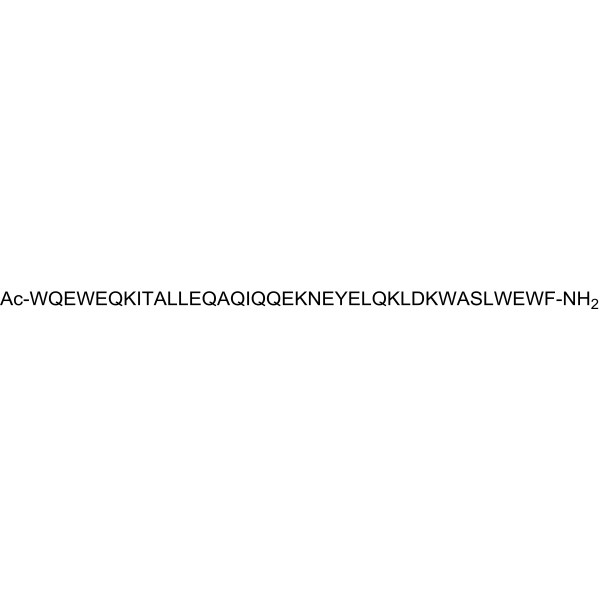 0 ImagesCat. No.: HY-P35433CAS No.: 251562-00-2Synonyms: T-1249
-
CHMA1004
 0 ImagesCat. No.: HY-W125425CAS No.: 2758-98-7Synonyms: Methyl piperazine-2-carboxylate; METTL3 activator-1 free baseCHMA1004 (Methyl piperazine-2-carboxylate; METTL3 activator-1 free base) is a METTL3/METTL14/WTAP methyltransferase complex activator. CHMA1004 exhibits neuroprotective and anxiolytic potential by enhancing m6A methylation modification of RNA. CHMA1004 promotes HIV replication in an infection context. CHMA1004 can be used in studies related to anxiety disorders and HIV-1 infection.
-
(-)-Lentiginosine
 0 ImagesCat. No.: HY-117910CAS No.: 125279-72-3(-)-Lentiginosine is a compound that can be obtained by a specific synthetic method.
-
3-Oxobetulin acetate
 0 ImagesCat. No.: HY-139090CAS No.: 136587-07-0Synonyms: 28-O-Acetyl-3-Oxobetulin; 3-oxo-28-O-Acetylbetulin3-Oxobetulin acetate (28-O-Acetyl-3-Oxobetulin; 3-oxo-28-O-Acetylbetulin) is a derivative of betulin (HY-N0083), a cholesterol biosynthesis inhibitor. 3-Oxobetulin acetate inhibits the growth of P388 murine lymphocytic leukemia cells (EC50=0.12 μg/mL) and human MCF-7 breast cancer, SF-268 CNS cancer, H460 lung cancer, and KM20L2 colon cancer cells (GI50s=8, 10.6, 5.2, and 12.7 μg/mL), but not BxPC-3 pancreatic cancer cells or DU145 prostate cancer cells (GI50s=>10 μg/mL for both). 3-Oxobetulin acetate inhibits the replication of X4-tropic recombinant HIV (NL4.3-Ren) in MT-2 lymphoblastoid cells (IC50=13.4 μM). 3-Oxobetulin acetate is also effective against Listeria donovani amastigotes.
-
HIV gag peptide (197-205)
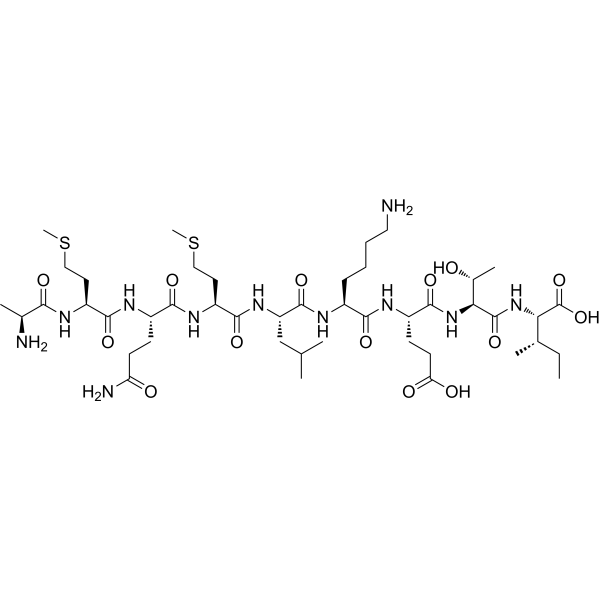 0 ImagesCat. No.: HY-P1885CAS No.: 214978-47-9HIV gag peptide (197-205) is a H-2Kd-restricted epitope derived from the p24 portion of the HIV-1 gag protein, consists of amino acids 197-205 (AMQMLKETI).
-
Zintevir sodium
 0 ImagesCat. No.: HY-177670ASynonyms: AR177 sodium; T30177 sodiumZintevir sodium is an antisense oligonucleotide that targets HIV-1 integrase.
-
FGI-1011A6
 0 ImagesCat. No.: HY-P991414FGI-1011A6 is a human monoclonal antibody (mAb) targeting TSG101. FGI-1011A6 can be used in Prostate cancer and Viral infections research.




