



Thrombin Activator
- 1

-
Fitusiran
 0 ImagesSynonyms: ALN-AT3SC; SAR439774
Fitusiran (ALN-AT3SC) is a siRNA strategy. Fitusiran delivers siRNA targeting the SERPINC1 gene in hepatocytes to inhibit antithrombin synthesis. Fitusiran enhances thrombin activity and increases Thrombin generation, thereby restoring hemostatic function. Fitusiran can be used in hemophilia-related research.
-
Fitusiran sodium
 0 ImagesCat. No.: HY-132587ASynonyms: ALN-AT3SC sodium; SAR439774 sodium
Fitusiran (ALN-AT3SC) sodium is a siRNA strategy. Fitusiran delivers siRNA targeting the SERPINC1 gene in hepatocytes to inhibit antithrombin synthesis. Fitusiran sodium enhances thrombin activity and increases Thrombin generation, thereby restoring hemostatic function. Fitusiran sodium can be used in hemophilia-related research.
-
Marstacimab
 0 ImagesCat. No.: HY-P99725CAS No.: 1985638-39-8Synonyms: PF-06741086
Marstacimab (PF-06741086) is an anti-tissue factor pathway inhibitor (TFPI) monoclonal antibody. Marstacimab can be used for the research of hemophilia.
-
Human α-Thrombin (Lyophilized)
 0 ImagesCat. No.: HY-114164HCAS No.: 9002-04-4Synonyms: EC 3.4.21.5 (Lyophilized); Human Alpha Thrombin (Lyophilized)
Human α-Thrombin (EC 3.4.21.5; Human Alpha Thrombin) (Lyophilized) is a terminal serine protease in the coagulation cascade, as well as a potent physiological platelet agonist and fibrin-generating enzyme in vivo. Human α-Thrombin catalyzes the conversion of fibrinogen to fibrin for blood clot formation, and activates platelet aggregation by cleaving the protease-activated receptors PAR1 (major) (Kd = 1 nM) and PAR4 (minor) on the platelet surface to expose tethered ligands. Human α-Thrombin also amplifies coagulation via positive feedback by activating coagulation factors V, VIII, XI (FV/FVIII/FXI), and switches to activate protein C to exert anticoagulant effects after binding to thrombomodulin.
This product is in a freeze-dried form.
-
Sutacimig
 0 ImagesSynonyms: HMB-001
Sutacimig (HMB-001) is a humanized antibody of the (H-γ4_L-κ)_(H-γ4_L-κ) format that targets FⅦa/TREML1. One arm of Sutacimig binds to endogenous FVIIa, thereby prolonging the half-life of FVIIa and increasing its accumulation in the bloodstream, while the other arm binds to TLT-1, which is exclusively expressed on the surface of activated platelets. This localizes endogenous FVIIa to activated platelets, further enhancing the activity of FVIIa. Sutacimig enhances Thrombin generation, fibrin formation, and the formation of stable fibrin-platelet networks at sites of vascular injury. Sutacimig can be used in studies related to Glanzmann thrombasthenia.
-
Idarucizumab
 0 ImagesCat. No.: HY-108739CAS No.: 1362509-93-0Synonyms: BI 655075
Idarucizumab is a humanized monoclonal antibody fragment. Idarucizumab is first reversal agent for a direct oral anticoagulant (DOAC). Idarucizumab can specifically neutralize the effects of the oral direct thrombin inhibitor in order to restore hemostasis.
-
FAM labled Fitusiran sodium
 0 ImagesCat. No.: HY-132587D
FAM labled Fitusiran sodiumis a FAM labled Fitusiran sodium (HY-132587A). Fitusiran (ALN-AT3SC) sodium is a siRNA strategy. Fitusiran delivers siRNA targeting the SERPINC1 gene in hepatocytes to inhibit antithrombin synthesis. Fitusiran sodium enhances thrombin activity and increases Thrombin generation, thereby restoring hemostatic function. Fitusiran sodium can be used in hemophilia-related research.
-
Cy3 labled Fitusiran sodium
 0 ImagesCat. No.: HY-132587E
Cy3 labled Fitusiran sodium is a Cy3 labled Fitusiran sodium (HY-132587A). Fitusiran (ALN-AT3SC) sodium is a siRNA strategy. Fitusiran delivers siRNA targeting the SERPINC1 gene in hepatocytes to inhibit antithrombin synthesis. Fitusiran sodium enhances thrombin activity and increases Thrombin generation, thereby restoring hemostatic function. Fitusiran sodium can be used in hemophilia-related research.
-
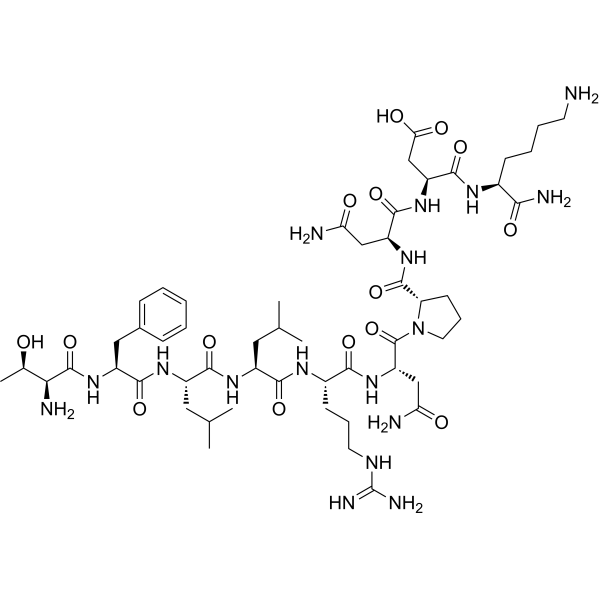
TFLLRNPNDK-NH2
 0 ImagesCat. No.: HY-P5371CAS No.: 145229-90-9
TFLLRNPNDK-NH2 is a biological active peptide. (This peptide is a thrombin receptor activating peptide. This PAR-1 agonist peptide reversibly binds to PAR-1 mimicking the 'tethered ligand' that thrombin makes available through proteolytic cleavage of substrate. It is also known to cause increase in liquid and protein permeability much like thrombin.)
-
Fitusiran sodium scrambled negative control
 0 ImagesCat. No.: HY-132587C
Fitusiran sodium scrambled negative control is the sequence scrambled negative control of Fitusiran sodium. Fitusiran (ALN-AT3SC) sodium is a siRNA strategy. Fitusiran delivers siRNA targeting the SERPINC1 gene in hepatocytes to inhibit antithrombin synthesis. Fitusiran sodium enhances thrombin activity and increases Thrombin generation, thereby restoring hemostatic function. Fitusiran sodium can be used in hemophilia-related research.
- 1



