



HCAR3
HCAR3 (hydroxycarboxylic acid receptor 3; also known as GPR109B) is a metabolite-sensing G protein-coupled receptor within the hydroxycarboxylic acid receptor family and functions through inhibitory Gi/o-protein signaling pathways that couple metabolic status to cellular responses[1][2]. Mechanistically, activated HCAR3 can engage phospholipase C-dependent protein kinase C signaling and matrix metalloproteinase-mediated epidermal growth factor receptor transactivation, leading to activation of MAP kinase cascades and downstream cellular regulatory programs[3]. As a receptor for hydroxycarboxylic acid metabolites, HCAR3 participates in metabolic sensing processes that are linked to the regulation of lipid metabolism and cellular adaptation to changes in energy metabolism[1][4]. Experimental studies further indicate that HCAR3 regulates epithelial proliferation, migration, and cellular respiration, supporting its utility as a model for investigating metabolite-driven signaling networks and tissue responses[5]. In disease-related contexts, HCAR3 has been proposed as a potential pharmacological target in inflammatory disorders and has also been implicated through genetic and functional studies in cancer-associated biological processes[5]. Compared with the closely related isoform HCAR2 (GPR109A), HCAR3 displays distinct ligand recognition properties, including substantially lower affinity for nicotinic acid and unique structural determinants governing ligand selectivity[1][2]. For experimental applications, selective HCAR3 agonists and recently resolved receptor-ligand structures provide valuable tools for dissecting receptor-specific signaling mechanisms and for guiding the development of HCAR3-selective pharmacological probes[2][6].
References:
- [1]. Offermanns S, et al. International Union of Basic and Clinical Pharmacology. LXXXII [Content Brief]
- [2]. Kiros M, et al. Trends in HIV-1 pretreatment drug resistance and HIV-1 variant dynamics among antiretroviral therapy-naive Ethiopians from 2003 to 2018: a pooled sequence analysis. Virol J. 2023 Oct 25;20(1):243. [Content Brief]
- [3]. Ancrenaz V, et al. The paraoxonase-1 pathway is not a major bioactivation pathway of clopidogrel in vitro. Br J Pharmacol. 2012 Aug;166(8):2362-70. [Content Brief]
- [4]. Ahmed K, et al. Biological Roles and Therapeutic Potential of Hydroxy-Carboxylic Acid Receptors. Front Endocrinol. 2011 Oct 25;2011, Volume 21.
- [5]. HCAR3 gene information from NCBI.
- [6]. HCAR3 gene information from NCBI.
- [7]. HCAR3 gene information from NCBI.
- [8]. Ye F, et al. Structures of G-protein coupled receptor HCAR3 in complex with selective agonists reveal the basis for ligand recognition and selectivity. PLoS Biol. 2025 Dec 8;23(12):e3003480. [Content Brief]
All Product Categories
-
HCAR3 Related Products (3)
Related Products (3)

-
3-Hydroxyoctanoic acid
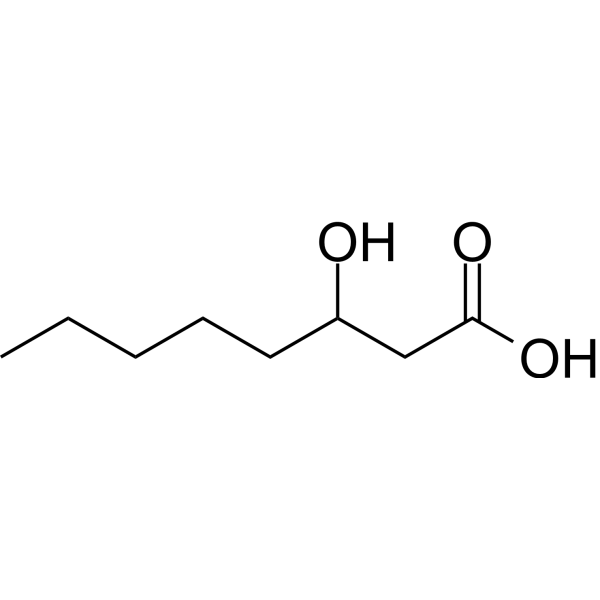 0 Images3-Hydroxyoctanoic acid is a medium-chain β-hydroxy fatty acid that possesses antibacterial, antifungal, and quorum-sensing regulatory activities. 3-Hydroxyoctanoic acid is an endogenous agonist of the human HCAR3 receptor, decreases intracellular cAMP, reduces IL-1beta secretion, increases IL-10 secretion, and decreases ROS production in macrophages. 3-Hydroxyoctanoic acid inhibits quorum-sensing-regulated pyocyanin production in Pseudomonas aeruginosa PAO1 and inhibits the yeast-to-hypha transition in Candida albicans. 3-Hydroxyoctanoic acid is used in research related to metabolism, bacterial infections, and fungal infections.
-
3-Hydroxyoctanoic acid-d12
 0 ImagesCat. No.: HY-W700715CAS No.: 1215622-76-63-Hydroxyoctanoic acid-d12 is the deuterated-labeled 3-Hydroxyoctanoic acid (HY-113058). 3-Hydroxyoctanoic acid is a medium-chain β-hydroxy fatty acid that possesses antibacterial, antifungal, and quorum-sensing regulatory activities. 3-Hydroxyoctanoic acid is an endogenous agonist of the human HCAR3 receptor, decreases intracellular cAMP, reduces IL-1beta secretion, increases IL-10 secretion, and decreases ROS production in macrophages. 3-Hydroxyoctanoic acid inhibits quorum-sensing-regulated pyocyanin production in Pseudomonas aeruginosa PAO1 and inhibits the yeast-to-hypha transition in Candida albicans. 3-Hydroxyoctanoic acid is used in research related to metabolism, bacterial infections, and fungal infections.
-
3-Hydroxyoctanoic acid (Standard)
 0 ImagesCat. No.: HY-113058RCAS No.: 14292-27-43-Hydroxyoctanoic acid (Standard) is the analytical standard of 3-Hydroxyoctanoic acid (HY-113058). This product is intended for research and analytical applications. 3-Hydroxyoctanoic acid is a medium-chain β-hydroxy fatty acid that possesses antibacterial, antifungal, and quorum-sensing regulatory activities. 3-Hydroxyoctanoic acid is an endogenous agonist of the human HCAR3 receptor, decreases intracellular cAMP, reduces IL-1beta secretion, increases IL-10 secretion, and decreases ROS production in macrophages. 3-Hydroxyoctanoic acid inhibits quorum-sensing-regulated pyocyanin production in Pseudomonas aeruginosa PAO1 and inhibits the yeast-to-hypha transition in Candida albicans. 3-Hydroxyoctanoic acid is used in research related to metabolism, bacterial infections, and fungal infections.



