



mAChR5 Agonist
-
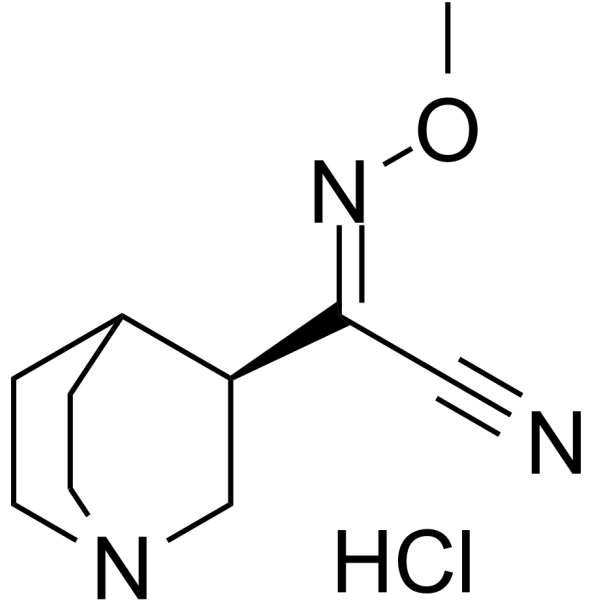
Sabcomeline hydrochloride
 0 Images別名: SB-202026 hydrochloride; Memric hydrochloride
Sabcomeline (SB-202026; Memric) hydrochloride is a muscarinic receptor agonist capable of crossing the blood-brain barrier. Sabcomeline hydrochloride exhibits affinity for all hM1 to hM5 subtypes (pKi=6.72-7.23), and shows near-full agonism at the hM3 receptor, inducing extracellular acidification. Sabcomeline hydrochloride alters the binding kinetics of dopamine D2 receptors through neural network regulation. Sabcomeline hydrochloride also causes minimal cardiovascular changes, effectively reverses spatial memory deficits in rodents and induces conditioned taste aversion. Sabcomeline hydrochloride is an important tool compound in studies of Alzheimer's disease and related neurodegenerative diseases.
-
M1/M4 muscarinic agonist 4
 0 Images製品番号: HY-187957
M1/M4 muscarinic agonist 4 is a dual-site muscarinic acetylcholine receptor ligand with potent agonistic activity at M1/M4 muscarinic acetylcholine receptors. M1/M4 muscarinic agonist 4 activates M1R to induce phosphorylation of ERK1/2, and activates M4R to induce GαoB protein activation as well as ERK1/2 phosphorylation. M1/M4 muscarinic agonist 4 exhibits higher binding affinity for M4R than for other muscarinic receptors, while its binding affinity for the W435A mutant M4R is reduced. M1/M4 muscarinic agonist 4 can be used in the research of schizophrenia.
-
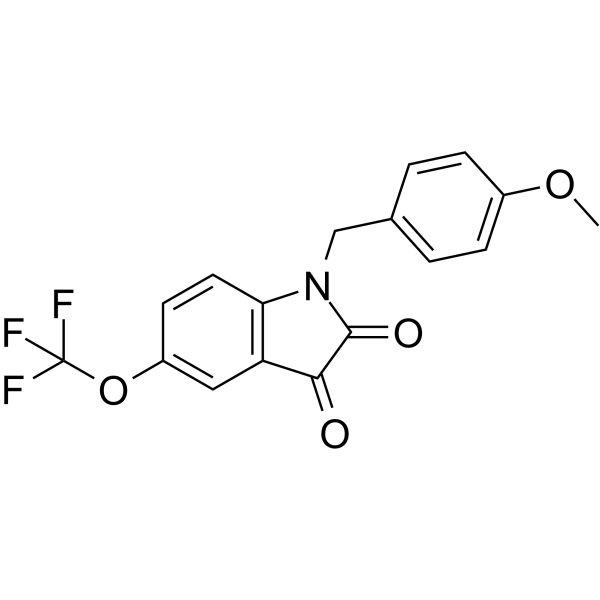
VU 0238429
 0 Images
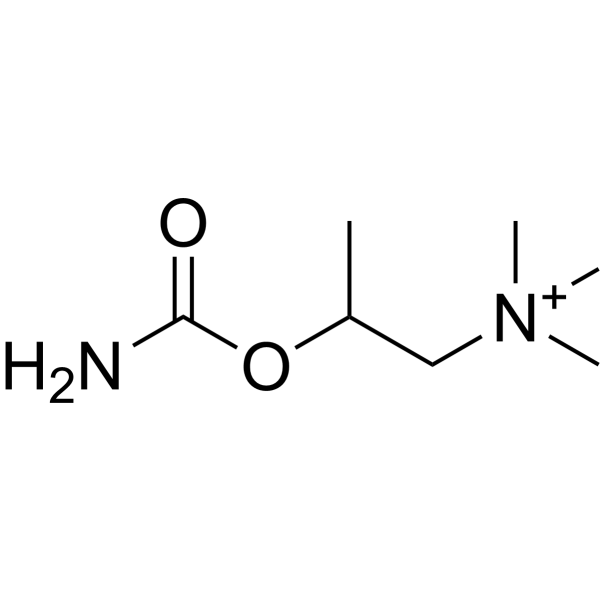
VU 0238429 is positive allosteric modulator of muscarinic acetylcholine receptor subtype 5 (mAChR5 or M5), with an EC50 of 1.16 μM.
-
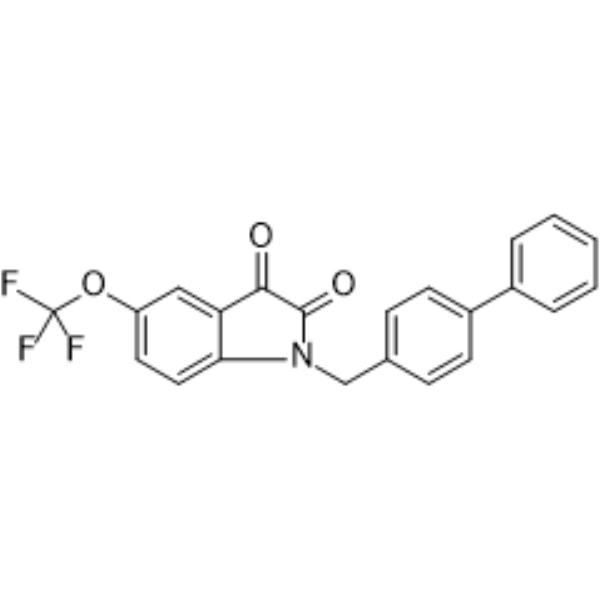
Lu AE51090
 0 Images
Lu AE51090 is selective muscarinic M1 receptor agonist with blood-brain barrier penetration. Lu AE51090 activates human M1 receptor with EC50 of 61 nM, while showing no significant agonism at M2-M5 receptors. Lu AE51090 exerts procognitive effects in mice. Lu AE51090 can be used for the study of Alzheimer’s disease (AD) and cognitive impairment associated with schizophrenia (CIAS).
-
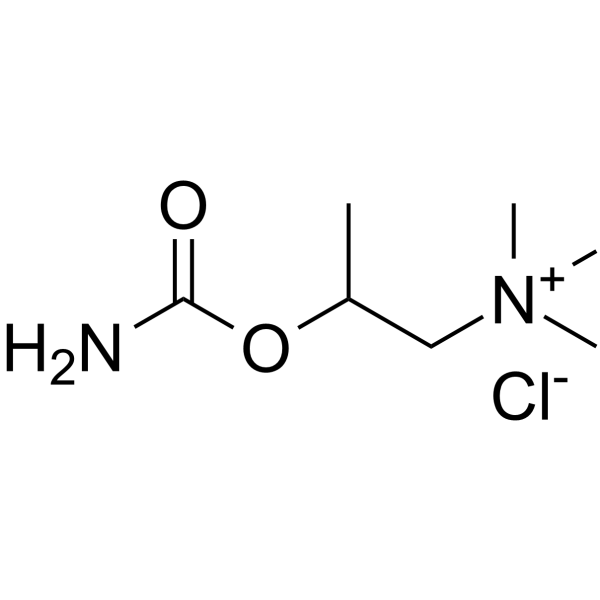
Bethanechol-d6 chloride
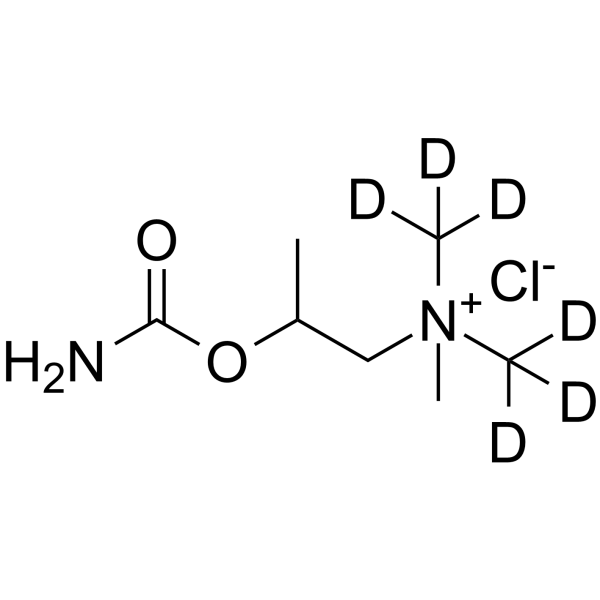 0 Images製品番号: HY-B0406AS別名: Carbamyl-β-methylcholine-d6 chloride
Bethanechol-d6 (chloride) is the deuterium labeled Bethanechol chloride. Bethanechol chloride (Carbamyl-β-methylcholine chloride), a parasympathomimetic agent, is a mAChR agonist that exerts its effects via directly stimulating the mAChR (M1, M2, M3, M4, and M5) of the parasympathetic nervous system.
-
M3 mAChR agonist 1
 0 Images製品番号: HY-131196CAS 番号: 1624297-26-2
M3 mAChR agonist 1 is an M3-preferring M3/M5 mAChR dual positive allosteric modulators (PAM). M3 mAChR agonist 1 shows excellent subtype selectivity over other subtypes of mAChRs including M1, M2, and M4 mAChRs. M3 mAChR agonist 1 increases the contraction of isolated rat bladder strips by modulating the M3 muscarinic acetylcholine receptor, leading to enhanced signaling pathways. M3 mAChR agonist 1 can be used for the research of endocrinology.
-
Arecaidine-propargyl ester
 0 Images製品番号: HY-183853CAS 番号: 35516-99-5
Arecaidine-propargyl ester is a selective M2 muscarinic receptor agonist with blood-brain barrier permeability, with a pKi of 5.91 for hm1, 7.06 for hm2, 6.07 for hm3, 6.01 for hm4, and 6.03 for hm5. Arecaidine-propargyl ester stimulates central and peripheral muscarinic receptors. Arecaidine-propargyl ester increases intracellular ROS, induces DNA damage and Apoptosis, and upregulates the expression of MnSOD and SIRT1. Arecaidine-propargyl ester reduces sympathetic nerve outflow, induces dose-dependent hypotension, and triggers negative chronotropic effects at high peripheral doses. Arecaidine-propargyl ester can be used in research related to Alzheimer's disease and glioblastoma.



