



Reference Standards
Material, sufficiently homogeneous and stable with respect to one or more specified properties, and the uses include the calibration of a measurement system, assessment of a measurement procedure, assigning values to other materials, and quality control and so on.
-
Reference Standards Related Products (11532)
Related Products (11532)

-
Acebilustat (Standard)
 0 ImagesSynonyms: CTX-4430 (Standard)Acebilustat (Standard) is the analytical standard of Acebilustat. This product is intended for research and analytical applications. Acebilustat (CTX-4430) is a leukotriene A4 hydrolase inhibitor, used for an oral antiinflammatory agent.
-
L-Ascorbic acid sodium salt (Standard)
 0 ImagesSynonyms: Sodium ascorbate (Standard); Sodium L-ascorbate (Standard); Vitamin C sodium salt (Standard)L-Ascorbic acid (sodium salt) (Standard) is the analytical standard of L-Ascorbic acid (sodium salt). This product is intended for research and analytical applications. L-Ascorbic acid sodium salt (Sodium ascorbate), an electron donor, is an endogenous antioxidant agent. L-Ascorbic acid sodium salt selectively inhibits Cav3.2 channels with an IC50 of 6.5 μM. L-Ascorbic acid sodium salt is also a collagen deposition enhancer and an elastogenesis inhibitor.
-
Flunisolide (Standard)
 0 ImagesFlunisolide (Standard) is the analytical standard of Flunisolide. This product is intended for research and analytical applications. Flunisolide is a corticosteroid, which is an orally active glucocorticoid receptor activator with anti-inflammatory activity. Flunisolide can induce eosinophil apoptosis, and is used for the research of asthma or rhinitis, and inflammation.
-
N-Desethyl amodiaquine dihydrochloride (Standard)
 0 ImagesN-Desethyl amodiaquine dihydrochloride (Standard) is the analytical standard of N-Desethyl amodiaquine dihydrochloride. This product is intended for research and analytical applications. N-Desethyl amodiaquine dihydrochloride is the biologically active metabolite of Amodiaquine (HY-B1322A). N-Desethyl amodiaquine dihydrochloride is an antiparasitic agent, has inhibitory for strains V1/S and 3D7 with IC50 values of 97 nM and 25 nM, respectively. N-Desethyl amodiaquine dihydrochloride can be used for the research of malaria.
-
Tafamidis meglumine (Standard)
 0 ImagesSynonyms: Fx-1006A (Standard)Tafamidis meglumine (Standard) is the analytical standard of Tafamidis meglumine. This product is intended for research and analytical applications. Tafamidis meglumine (Fx-1006A) is a potent and selective transthyretin (TTR) stabilizer, shows comparable potency and efficacy to the mutumant homotetramers V30M-TTR, V122I-TTR and wild type WT-TTR, with EC50s of 2.7-3.2 μM. Tafamidis meglumine inhibits amyloidogenesis.
-
Duocarmycin TM (Standard)
 0 ImagesCat. No.: HY-107769RCAS No.: 157922-77-5Synonyms: CBI-TMI (Standard)Duocarmycin TM (Standard) is the analytical standard of Duocarmycin TM (HY-107769). This product is intended for research and analytical applications. Duocarmycin TM (CBI-TMI) is a potent antitumor antibiotic. Duocarmycin TM induces a sequence-selective alkylation of duplex DNA.
-
Temafloxacin (Standard)
 0 ImagesCat. No.: HY-16487RCAS No.: 108319-06-8Synonyms: TMFX (Standard); TA-167 free acid (Standard); A-62254 free acid (Standard)Temafloxacin (Standard) is the analytical standard of Temafloxacin. This product is intended for research and analytical applications. Temafloxacin (TMFX) is an orally active quinolone broad-spectrum antibacterial agent. Temafloxacin is well tolerated in lower respiratory and genitourinary tract infections.
-
1-Chloro-3,5-dimethyladamantane (Standard)
 0 ImagesCat. No.: HY-W009807RCAS No.: 707-36-81-Chloro-3,5-dimethyladamantane (Standard) is the analytical standard of 1-Chloro-3,5-dimethyladamantane. This product is intended for research and analytical applications.
-
Mesendogen (Standard)
 0 ImagesCat. No.: HY-103073RCAS No.: 864716-85-8Mesendogen (Standard) is the analytical standard of Mesendogen (HY-103073). This product is intended for research and analytical applications. Mesendogen is a TRPM6 inhibitor. Mesendogen enhances the mesoderm and definitive endoderm (DE) differentiations of human embryonic stem cells (hESCs) and human induced pluripotent stem cells (hiPSCs). Mesendogen can be used for the research of magnesium homeostasis during early embryonic cell development.
-
Higenamine (Standard)
 0 ImagesSynonyms: Norcoclaurine (Standard); Demethyl-Coclaurine (Standard)Higenamine (Norcoclaurine), a β2-AR agonist with antioxidant capability, is a key component of the Chinese herb aconite root that prescribes for treating symptoms of heart failure in the oriental Asian countries. Higenamine is also a α1-adrenergic receptor antagonist with hypotensive effect. is a selective LSD1 inhibitor (IC50=1.47 μM) that can be isolated from aconite. Higenamine hydrochloride has anti-inflammatory and antibacterial activity. Higenamine protects myocyte Apoptosis and ischemia/reperfusion (I/R) injury through selective activation of beta2-adrenergic receptor (β2-AR). Higenamine also reduces I/R-induced myocardial infarction in mice. Higenamine can attenuate IL-1β-induced Apoptosis through ROS-mediated PI3K/Akt signaling pathway. Higenamine protects brain cells from oxygen deprivation. Higenamine can promote bone formation in osteoporosis through the SMAD2/3 pathway. Higenamine can be used to study cancer, inflammation, cardiorenal syndrome and other diseases.
-
TDZD-8 (Standard)
 0 ImagesSynonyms: GSK-3β Inhibitor I (Standard); NP 01139 (Standard)
-
Cyflumetofen (Standard)
 0 ImagesCyflumetofen (Standard) is the analytical standard of Cyflumetofen (HY-W663938). This product is intended for research and analytical applications. Cyflumetofen is a non-systemic acylacetonitrile Acaricide. Cyflumetofen interferes with the Wnt/β-catenin signaling pathway, induces Apoptosis, and reduces the level of tight junction proteins. Cyflumetofen upregulates the expression of Pink1, Parkin and Lrrk2 genes associated with the pathogenesis of Parkinson's disease in zebrafish larvae. Cyflumetofen induces developmental toxicity and oxidative stress in zebrafish larvae, damages neurons, reduces motor activity, alters brain tissue structure, and disrupts blood-brain barrier structure. Cyflumetofen exhibits acaricidal activity against spider mites. Cyflumetofen can be used in studies related to Parkinson's disease and infestations by spider mites (Tetranychus urticae, Tetranychus kanzawai, Panonychus citri).
-
Phenethyl acetate-13C2
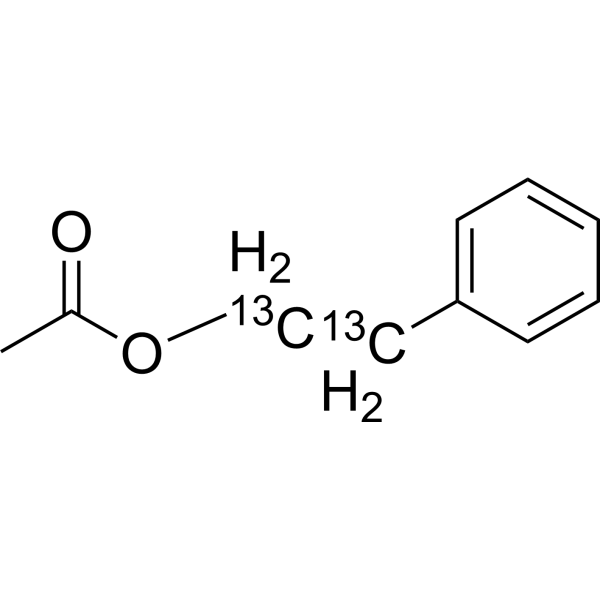 0 ImagesCat. No.: HY-W102356S1CAS No.: 1335402-21-5Synonyms: Phenethyl alcohol, acetate-13C2Phenethyl acetate-13C2 is 13C labeled Phenethyl acetate (HY-W102356). Phenethyl acetate (Phenethyl alcohol, acetate) is an aryl alkyl alcohol simple acid ester found in evergreen trees and cloves. Phenethyl acetate can induce skin and eye irritation. Phenethyl acetate can be used for food and flavor use.
-
LSZ-102 (Standard)
 0 ImagesCat. No.: HY-111486RCAS No.: 2135600-76-7LSZ-102 (Standard) is the analytical standard of LSZ-102 (HY-111486). This product is intended for research and analytical applications. LSZ-102 is a potent, orally bioavailable, selective estrogen receptor degrader (SERD) with an IC50 value of 0.2 nM.
-
Nimodipine (Standard)
 0 ImagesCat. No.: HY-B0265RCAS No.: 66085-59-4Synonyms: BAY-e 9736 (Standard)Nimodipine (Standard) is the analytical standard of Nimodipine. This product is intended for research and analytical applications. Nimodipine (BAY-e 9736) is an orally active, well-tolerated and light-sensitive dihydropyridine calcium antagonist. Nimodipine can be used for the research of cerebrovascular disorders.
-
Cefditoren Pivoxil (Standard)
 0 ImagesSynonyms: Cefditoren pivoxyl (Standard); Cefditoren pivaloyloxymethyl ester (Standard); ME 1207 (Standard)Cefditoren Pivoxil (Standard) is the analytical standard of Cefditoren Pivoxil. This product is intended for research and analytical applications. Cefditoren Pivoxil (ME 1207) is a broad-spectrum, third-generation, oral cephalosporin antibacterial with enhanced stability against many common β lactamases. Cefditoren Pivoxil has activity against Gram-negative organisms and Gram-positive organisms. Cefditoren Pivoxil can be used in the research of infection diseases such as acute exacerbations of chronic bronchitis, community-acquired pneumonia (CAP), streptococcal pharyngitis/tonsillitis, or uncomplicated skin and skin structure infections.
-
Pyrimethamine (Standard)
 0 ImagesSynonyms: Pirimecidan (Standard); Pirimetamin (Standard); RP 4753 (Standard)Pyrimethamine (Standard) is the analytical standard of Pyrimethamine. This product is intended for research and analytical applications. Pyrimethamine (Pirimecidan) is a potent, orally active dihydrofolate reductase (DHFR) inhibitor. Pyrimethamine is an antimalarial agent. Pyrimethamine affects the nucleoprotein metabolism of malarial parasites by interference in the folic–folinic acid systems and affects cell division by inhibiting the conversion of dihydrofolate to tetrahydrofolate.
-
HI-TOPK-032 (Standard)
 0 ImagesCat. No.: HY-101550RCAS No.: 487020-03-1HI-TOPK-032 (Standard) is the analytical standard of HI-TOPK-032 (HY-101550). This product is intended for research and analytical applications. HI-TOPK-032 is a potent and specific TOPK inhibitor.
-
AMD 3465 hexahydrobromide (Standard)
 0 ImagesCat. No.: HY-15971RCAS No.: 185991-07-5Synonyms: GENZ-644494 hexahydrobromide (Standard)AMD 3465 (hexahydrobromide) (Standard) is the analytical standard of AMD 3465 (hexahydrobromide). This product is intended for research and analytical applications. AMD 3465 hexahydrobromide (GENZ-644494 hexahydrobromide) is a potent antagonist of CXCR4, inhibits binding of 12G5 mAb and CXCL12AF647 to CXCR4, with IC50s of 0.75 nM and 18 nM in SupT1 cells; AMD 3465 also potently inhibits the replication of X4 HIV strains (IC50: 1-10 nM), but has no effect on CCR5-using (R5) viruses.
-
Multi-kinase inhibitor 1 (Standard)
 0 ImagesCat. No.: HY-103032RCAS No.: 778274-97-8Multi-kinase inhibitor 1 (Standard) is the analytical standard of Multi-kinase inhibitor 1 (HY-103032). This product is intended for research and analytical applications. Multi-kinase inhibitor 1 is a potent multi-kinase inhibitor. Multi-kinase inhibitor 1 has the potential for diseases or disorders associated with abnormal or deregulated tyrosine kinase activity, particularly diseases associated with the activity of PDGF-R, c-Kit and Bcr-abl.



