



Mesendogen
Based on 1 publication(s) in Google Scholar
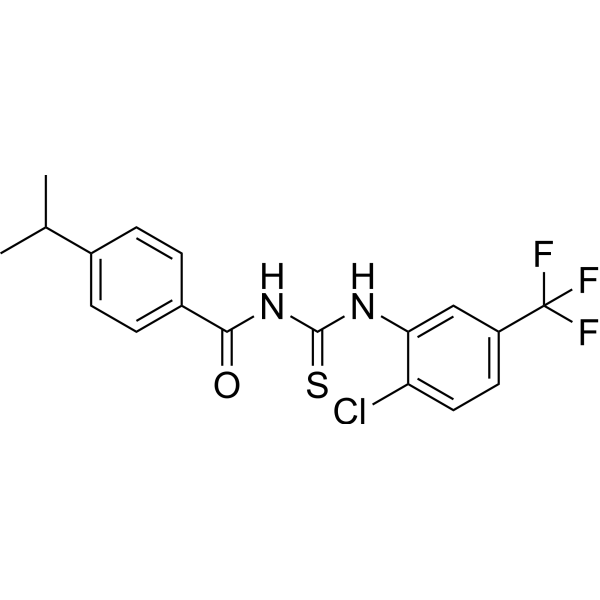
Mesendogen is a TRPM6 inhibitor. Mesendogen enhances the mesoderm and definitive endoderm (DE) differentiations of human embryonic stem cells (hESCs) and human induced pluripotent stem cells (hiPSCs). Mesendogen can be used for the research of magnesium homeostasis during early embryonic cell development.
For research use only. We do not sell to patients.
- Purity : 99.84%
- CAS No.: 864716-85-8
- Formula: C18H16ClF3N2OS
- Molecular Weight:400.85
-
Storage:Powder -20°C, 3 years , 4°C, 2 years ; In solvent -80°C, 6 months , -20°C, 1 month

To place orders, for customer services and technical support, please contact: MedChemExpress USA
Tel: 609-228-6898 E-mail: [email protected] [email protected]


-
 Biological Activity
-
Chemical Information
-
Solvent & Solubility
- Protocols
- Purity & Documentation
- References
-
 Help & FAQs



Publications Citing Use of MedChemExpress (MCE) Mesendogen
More

Biological Activity
Description
In Vitro
Mesendogen (10 μM) induces hESC mesoderm and endoderm differentiation, and decreases the level of neural differentiation markers[1]. Mesendogen (2.5, 10 and 25 μM; overnight) dose-dependently reduces intracellular magnesium level in H1 hESCs[1]. Mesendogen (10 μM; 7 days) inhibits the neural differentiation activity induced by Dorsomorphin[1].
MedChemExpress (MCE) has not independently confirmed the accuracy of these methods. They are for reference only.
-
Cell Line:H9 hESCs
-
Concentration:10 μM
-
Incubation Time:7 days
-
Result:Downregulated expression levels of pluripotency markers OCT4 and SOX2.


Chemical Information
-
CAS No. 864716-85-8
-
Appearance Solid
-
Molecular Weight 400.85
-
Formula C18H16ClF3N2OS
-
Color White to off-white
-
SMILES
O=C(NC(NC1=CC(C(F)(F)F)=CC=C1Cl)=S)C2=CC=C(C(C)C)C=C2
-
Shipping
Room temperature in continental US; may vary elsewhere.
-
Storage
Powder -20°C 3 years 4°C 2 years In solvent -80°C 6 months -20°C 1 month


Publications (1)
-
Journal Impact Factor
-
Most Recent
-
World J Gastrointest Oncol
Transient receptor potential melastatin 6 and transient receptor potential melastatin 6/7 antagonists suppress colon adenocarcinoma HT-29 cells. [Abstract]2025 Dec 15;17(12):110736. PMID: 41480213


Solvent & Solubility
In Vitro:
DMSO : 100 mg/mL (249.47 mM; Need ultrasonic; Hygroscopic DMSO has a significant impact on the solubility of product, please use newly opened DMSO)
Please refer to the solubility information to select the appropriate solvent. Once prepared, please aliquot and store the solution to prevent product inactivation from repeated freeze-thaw cycles.
Storage method and period of stock solution: -80°C, 6 months; -20°C, 1 month. When stored at -80°C, please use it within 6 months. When stored at -20°C, please use it within 1 month.
Please refer to the solubility information to select the appropriate solvent. Once prepared, please aliquot and store the solution to prevent product inactivation from repeated freeze-thaw cycles.
Storage method and period of stock solution: -80°C, 6 months; -20°C, 1 month. When stored at -80°C, please use it within 6 months. When stored at -20°C, please use it within 1 month.
Concentration (start) × Volume (start) = Concentration (final) × Volume (final)


Purity & Documentation
-
Data Sheet (270 KB)
-
SDS (251 KB)
- English - EN (251 KB)
- Français - FR (251 KB)
- Deutsch - DE (251 KB)
- Norwegian - NO (251 KB)
- Español - ES (251 KB)
- Swedish - SV (251 KB)
- Italian - IT (251 KB)
- Korean - KR (251 KB)
- Portuguese - PT (251 KB)
-
Handling Instructions (2659 KB)
References


Complete Stock Solution Preparation Table
Please refer to the solubility information to select the appropriate solvent. Once prepared, please aliquot and store the solution to prevent product inactivation from repeated freeze-thaw cycles.
Storage method and period of stock solution: -80°C, 6 months; -20°C, 1 month. When stored at -80°C, please use it within 6 months. When stored at -20°C, please use it within 1 month.
| Optional Solvent | Concentration Solvent Mass | 1 mg | 5 mg | 10 mg | 25 mg |
|---|---|---|---|---|---|
| DMSO | 1 mM | 2.4947 mL | 12.4735 mL | 24.9470 mL | 62.3675 mL |
| 5 mM | 0.4989 mL | 2.4947 mL | 4.9894 mL | 12.4735 mL | |
| 10 mM | 0.2495 mL | 1.2473 mL | 2.4947 mL | 6.2367 mL | |
| 15 mM | 0.1663 mL | 0.8316 mL | 1.6631 mL | 4.1578 mL | |
| 20 mM | 0.1247 mL | 0.6237 mL | 1.2473 mL | 3.1184 mL | |
| 25 mM | 0.0998 mL | 0.4989 mL | 0.9979 mL | 2.4947 mL | |
| 30 mM | 0.0832 mL | 0.4158 mL | 0.8316 mL | 2.0789 mL | |
| 40 mM | 0.0624 mL | 0.3118 mL | 0.6237 mL | 1.5592 mL | |
| 50 mM | 0.0499 mL | 0.2495 mL | 0.4989 mL | 1.2473 mL | |
| 60 mM | 0.0416 mL | 0.2079 mL | 0.4158 mL | 1.0395 mL | |
| 80 mM | 0.0312 mL | 0.1559 mL | 0.3118 mL | 0.7796 mL | |
| 100 mM | 0.0249 mL | 0.1247 mL | 0.2495 mL | 0.6237 mL |


Mesendogen Related Classifications
HY-103073 Related Classifications
 Powered by Bioz