



TLK1
TLK1 encodes a nuclear serine/threonine kinase involved in chromatin assembly, DNA replication, DNA repair, transcription, and chromosome segregation[1]. Mechanistically, TLK activity phosphorylates ASF1 histone chaperones, promotes histone supply during S phase, and supports replication-coupled nucleosome assembly[2][3]. In DNA damage contexts, TLK1B promotes chromatin assembly with ASF1 and has been reported to act as a molecular chaperone in DNA repair[4][5]. In prostate cancer models, androgen deprivation increased TLK1B, and thioridazine inhibited the TLK1-NEK1-ATR-CHK1 DNA damage response axis, suppressing androgen-independent tumor outgrowth[6]. Compared with TLK2, TLK1 shows overlapping genome-maintenance functions, but mouse studies found TLK1 dispensable for viability whereas TLK2 loss caused late embryonic lethality through placental failure[7].
参考文献:
- [1]. Silljé HH, et al. Identification of human Asf1 chromatin assembly factors as substrates of Tousled-like kinases. Curr Biol. 2001 Jul 10;11(13):1068-73. [Content Brief]
- [2]. Klimovskaia IM, et al. Tousled-like kinases phosphorylate Asf1 to promote histone supply during DNA replication. Nat Commun. 2014 Mar 6;5:3394. [Content Brief]
- [3]. Lee SB, et al. Tousled-like kinases stabilize replication forks and show synthetic lethality with checkpoint and PARP inhibitors. Sci Adv. 2018 Aug 8;4(8):eaat4985. [Content Brief]
- [4]. De Benedetti A. Tousled kinase TLK1B mediates chromatin assembly in conjunction with Asf1 regardless of its kinase activity. BMC Res Notes. 2010 Mar 11;3:68. doi: 10.1186/1756-0500-3-68. PMID: 20222959; PMCID: PMC2845150. et al. Tousled kinase TLK1B mediates chromatin assembly in conjunction with Asf1 regardless of its kinase activity. BMC Res Notes. 2010 Mar 11;3:68. [Content Brief]
- [5]. Lee MJ, et al. Time to HIV rebound after infusion of long-acting broadly neutralising antibodies 3BNC117-LS and 10-1074-LS and analytical treatment interruption (the RIO trial): a double-blind, randomised, placebo-controlled trial. Lancet HIV. 2026 May 27:S2352-3018(26)00059-7. [Content Brief]
- [6]. Singh V, et al. Targeting the TLK1/NEK1 DDR axis with Thioridazine suppresses outgrowth of androgen independent prostate tumors. Int J Cancer. 2019 Aug 15;145(4):1055-1067. [Content Brief]
- [7]. Segura-Bayona S, et al. Differential requirements for Tousled-like kinases 1 and 2 in mammalian development. Cell Death Differ. 2017 Nov;24(11):1872-1885. [Content Brief]
All Product Categories
-
TLK1 関連製品 (2)
関連製品 (2)

-
LSD1/TLK1-IN-1
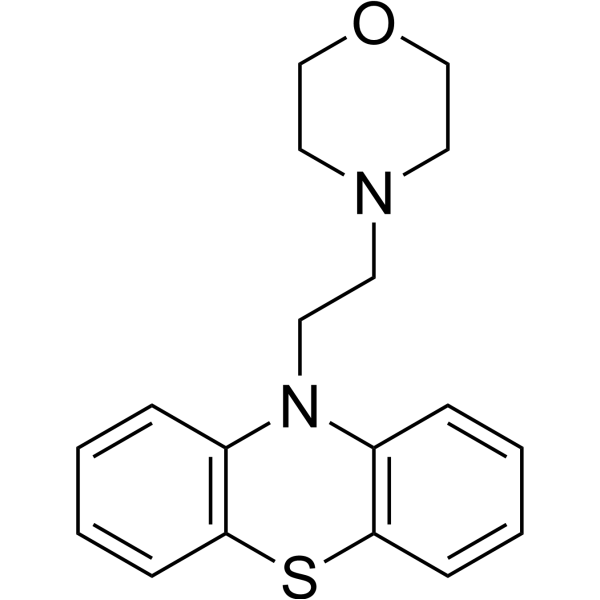 0 ImagesLSD1/TLK1-IN-1 is an orally active LSD1, TLK1, TLK2, TTK inhibitor with an LSD1 IC50 of 0.247 μM. LSD1/TLK1-IN-1 suppresses phosphorylation of Nek1 at T141 and Rad9 at S328, abrogates the TLK1>Nek1>ATR>Chk1 axis, protects H3K4me1/2 from demethylation, and does not affect LSD2, MAO-A, or MAO-B. LSD1/TLK1-IN-1 induces apoptosis, bypasses cell-cycle arrest, suppresses tumor growth, downregulates PD-L1 expression, enhances T-cell killing response, inhibits gastric cancer cell proliferation. LSD1/TLK1-IN-1 can be used for the research of prostate cancer and gastric cancer.
-
TLK1-IN-1
 0 Images製品番号: HY-173186TLK1-IN-1 is a TLK1B inhibitor with a human IC50 of 7.2 μM. TLK1-IN-1 causes accumulation of DNA damage and induces apoptotic cell death in cancer cells. TLK1-IN-1 can be used for the research of metastatic castration-resistant prostate cancer.



