



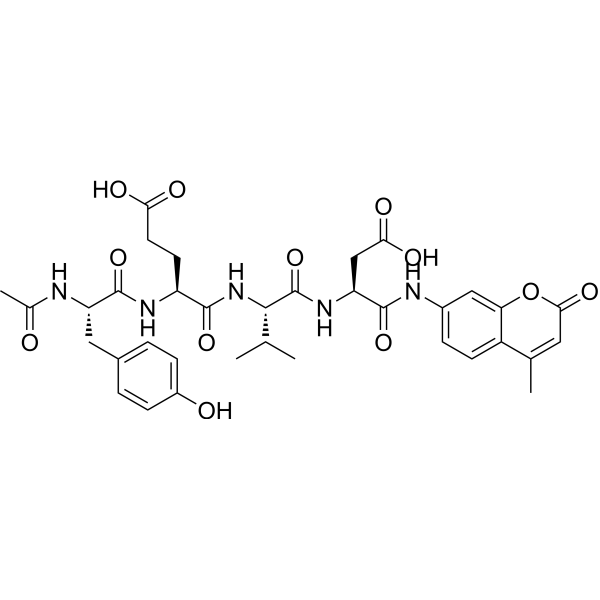
Ac-YEVD-AMC

Based on 1 Customer Validation
Ac-YEVD-AMC is a fluorescent substrate of caspase-1/11. Ac-YEVD-AMC releases amino-4-methylcoumarin (AMC) for fluorescence detection when treating with cell lysate.
Nur für Forschungszwecke. Wir verkaufen nicht an Patienten.
- Reinheit : 98.20%
- CAS. Nr.: 1631716-11-4
- Formel: C35H41N5O12
- Molecular Weight:723.73
-
Speicherung:
Sealed storage, away from moisture.
Powder -80°C, 2 years , -20°C, 1 year* In solvent : -80°C, 6 months; -20°C, 1 month (sealed storage, away from moisture)

To place orders, for customer services and technical support, please contact: MedChemExpress USA
Tel: 609-228-6898 E-mail: [email protected] [email protected]


-
 Biologische Aktivität
-
Chemical Information
-
Lösungsmittel & Löslichkeit
- Protokoll
- Reinheit & Dokumentation
- Verweise
-
 Help & FAQs




Biologische Aktivität
Beschreibung


Chemical Information
-
CAS. Nr. 1631716-11-4
-
Appearance Solid
-
Molecular Weight 723.73
-
Formel C35H41N5O12
-
Color White to off-white
-
Sequence
Ac-Tyr-Glu-Val-Asp-{AMC}
-
Sequence Shortening
Ac-YEVD-{AMC}
-
Versand
Room temperature in continental US; may vary elsewhere.
-
Speicherung
Sealed storage, away from moisture
Powder -80°C 2 years -20°C 1 year * In solvent : -80°C, 6 months; -20°C, 1 month (sealed storage, away from moisture)


Lösungsmittel & Löslichkeit
In Vitro:
DMSO : 100 mg/mL (138.17 mM; Need ultrasonic; Hygroscopic DMSO has a significant impact on the solubility of product, please use newly opened DMSO)
Please refer to the solubility information to select the appropriate solvent. Once prepared, please aliquot and store the solution to prevent product inactivation from repeated freeze-thaw cycles.
Storage method and period of stock solution: -80°C, 6 months; -20°C, 1 month (sealed storage, away from moisture). When stored at -80°C, please use it within 6 months. When stored at -20°C, please use it within 1 month.
Please refer to the solubility information to select the appropriate solvent. Once prepared, please aliquot and store the solution to prevent product inactivation from repeated freeze-thaw cycles.
Storage method and period of stock solution: -80°C, 6 months; -20°C, 1 month (sealed storage, away from moisture). When stored at -80°C, please use it within 6 months. When stored at -20°C, please use it within 1 month.
Konzentration (Stammlösung) × Volumen (Stammlösung) = Konzentration (Ziellösung) × Volumen (Ziellösung)

Protokoll
-
Apoptosis Solutions
Apoptosis is a regulated, generally non-lytic cell-death pathway that removes unwanted, damaged, infected, or abnormal cells through coordinated morphological changes, caspase activation, DNA fragmentation, and membrane remodeling. The intrinsic apoptosis pathway is controlled mainly by mitochondrial outer membrane permeabilization, BCL-2 family proteins, cytochrome c release, apoptosome formation, caspase-9 activation, and downstream executioner caspase-3/7 activation. The extrinsic apoptosis pathway is initiated by death receptors such as Fas, TNFR, and TRAIL receptors, which recruit adaptor proteins and activate caspase-8 before engaging executioner caspases or mitochondrial amplification through BID cleavage. Apoptosis is linked to many phenotypes, including cancer cell killing, tissue homeostasis, immune regulation, neurodegeneration, infection response, and treatment-induced cytotoxicity; unresolved questions include how apoptosis interacts with necroptosis, pyroptosis, ferroptos
-
Detergent-Based Total Protein Extraction from Cultured Mammalian Cells (RIPA/NP-40/Triton Lysis)
Detergent-based total protein extraction lyses cultured mammalian cells by using amphipathic detergents to disrupt lipid membranes and solubilize proteins into aqueous lysate; RIPA combines non-ionic detergent with ionic detergents, whereas NP-40/Triton buffers are milder non-ionic lysis conditions. The readout is the recovered clarified protein lysate, which is commonly quantified by detergent-compatible protein assays and then used for downstream protein analysis such as SDS-PAGE and Western blotting.
-
Pyroptosis Solutions
Pyroptosis is a lytic inflammatory cell-death pathway executed by gasdermin pores, most classically through inflammasome-mediated activation of caspase-1, cleavage of gasdermin D, membrane pore formation, LDH release, and secretion of IL-1β and IL-18. The canonical pathway is commonly modeled by priming cells with an inflammatory signal such as LPS to induce pro-IL-1β and inflammasome components, followed by an activation signal such as ATP or nigericin to activate NLRP3, ASC speck formation, caspase-1 cleavage, GSDMD cleavage, cytokine release, and pyroptotic membrane rupture. The non-canonical pathway is triggered when cytosolic LPS activates mouse caspase-11 or human caspase-4/5, leading to GSDMD cleavage and pyroptosis, and this can secondarily activate NLRP3-dependent IL-1β release. Pyroptosis is linked to inflammatory injury, infection, cancer, liver disease, ocular disease, placental inflammation, and other disease phenotypes, but unresolved questions include which gasdermin fam


Reinheit & Dokumentation
-
Data Sheet (271 KB)
-
SDS (252 KB)
- English - EN (252 KB)
- Français - FR (252 KB)
- Deutsch - DE (252 KB)
- Norwegian - NO (252 KB)
- Español - ES (252 KB)
- Swedish - SV (252 KB)
- Italian - IT (252 KB)
- Korean - KR (252 KB)
- Portuguese - PT (252 KB)
-
Handling Instructions (2659 KB)
Verweise


Complete Stock Solution Preparation Table
Please refer to the solubility information to select the appropriate solvent. Once prepared, please aliquot and store the solution to prevent product inactivation from repeated freeze-thaw cycles.
Storage method and period of stock solution: -80°C, 6 months; -20°C, 1 month (sealed storage, away from moisture). When stored at -80°C, please use it within 6 months. When stored at -20°C, please use it within 1 month.
| Optional Solvent | Concentration Solvent Mass | 1 mg | 5 mg | 10 mg | 25 mg |
|---|---|---|---|---|---|
| DMSO | 1 mM | 1.3817 mL | 6.9087 mL | 13.8173 mL | 34.5433 mL |
| 5 mM | 0.2763 mL | 1.3817 mL | 2.7635 mL | 6.9087 mL | |
| 10 mM | 0.1382 mL | 0.6909 mL | 1.3817 mL | 3.4543 mL | |
| 15 mM | 0.0921 mL | 0.4606 mL | 0.9212 mL | 2.3029 mL | |
| 20 mM | 0.0691 mL | 0.3454 mL | 0.6909 mL | 1.7272 mL | |
| 25 mM | 0.0553 mL | 0.2763 mL | 0.5527 mL | 1.3817 mL | |
| 30 mM | 0.0461 mL | 0.2303 mL | 0.4606 mL | 1.1514 mL | |
| 40 mM | 0.0345 mL | 0.1727 mL | 0.3454 mL | 0.8636 mL | |
| 50 mM | 0.0276 mL | 0.1382 mL | 0.2763 mL | 0.6909 mL | |
| 60 mM | 0.0230 mL | 0.1151 mL | 0.2303 mL | 0.5757 mL | |
| 80 mM | 0.0173 mL | 0.0864 mL | 0.1727 mL | 0.4318 mL | |
| 100 mM | 0.0138 mL | 0.0691 mL | 0.1382 mL | 0.3454 mL |


Ac-YEVD-AMC Related Classifications
HY-P10142 Related Classifications
 Powered by Bioz