



Acibenzolar-S-methyl

Based on 1 Customer Validation
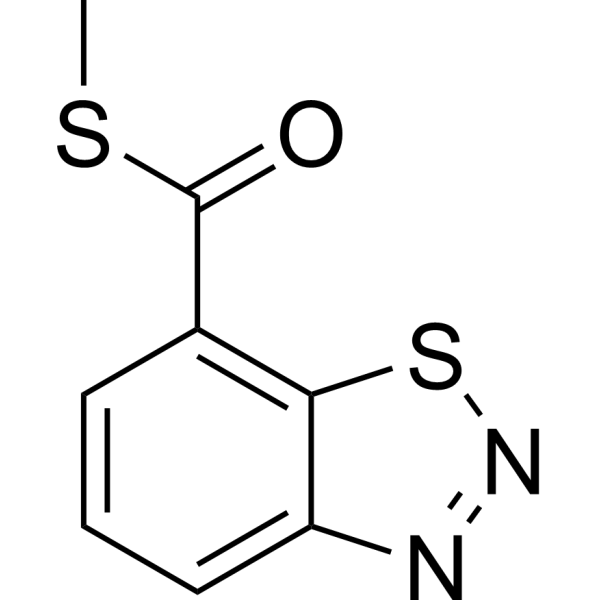
Acibenzolar-S-methyl (ASM) is a synthetic analog of Salicylic acid (HY-B0167) and a plant activator. Acibenzolar‑S‑methyl induces increased activities of defense-related enzymes such as peroxidase and chitinase, activates stomatal defense responses and PR defense gene expression, induces the production of ROS, triggers local and systemic acquired resistance, and inhibits the proliferation of bacterial and fungal pathogens in plants. Acibenzolar‑S‑methyl can be used in studies related to plant infection.
For research use only. We do not sell to patients.
- Purity : 99.77%
- CAS No.: 135158-54-2
- Formula: C8H6N2OS2
- Molecular Weight:210.28
-
Storage:
Store at room temperature 3 years.
In solvent -80°C, 2 years , -20°C, 1 year

To place orders, for customer services and technical support, please contact: MedChemExpress USA
Tel: 609-228-6898 E-mail: [email protected] [email protected]


-
 Biological Activity
-
Chemical Information
-
Solvent & Solubility
- Protocols
- Purity & Documentation
- References
-
 Help & FAQs


-
HY-134094
FluridoneABA Biosynthesis Inhibitor -
HY-W744966
MandipropamidCesA3 Inhibitor -

HY-134094R
Fluridone (Standard)ABA Biosynthesis Inhibitor -

HY-116541R
Acibenzolar-S-methyl (Standard)Reference Standard -
HY-B1198S
Piperonyl butoxide-d9Stable Isotope -

HY-B1970
o,p'-DDT -

HY-120253
SpirotetramatInsecticide -

HY-W744966R
Mandipropamid (Standard)Reference Standard -

HY-120253R
Spirotetramat (Standard)Pesticide


Biological Activity
Description
IC50 & Target
In Vitro
Acibenzolar‑S‑methyl (ASM) inhibits lesion formation by this pathogen, reduces bacterial abundance in both treated leaves and untreated systemic leaves of the Japanese radish (Raphanus sativus var. longipinnatus cultivar Natsutsukasa); triggers local and systemic stomatal closure mediated by peroxidase-derived reactive oxygen species, and enhances stomata-associated disease resistance; induces local and systemic expression of the leaf defense genes PR1, PR2, and PR3 at 4 h post-administration[1].
Acibenzolar-S-methyl (ASM) (0.2 mg/mL) increases the activities of peroxidase and chitinase in crude enzyme extracts from leaf tissues of tomato (cv. F144)[3].
MedChemExpress (MCE) has not independently confirmed the accuracy of these methods. They are for reference only. Further protocols information, click here.
Clinical Trial
| NCT Number | Sponsor | Condition | Start Date |
Phase

|
|---|---|---|---|---|
| NCT01329991 | Plexxikon| | 2011-05 | PHASE1 |


Chemical Information
-
CAS No. 135158-54-2
-
Appearance Solid
-
Molecular Weight 210.28
-
Formula C8H6N2OS2
-
Color White to off-white
-
SMILES
O=C(SC)C1=C2SN=NC2=CC=C1
-
Synonyms
ASM
-
Shipping
Room temperature in continental US; may vary elsewhere.
-
Storage
Store at room temperature 3 years
In solvent -80°C 2 years -20°C 1 year


Solvent & Solubility
In Vitro:
DMSO : 31.25 mg/mL (148.61 mM; ultrasonic and warming and heat to 60°C; Hygroscopic DMSO has a significant impact on the solubility of product, please use newly opened DMSO)
Please refer to the solubility information to select the appropriate solvent. Once prepared, please aliquot and store the solution to prevent product inactivation from repeated freeze-thaw cycles.
Storage method and period of stock solution: -80°C, 2 years; -20°C, 1 year. When stored at -80°C, please use it within 2 years. When stored at -20°C, please use it within 1 year.
Please refer to the solubility information to select the appropriate solvent. Once prepared, please aliquot and store the solution to prevent product inactivation from repeated freeze-thaw cycles.
Storage method and period of stock solution: -80°C, 2 years; -20°C, 1 year. When stored at -80°C, please use it within 2 years. When stored at -20°C, please use it within 1 year.
Concentration (start) × Volume (start) = Concentration (final) × Volume (final)

Protocols
-
RT-PCR
Reverse transcription technology uses RNA as a template to synthesize DNA. RT-PCR is simple, specific and sensitive, and can be used to detect gene expression levels and expression differences in cells; detect RNA virus content; clone cDNA sequences of specific genes.
-
RNA extraction experimental
By lysing cells, releasing RNA, and removing impurities such as proteins and DNA, high-purity RNA products are finally obtained. The commonly used traditional method is the guanidine isothiocyanate/phenol/chloroform method (Trizol), which is suitable for a variety of animal materials including animal tissues, microorganisms, cultured cells, etc., and most plant materials.
-
Research Protocol for Infectious Diseases
Infectious-disease experiments test how pathogens interact with host barriers, innate immune receptors, inflammatory signaling, pathogen replication, and tissue injury; pattern-recognition receptors such as TLRs, RIG-I-like receptors, NOD-like receptors, and inflammasomes detect microbial molecules and activate NF-κB, interferon, and cytokine responses. The central hypothesis is that infection severity reflects the balance between pathogen burden and host response: protective inflammation restricts pathogen growth, whereas excessive or mislocalized inflammation contributes to tissue damage and disease phenotype. Unresolved questions include which host pathways are protective versus pathogenic, why some infection models fail to translate to human disease, and which combined readouts best predict clinically relevant infection outcomes.
-
ROS/oxidative-stress fluorescent staining
ROS/oxidative-stress fluorescent staining uses cell-permeant fluorogenic probes that become fluorescent after oxidation inside cells or tissues; commonly used examples include DCFH-DA/DCFDA for broad cellular oxidant detection, DHE for superoxide-related signal detection, MitoSOX for mitochondrial superoxide-related signal detection, and CellROX probes for oxidative-stress-associated fluorescence readouts. The assay detects probe oxidation rather than a single ROS species unless the probe and analysis method have been chemically validated for that species. DCFH-DA enters cells, is deacetylated by intracellular esterases to DCFH, and produces fluorescent DCF after oxidation, so the readout is used as an operational measure of total cellular oxidative stress rather than a species-specific ROS measurement. DHE and MitoSOX can report superoxide-related oxidation, but red fluorescence alone can include non-specific ethidium-like oxidation products; HPLC or optimized spectral approaches are
-
Real Time qPCR (Q-PCR)
Real-time quantitative PCR (qPCR) quantifies an amplifiable nucleic-acid target by monitoring fluorescence during PCR cycling rather than measuring product only after amplification. The increase in fluorescence tracks accumulation of PCR product, and the quantification cycle (Cq; historically also Ct/CP) is related to the initial amount of target: samples containing more starting target generally reach the defined fluorescence threshold in fewer cycles.
-
Cell Viability Determination by MTT Colorimetric Assay
The following protocol uses the MTT colorimetric assay as a classic literature-established method for assessing cell viability/metabolic activity in cultured mammalian cells. MTT[3-(4,5-dimethylthiazol-2-yl)-2,5-diphenyltetrazolium bromide] is reduced by metabolically active cells to a colored formazan product; the amount of formazan is quantified spectrophotometrically and provides an indirect measure of metabolically active viable cells. Importantly, MTT reduction reflects cellular oxidoreductase/metabolic activity rather than an absolute direct count of living cells, so changes in cellular metabolism can alter the signal independently of cell number.


Purity & Documentation
-
Data Sheet (291 KB)
-
SDS (597 KB)
- English - EN (597 KB)
- Français - FR (597 KB)
- Deutsch - DE (597 KB)
- Norwegian - NO (597 KB)
- Español - ES (597 KB)
- Swedish - SV (597 KB)
- Italian - IT (597 KB)
- Korean - KR (597 KB)
- Portuguese - PT (597 KB)
-
Handling Instructions (2659 KB)
References


Complete Stock Solution Preparation Table
Please refer to the solubility information to select the appropriate solvent. Once prepared, please aliquot and store the solution to prevent product inactivation from repeated freeze-thaw cycles.
Storage method and period of stock solution: -80°C, 2 years; -20°C, 1 year. When stored at -80°C, please use it within 2 years. When stored at -20°C, please use it within 1 year.
| Optional Solvent | Concentration Solvent Mass | 1 mg | 5 mg | 10 mg | 25 mg |
|---|---|---|---|---|---|
| DMSO | 1 mM | 4.7556 mL | 23.7778 mL | 47.5556 mL | 118.8891 mL |
| 5 mM | 0.9511 mL | 4.7556 mL | 9.5111 mL | 23.7778 mL | |
| 10 mM | 0.4756 mL | 2.3778 mL | 4.7556 mL | 11.8889 mL | |
| 15 mM | 0.3170 mL | 1.5852 mL | 3.1704 mL | 7.9259 mL | |
| 20 mM | 0.2378 mL | 1.1889 mL | 2.3778 mL | 5.9445 mL | |
| 25 mM | 0.1902 mL | 0.9511 mL | 1.9022 mL | 4.7556 mL | |
| 30 mM | 0.1585 mL | 0.7926 mL | 1.5852 mL | 3.9630 mL | |
| 40 mM | 0.1189 mL | 0.5944 mL | 1.1889 mL | 2.9722 mL | |
| 50 mM | 0.0951 mL | 0.4756 mL | 0.9511 mL | 2.3778 mL | |
| 60 mM | 0.0793 mL | 0.3963 mL | 0.7926 mL | 1.9815 mL | |
| 80 mM | 0.0594 mL | 0.2972 mL | 0.5944 mL | 1.4861 mL | |
| 100 mM | 0.0476 mL | 0.2378 mL | 0.4756 mL | 1.1889 mL |


Acibenzolar-S-methyl Related Classifications
HY-116541 Related Classifications
 Powered by Bioz
Keywords
- Acibenzolar-S-methyl
- 135158-54-2
- ASM
- Drug Derivative
- Fungal
- Bacterial
- Reactive Oxygen Species (ROS)
- Pseudomonas cannabina pv. alisalensis
- reactive oxygen species (ROS)
- PR3
- Clavibacter michiganensis ssp. michiganensis
- salicylic acid
- SA-binding protein (SABP2)
- Raphanus sativus var. longipinnatus
- PR1
- PR2
- systemic acquired resistance (SAR)
- Inhibitor
- inhibitor
- inhibit