



Albiglutide

Based on 1 Customer Validation
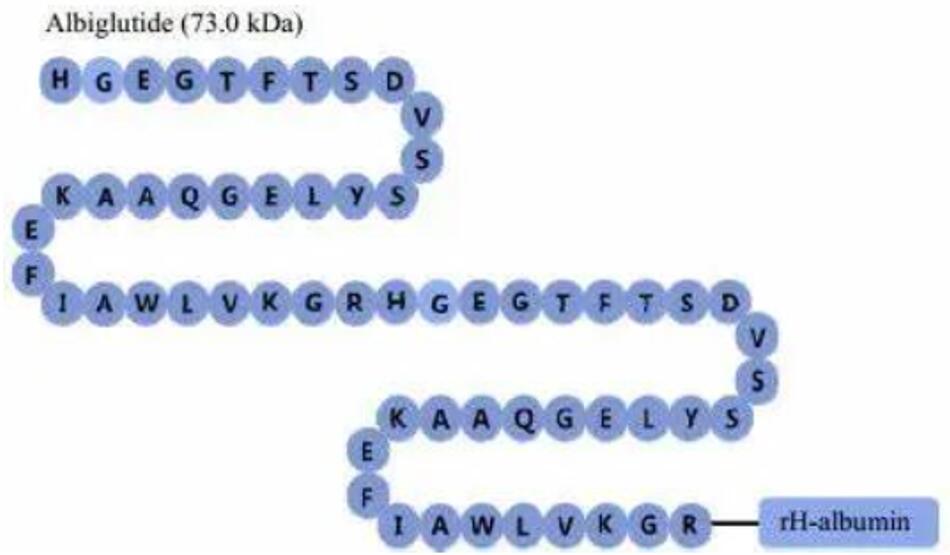
Albiglutide is a long acting GLP-1 receptor agonist. Albiglutide is a recombinant fusion protein consisting of two copies of a 30-amino-acid sequence of modified human GLP-1 (fragment 7-36), modified with a glycine substituted for the naturally occurring alanine at position 8 in order to augment resistance to DPP-4. Albiglutide can be used for research of Type 2 diabetes.
For research use only. We do not sell to patients.
- Purity : 99.92%
- CAS No.: 782500-75-8
- Molecular Weight:73 kDa
-
Storage:
Please store the product under the recommended conditions in the Certificate of Analysis.


To place orders, for customer services and technical support, please contact: MedChemExpress USA
Tel: 609-228-6898 E-mail: [email protected] [email protected]


-
 Biological Activity
-
Chemical Information
- Protocols
- Purity & Documentation
- References
-
 Help & FAQs


-

HY-P0119
LixisenatideGLP-1 Agonist -

HY-P0120
DulaglutideGLP-1 Receptor Agonist -

HY-114118
SemaglutideGLP-1R Agonist -

HY-13443
Exendin-4GLP-1 Receptor Agonist -

HY-P0264
Exendin(9-39) amideGLP-1R Antagonist -

HY-P0014
LiraglutideGLP-1R Agonist -
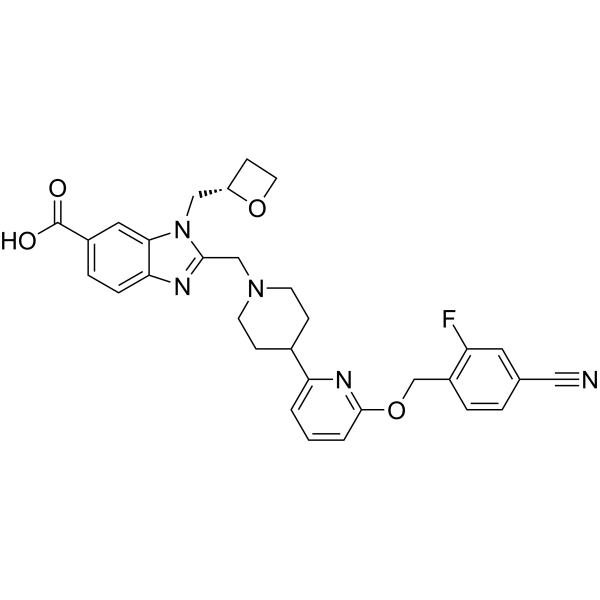
HY-125824
DanuglipronGLP-1R Agonist -
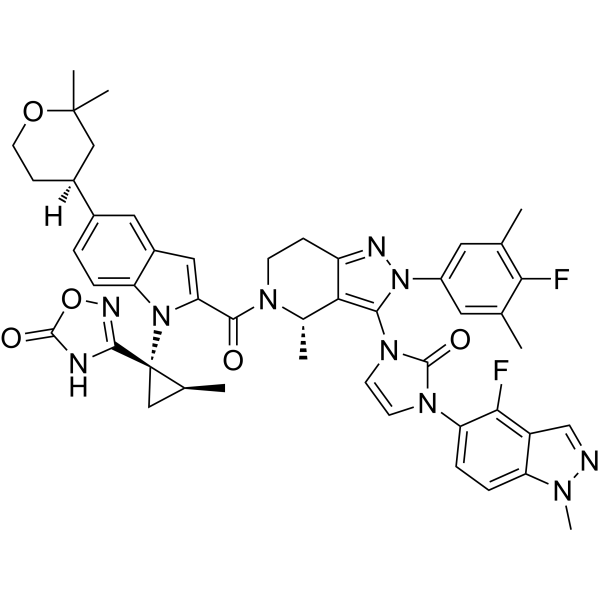
HY-112185
OrforglipronGLP-1R Agonist -
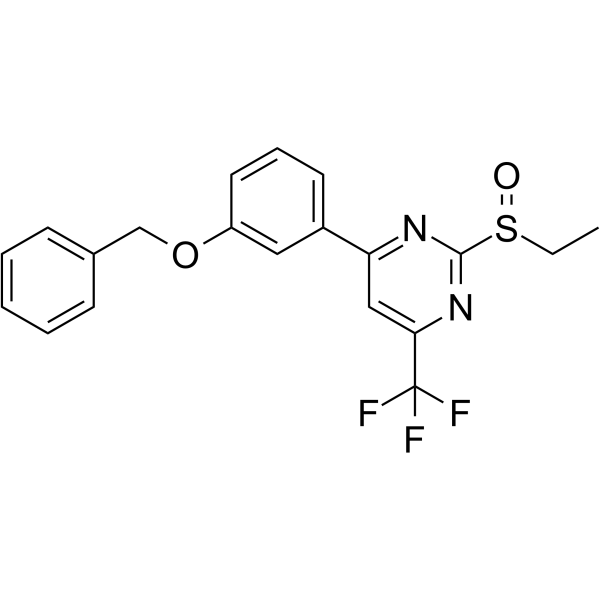
HY-103546
BETPGLP-1 Agonist -

HY-114118CP
Semaglutide (crude)Crude Semaglutide -
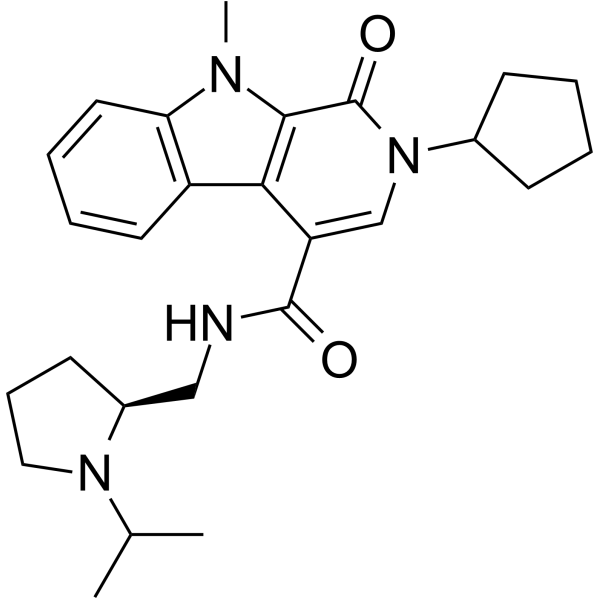
HY-116819
VU0453379GLP-1R PAM


Biological Activity
Description
Species Reactivity
Human
IC50 & Target
GLP-1 receptor[1].
Clinical Trial
| NCT Number | Sponsor | Condition | Start Date |
Phase

|
|---|---|---|---|---|
| NCT01329991 | Plexxikon| | 2011-05 | PHASE1 |
Reconsititution
The product can be reconstituted/diluted with sterile PBS or saline.
Format
-
human GLP-1 genetically fused in tandem to human albumin


Chemical Information
-
CAS No. 782500-75-8
-
Appearance Liquid
-
Molecular Weight 73 kDa
-
Color Colorless to light yellow
-
SMILES
[Albiglutide]
-
Synonyms
GSK-716155
-
Shipping
Shipping with dry ice.
-
Formulation
Please refer to the lot-specific COA for specific buffer information.
-
Storage
Please store the product under the recommended conditions in the Certificate of Analysis.

Protocols
-
Research Protocol for Metabolic Diseases
AMP-activated protein kinase, AMPK, is a conserved cellular energy sensor that responds to reduced cellular energy status and coordinates metabolism by increasing ATP-generating catabolic pathways while suppressing ATP-consuming anabolic processes. In metabolic disease research, the AMPK pathway is experimentally relevant because it regulates hepatic lipid synthesis, fatty acid oxidation, glucose production, skeletal-muscle glucose disposal, mTORC1-linked biosynthesis, autophagy, mitochondrial homeostasis, and whole-body energy balance. The central pathway logic is that energy stress, metformin, exercise-like stimulation, or direct AMPK activators increase AMPKα Thr172 phosphorylation and downstream substrate phosphorylation, including ACC and RAPTOR. Phosphorylation of ACC suppresses lipogenesis and supports fatty acid oxidation, whereas phosphorylation of RAPTOR suppresses mTORC1 signaling and links cellular energy status to growth and protein synthesis control. The pathway is linked


Purity & Documentation
-
Data Sheet (255 KB)
-
SDS (251 KB)
- English - EN (251 KB)
- Français - FR (251 KB)
- Deutsch - DE (251 KB)
- Norwegian - NO (251 KB)
- Español - ES (251 KB)
- Swedish - SV (251 KB)
- Italian - IT (251 KB)
- Korean - KR (251 KB)
- Portuguese - PT (251 KB)
-
Inhibitory Antibodies User Guide (603 KB)
References

Calculators
Concentration (start) × Volume (start) = Concentration (final) × Volume (final)


Albiglutide Related Classifications
HY-P5311 Related Classifications
 Powered by Bioz