



Ambroxol-d5 hydrochloride

Based on 1 Customer Validation
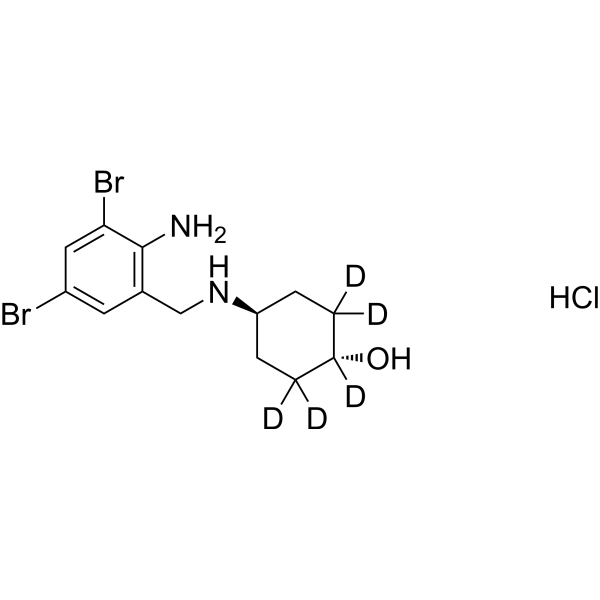
Ambroxol-d5 (hydrochloride) is the deuterium labeled Ambroxol hydrochloride. Ambroxol hydrochloride (NA-872 hydrochloride), an active metabolite of the proagent Bromhexine, has potent expectorant effects. Ambroxol hydrochloride is a glucocerebrosidase (GCase) chaperone and increases glucocerebrosidase activity. Ambroxol hydrochloride induces lung autophagy and has the potential for Parkinson disease and neuronopathic Gaucher disease research.
For research use only. We do not sell to patients.
- Purity : 99.61%
- CAS No.: 2741380-71-0
- Formula: C13H14D5Br2ClN2O
- Molecular Weight:419.59
-
Storage:
4°C, sealed storage, away from moisture
* In solvent : -80°C, 6 months; -20°C, 1 month (sealed storage, away from moisture)

To place orders, for customer services and technical support, please contact: MedChemExpress USA
Tel: 609-228-6898 E-mail: [email protected] [email protected]


-
 Biological Activity
-
Chemical Information
-
Solvent & Solubility
- Protocols
- Purity & Documentation
- References
-
 Help & FAQs


-
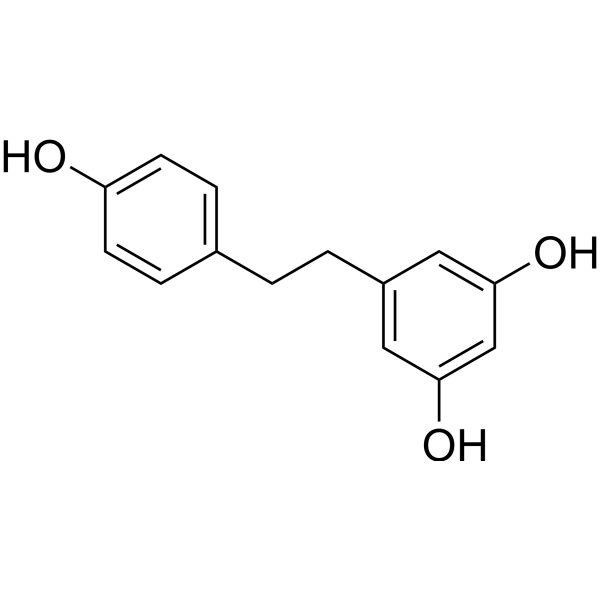
HY-N3755
DihydroresveratrolEstrogen Receptor/ERR Modulator -

HY-N3755R
Dihydroresveratrol (Standard)Estrogen Receptor/ERR Modulator -
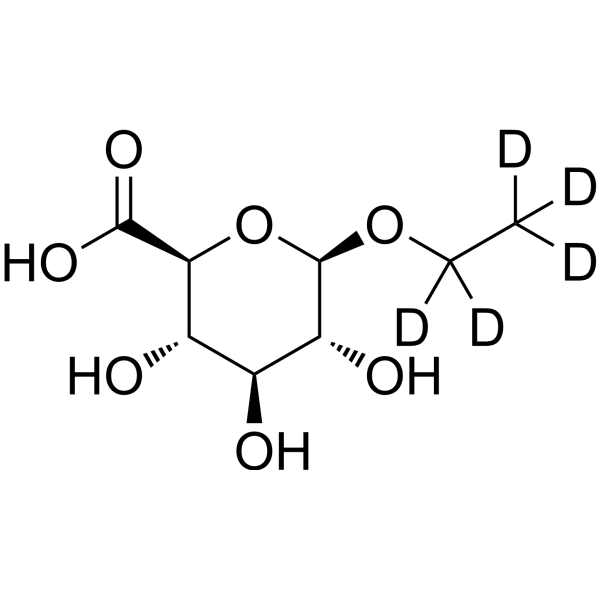
HY-113093S
Ethyl glucuronide-d5Stable Isotope -
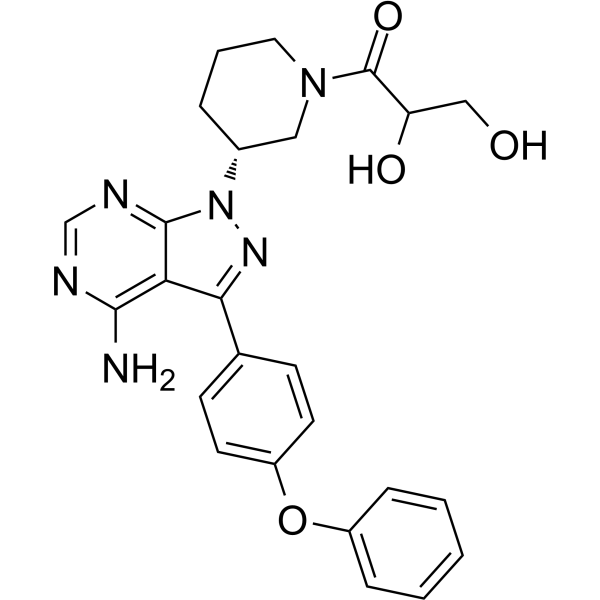
HY-100659
Dihydrodiol-IbrutinibBTK Inhibitor -

HY-122489A
(S)-LaudanosineAlkaloid -

HY-W002112S
(±)-Nornicotine-d4Stable Isotope -

HY-W741557
Griseofulvic Acid -

HY-137387
Carvedilol GlucuronideDrug Metabolite -

HY-W741491
6-O-Demethyl griseofulvinGriseofulvin Metabolite -

HY-137909
Formoterol O-β-D-glucuronideFormoterol Metabolite -

HY-W653803
Lamotrigine N2-Oxide -

HY-167570
6β-Hydroxy prednisolone


Biological Activity
Description
In Vitro
Stable heavy isotopes of hydrogen, carbon, and other elements have been incorporated into drug molecules, largely as tracers for quantitation during the drug development process. Deuteration has gained attention because of its potential to affect the pharmacokinetic and metabolic profiles of drugs[1].
MedChemExpress (MCE) has not independently confirmed the accuracy of these methods. They are for reference only. Further protocols information, click here.
Application
1. This compound can be used as a tracer
2. This compound can be used as an internal standard for quantitative analysis by NMR, GC-MS, or LC-MS.


Chemical Information
-
CAS No. 2741380-71-0
-
Unlabeled CAS 23828-92-4
-
Appearance Solid
-
Molecular Weight 419.59
-
Formula C13H14D5Br2ClN2O
-
Color White to off-white
-
SMILES
O[C@@](C([2H])([2H])C1)([2H])C([2H])([2H])C[C@@H]1NCC2=C(C(Br)=CC(Br)=C2)N.Cl
-
Synonyms
NA-872-d5 hydrochloride
-
Shipping
Room temperature in continental US; may vary elsewhere.
-
Storage
4°C, sealed storage, away from moisture
* In solvent : -80°C, 6 months; -20°C, 1 month (sealed storage, away from moisture)


Solvent & Solubility
In Vitro:
DMSO : ≥ 20 mg/mL (47.67 mM; Hygroscopic DMSO has a significant impact on the solubility of product, please use newly opened DMSO)
DMF : ≥ 20 mg/mL (47.67 mM)
* "≥" means soluble, but saturation unknown.
Please refer to the solubility information to select the appropriate solvent. Once prepared, please aliquot and store the solution to prevent product inactivation from repeated freeze-thaw cycles.
Storage method and period of stock solution: -80°C, 6 months; -20°C, 1 month (sealed storage, away from moisture). When stored at -80°C, please use it within 6 months. When stored at -20°C, please use it within 1 month.
Please refer to the solubility information to select the appropriate solvent. Once prepared, please aliquot and store the solution to prevent product inactivation from repeated freeze-thaw cycles.
Storage method and period of stock solution: -80°C, 6 months; -20°C, 1 month (sealed storage, away from moisture). When stored at -80°C, please use it within 6 months. When stored at -20°C, please use it within 1 month.
Concentration (start) × Volume (start) = Concentration (final) × Volume (final)

Protocols
-
Autophagy
Autophagy is a process in which eukaryotic cells use lysosomes to degrade their own cytoplasmic proteins and damaged organelles under the regulation of autophagy related gene (Atg). Microtubule-associated proteins light chain 3 (LC3) is recognized as autophagy marker, which transfers from cytoplasmic LC3 (LC3-I) to membrane type (LC3-II). LC3-II/I ratio could be detected by Western Blot and fluorescence microscopy.
-
Lysosome and acidic-vesicle live-cell staining
Lysosome and acidic-vesicle live-cell staining detects acidic intracellular compartments by using membrane-permeant acidotropic probes that accumulate in low-pH vesicles, including lysosomes, late endosomes, autolysosomes, and acidic phagosomes. LysoTracker staining is commonly used as an intensity-based readout of acidic lysosomal compartment abundance or enlargement, while acridine orange produces green fluorescence in less concentrated compartments and red fluorescence after concentration-dependent accumulation in acidic vesicular organelles. Loss or reduction of acridine-orange red signal can be used as a readout of lysosomal membrane permeabilization or reduced acidic-vesicle integrity. This protocol is designed for live cultured cells and can be adapted for fluorescence microscopy, high-content imaging, plate-reader readout, or flow cytometry when the selected literature supports the readout. Because these dyes report acidotropic accumulation rather than lysosome identity alone,
-
Macroautophagy Solutions
Macroautophagy is a conserved lysosome-dependent degradation pathway in which cytoplasmic material is sequestered into double-membrane autophagosomes and delivered to lysosomes for degradation and recycling. The pathway supports cellular homeostasis during nutrient limitation, organelle stress, protein-aggregate accumulation, infection, differentiation, and tissue remodeling by coupling cargo sequestration, autophagosome maturation, lysosomal fusion, and degradation of cargo-derived macromolecules. The core molecular sequence includes initiation by nutrient- and stress-regulated autophagy machinery, autophagosome nucleation, LC3/ATG8-family conjugation to autophagosomal membranes, cargo selection through receptors such as SQSTM1/p62, autophagosome-lysosome fusion, and lysosomal degradation. LC3 was identified as a mammalian homolog of yeast Atg8 that localizes to autophagosomal membranes after processing, and p62/SQSTM1 was shown to connect ubiquitinated cargo with autophagic degradati


Purity & Documentation
-
Data Sheet (270 KB)
-
SDS (252 KB)
- English - EN (252 KB)
- Français - FR (252 KB)
- Deutsch - DE (252 KB)
- Norwegian - NO (252 KB)
- Español - ES (252 KB)
- Swedish - SV (252 KB)
- Italian - IT (252 KB)
- Korean - KR (252 KB)
- Portuguese - PT (252 KB)
-
Handling Instructions (2659 KB)
References
[1]. Russak EM, et al. Impact of Deuterium Substitution on the Pharmacokinetics of Pharmaceuticals. Ann Pharmacother. 2019;53(2):211-216. [Content Brief]
[2]. Vojo Deretic, et al. Enhancement of lung levels of antibiotics by ambroxol and bromhexine. Expert Opin Drug Metab Toxicol. 2019 Mar;15(3):213-218. [Content Brief]
[3]. Anna Migdalska-Richards, et al. Ambroxol effects in glucocerebrosidase and α-synuclein transgenic mice. Ann Neurol. 2016 Nov;80(5):766-775. [Content Brief]


Complete Stock Solution Preparation Table
Please refer to the solubility information to select the appropriate solvent. Once prepared, please aliquot and store the solution to prevent product inactivation from repeated freeze-thaw cycles.
Storage method and period of stock solution: -80°C, 6 months; -20°C, 1 month (sealed storage, away from moisture). When stored at -80°C, please use it within 6 months. When stored at -20°C, please use it within 1 month.
| Optional Solvent | Concentration Solvent Mass | 1 mg | 5 mg | 10 mg | 25 mg |
|---|---|---|---|---|---|
| DMSO / DMF | 1 mM | 2.3833 mL | 11.9164 mL | 23.8328 mL | 59.5820 mL |
| 5 mM | 0.4767 mL | 2.3833 mL | 4.7666 mL | 11.9164 mL | |
| 10 mM | 0.2383 mL | 1.1916 mL | 2.3833 mL | 5.9582 mL | |
| 15 mM | 0.1589 mL | 0.7944 mL | 1.5889 mL | 3.9721 mL | |
| 20 mM | 0.1192 mL | 0.5958 mL | 1.1916 mL | 2.9791 mL | |
| 25 mM | 0.0953 mL | 0.4767 mL | 0.9533 mL | 2.3833 mL | |
| 30 mM | 0.0794 mL | 0.3972 mL | 0.7944 mL | 1.9861 mL | |
| 40 mM | 0.0596 mL | 0.2979 mL | 0.5958 mL | 1.4895 mL |


Ambroxol-d5 hydrochloride Related Classifications
HY-B1039AS Related Classifications
 Powered by Bioz