



cIAP2 Antibody (YA795)
(Synonyms: cIAP2; AIP1; API2; BIRC3; CIAP2; HAIP1; IAP homolog C; RNF49; MIHC; MALT2; Apoptosis inhibitor 2; IAP2)
Based on 1 Customer Validation
cIAP2 Antibody (YA795) is a Mouse-derived and non-conjugated IgG1 monoclonal antibody, targeting to cIAP2.
-
Host:
Mouse
-
Isotype:
IgG
-
Application:
WB
-
Reactivity :
Human, Monkey
-
Formulation:
Supplied in 1*PBS (pH 7.3), 50% glycerol and 0.5% BSA. Preservative: 0.02% sodium azide.
-
Conjugation:
Non-conjugated


To place orders, for customer services and technical support, please contact: MedChemExpress USA
Tel: 609-228-6898 E-mail: [email protected] [email protected]





Applications
| Application |
WB

WB: Western Blot
|
|---|---|
| Dilution Ratio | 1:500-1:1000 |


Product Details
cIAP2 Antibody (YA795) is a Mouse-derived and non-conjugated IgG1 monoclonal antibody, targeting to cIAP2.
-
Host Mouse

-
Clonality Monoclonal

-
Species ReactivityHuman, Monkey
-
Observed Molecular WeightObserved band size: 72 kDa
Note: Due to possible protein modifications or aggregation, the molecular weight should be confirmed by actual measurement, and the predicted value is for reference only.

-
Calculated Molecular Weight Predicted band size: 68 kDa

Synthetic peptide corresponding to Human c-IAP2.The exact sequence is proprietary to MCE.
Endogenous
affinity purified
Non-conjugated
Unmodified
IgG


Product Properties
-
Appearance
Solution
-
Formulation
Supplied in 1*PBS (pH 7.3), 50% glycerol and 0.5% BSA. Preservative: 0.02% sodium azide.
-
Concentration
Batch-dependent, Please check the COA for the concentration of each lot. Check Lot Concentration
-
Storage & Stability
Stored at -20°C for 1 year. Avoid repeated freeze / thaw cycles.
-
Shipping
Shipping with blue ice.


Verification Images
-
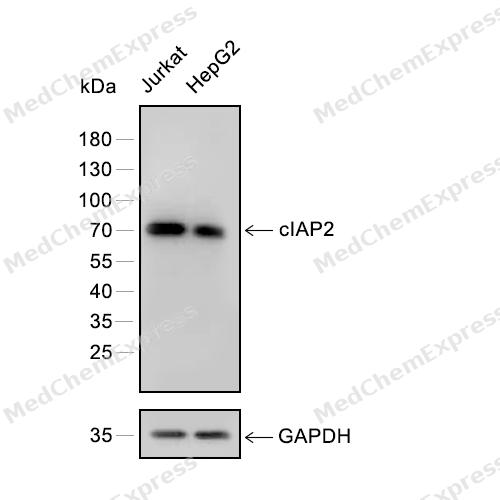 Western blot analysis of extracts from Jurkat (lane 1) and HepG2 (lane 2) using cIAP2 antibody. Proteins were transferred to a PVDF membrane and blocked with 5% nonfat powdered milk in PBST for 2 hour at room temperature. The primary antibody (1/1000) and loading control antibody (GAPDH, 1/3000) was diluted with 5% nonfat powdered milk in PBST at 4°C overnight. Goat Anti-Rabbit IgG-HRP Secondary Antibody (1/8,000) was incubated for 45min at room temperature.


Background
-
Function
cIAP-2 (cellular inhibitor of apoptosis protein 2, encoded by BIRC3) is a member of the inhibitor of apoptosis protein (IAP) family that functions as a signaling regulator linking cell survival, inflammatory responses, and programmed cell death pathways[1][2]. Mechanistically, cIAP-2 acts as an E3 ubiquitin ligase within TNF receptor and pattern-recognition receptor signaling complexes, where it contributes to ubiquitination-dependent activation of NF-κB signaling and downstream transcriptional programs that support cellular adaptation to stress and immune stimulation[3][4]. Through cooperation with TRAF family proteins, cIAP-2 participates in the regulation of receptor-mediated signaling networks that control apoptosis, innate immunity, and inflammatory responses[3][5]. In disease settings, altered BIRC3 expression or mutation has been associated with hematologic malignancies and other cancers, highlighting the importance of cIAP-2 in tumor cell survival and therapy response[6][7]. Compared with the closely related isoform cIAP-1 (BIRC2), cIAP-2 displays distinct expression kinetics and regulatory patterns; cIAP-2 is strongly inducible by inflammatory cytokines through NF-κB-dependent mechanisms, whereas cIAP-1 is more constitutively expressed and is thought to support rapid signaling events[4]. This distinction suggests that cIAP-2 may contribute preferentially to sustained or later-phase signaling responses following inflammatory stimulation[4]. For experimental applications, cIAP-2 is widely investigated as a target of SMAC mimetics and other IAP-directed compounds that promote cIAP degradation or disrupt cIAP-associated signaling complexes, providing useful tools for studying NF-κB regulation, apoptosis sensitivity, and anticancer therapeutic mechanisms[2][8].
-
Subcellular Localization
Cytoplasm; Nucleus
-
Expression
Tissue_specificity:It is highly expressed in the fetal lungs and kidneys. In humans, it is primarily expressed in lymphoid tissues, including the spleen, thymus, and peripheral blood lymphocytes. -
Subunit
Interacts with PRSS25; interaction inhibits apoptotic suppressor activity. The BIR motifs region interacts with TNF receptor associated factors 1 and 2 (TRAF1 and TRAF2) to form a heteromeric complex, which is then recruited to the tumor necrosis factor receptor 2 (TNFR2). Interaction with TRAF2 is required for ubiquitination of IKBKE, degradation of NFKBIA and activation of NF-kappa-B. Interacts with RIP1, RIP2, RIP3, RIP4 and USP19
-
SwissProt ID
-
Synonyms
cIAP2; AIP1; API2; BIRC3; CIAP2; HAIP1; IAP homolog C; RNF49; MIHC; MALT2; Apoptosis inhibitor 2; IAP2
-
Research Field
Cell Biology


Documentation
-
Data Sheet (262 KB)
-
SDS (252 KB)
- English - EN (252 KB)
- Français - FR (252 KB)
- Deutsch - DE (252 KB)
- Norwegian - NO (252 KB)
- Español - ES (252 KB)
- Swedish - SV (252 KB)
- Italian - IT (252 KB)
- Korean - KR (252 KB)
- Portuguese - PT (252 KB)
-
User Guide for Antibodies (1077 KB)
References
[1]. Bertrand MJ, et al. Cellular inhibitors of apoptosis cIAP1 and cIAP2 are required for innate immunity signaling by the pattern recognition receptors NOD1 and NOD2. Immunity. 2009 Jun 19;30(6):789-801. [Content Brief]
[2]. Rabezanahary H, et al. Live virus neutralizing antibodies against pre and post Omicron strains in food and retail workers in Québec, Canada. Heliyon. 2024 May 21;10(10):e31026. [Content Brief]
[3]. Li Y, et al. Structure of natural killer cell receptor KLRG1 bound to E-cadherin reveals basis for MHC-independent missing self recognition. Immunity. 2009 Jul 17;31(1):35-46. [Content Brief]
[4]. Thorne A, et al. Differential regulation of BIRC2 and BIRC3 expression by inflammatory cytokines and glucocorticoids in pulmonary epithelial cells. PLoS One. 2023 Jun 8;18(6):e0286783. [Content Brief]
[5]. Lee MJ, et al. Time to HIV rebound after infusion of long-acting broadly neutralising antibodies 3BNC117-LS and 10-1074-LS and analytical treatment interruption (the RIO trial): a double-blind, randomised, placebo-controlled trial. Lancet HIV. 2026 May 27:S2352-3018(26)00059-7. [Content Brief]
[6]. Frazzi R. BIRC3 and BIRC5: multi-faceted inhibitors in cancer. Cell Biosci. 2021 Jan 7;11(1):8. doi: 10.1186/s13578-020-00521-0. PMID: 33413657; PMCID: PMC7792207. et al. BIRC3 and BIRC5: multi-faceted inhibitors in cancer. Cell Biosci. 2021 Jan 7;11(1):8. [Content Brief]
[7]. Yamato A, et al. Oncogenic activity of BIRC2 and BIRC3 mutants independent of nuclear factor-κB-activating potential. Cancer Sci. 2015 Sep;106(9):1137-42. [Content Brief]
[8]. Cossu F, et al. Computational and Experimental Characterization of NF023, A Candidate Anticancer Compound Inhibiting cIAP2/TRAF2 Assembly. J Chem Inf Model. 2020 Oct 26;60(10):5036-5044. [Content Brief]

 Powered by Bioz
