



DOCK2 Antibody (YA2710)
(Synonyms: DOCK 2; IMD40)
Based on 1 Customer Validation
DOCK2 Antibody (YA2710) is a Rabbit-derived and non-conjugated IgG monoclonal antibody, targeting to DOCK2.
-
Host:
Rabbit
-
Isotype:
IgG
-
Application:
WB
-
Reactivity :
Human
-
Formulation:
Supplied as a 0.22 μm filtered solution of 50mM Tris-Glycine, pH 7.4, 0.15M NaCl, 40% Glycerol, 0.01% sodium azide and 0.05% BSA.
-
Conjugation:
Non-conjugated


To place orders, for customer services and technical support, please contact: MedChemExpress USA
Tel: 609-228-6898 E-mail: [email protected] [email protected]





Applications
| Application |
WB

WB: Western Blot
|
|---|---|
| Dilution Ratio | 1:1000-1:5000 |


Product Details
DOCK2 Antibody (YA2710) is a Rabbit-derived and non-conjugated IgG monoclonal antibody, targeting to DOCK2.
-
Host Rabbit

-
Clonality Recombinant,Monoclonal

-
Species ReactivityHuman
-
Observed Molecular WeightObserved band size: 212 kDa
Note: Due to possible protein modifications or aggregation, the molecular weight should be confirmed by actual measurement, and the predicted value is for reference only.

-
Calculated Molecular Weight Predicted band size: 212 kDa

A synthetic peptide of human DOCK2
Endogenous
Affinity Purified
Non-conjugated
Unmodified
IgG


Product Properties
-
Appearance
Solution
-
Formulation
Supplied as a 0.22 μm filtered solution of 50mM Tris-Glycine, pH 7.4, 0.15M NaCl, 40% Glycerol, 0.01% sodium azide and 0.05% BSA.
-
Concentration
Batch-dependent, Please check the COA for the concentration of each lot. Check Lot Concentration
-
Storage & Stability
Stored at -20°C for 1 year. Avoid repeated freeze / thaw cycles.
-
Shipping
Shipping with blue ice.


Verification Images
-
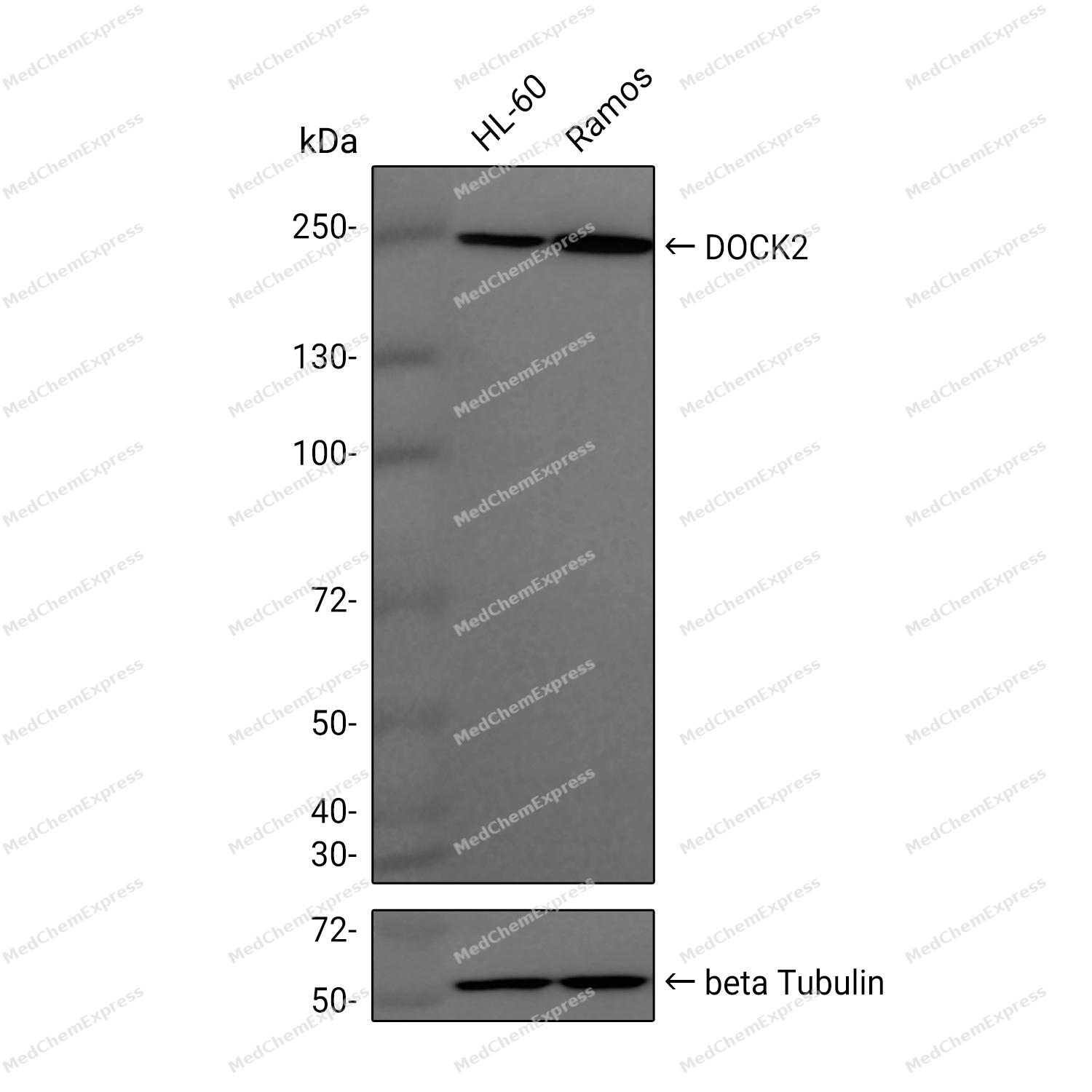 Western blot analysis of extracts from Jurkat (lane 2(20μg), THP-1 (lane 3(20μg), Raji (lane 4(20μg), HepG2 (lane 5(20μg) using DOCK2 Antibody. Proteins were transferred to a PVDF membrane and blocked with 5% BSA in TBST for 2 hour at room temperature. The primary antibody (1/1000) and Loading control antibody (Beta Actin, HY-P80438, 1/3000) was used in 5% BSA in TBST at 4°C overnight. Goat Anti-Mouse/Rabbit IgG-HRP Secondary Antibody (HY-P8004/HY-P8001, 1/10,000) was used for 1 hour at room temperature.


Background
-
Function
DOCK2 (Dedicator of Cytokinesis 2) is a hematopoietic cell-enriched atypical guanine nucleotide exchange factor that primarily activates the small GTPases RAC1 and RAC2, thereby regulating actin cytoskeleton remodeling and immune cell behavior[1][2]. Mechanistically, DOCK2 controls lymphocyte trafficking, homing, adhesion, polarity, and migration through RAC-dependent cytoskeletal reorganization, making it a central regulator of leukocyte motility and immune surveillance[1][2][3]. DOCK2 also contributes to T-cell activation and immune synapse function by supporting actin dynamics required for effective signaling between lymphocytes and antigen-presenting cells[2]. In disease settings, genetic deficiency of DOCK2 is associated with severe combined immunodeficiency characterized by impaired T-cell, B-cell, and natural killer cell function, highlighting its essential role in host defense and immune homeostasis[3]. Beyond immunodeficiency, altered DOCK2 activity has been linked to immune-related disorders and inflammatory pathologies through its effects on immune-cell activation, cytokine regulation, and RAC signaling pathways[3]. Compared with related DOCK family members, DOCK2 is distinguished by its predominant expression in leukocytes and its specialized role in regulating immune-cell migration and activation, whereas other family members display broader tissue distributions and functions[4]. For experimental applications, DOCK2 serves as a valuable molecular target for investigating RAC-dependent signaling, leukocyte trafficking, chemotaxis, and immune dysfunction, and studies have demonstrated that DOCK2 dimerization is required for efficient RAC activation and lymphocyte migration in cellular models[5].
-
Subcellular Localization
Endomembrane system; Peripheral membrane protein; Cytoplasm, cytoskeleton
-
Expression
Tissue_specificity:Specifically expressed in hematopoietic cells. Highly expressed in peripheral blood leukocytes, and expressed at intermediate level in thymus and spleen. Expressed at very low level in the small intestine and colon -
Isoforms & Post-Translational Modification
Q92608 has 2 isomers: Q92608-1: 211948 Da (predicted); Q92608-2: 38461 Da (predicted).
-
Subunit
Homodimer (Probable). Interacts with RAC1 and RAC2. Interacts with CRKL and VAV. Interacts with CD3Z
-
SwissProt ID
-
Synonyms
DOCK 2; IMD40
-
Research Field
Signal Transduction


Documentation
-
Data Sheet (260 KB)
-
SDS (251 KB)
- English - EN (251 KB)
- Français - FR (251 KB)
- Deutsch - DE (251 KB)
- Norwegian - NO (251 KB)
- Español - ES (251 KB)
- Swedish - SV (251 KB)
- Italian - IT (251 KB)
- Korean - KR (251 KB)
- Portuguese - PT (251 KB)
-
User Guide for Antibodies (1077 KB)
References
[1]. Uniprotkb.
[2]. Ji L, et al. Insights from DOCK2 in cell function and pathophysiology. Front Mol Biosci. 2022 Sep 29;9:997659. [Content Brief]
[4]. DOCK2 gene information from NCBI.
[5]. Terasawa M, et al. Dimerization of DOCK2 is essential for DOCK2-mediated Rac activation and lymphocyte migration. PLoS One. 2012;7(9):e46277. [Content Brief]

 Powered by Bioz
