



Oct-4 Antibody
(Synonyms: MGC22487; Oct 3; Oct 4; Oct-3; Oct-4; OCT3; Oct4; Octamer binding protein 3; Octamer binding protein 4; Octamer binding transcription factor 3; Octamer-binding protein 3; Octamer-binding protein 4; Octamer-binding transcription factor 3; OTF 3; OTF 4; OTF)
Based on 1 Customer Validation
Oct-4 Antibody is a Rabbit-derived and non-conjugated IgG polyclonal antibody, targeting to Oct-4.
-
Host:
Rabbit
-
Isotype:
IgG
-
Application:
WB, IHC-P, ICC/IF, IP, ChIP
-
Reactivity :
Human, Mouse
-
Formulation:
Supplied in 50mM Tris-Glycine(pH 7.4), 0.15M NaCl, 40%Glycerol, 0.01% sodium azide and 0.05% BSA.
-
Conjugation:
Non-conjugated


To place orders, for customer services and technical support, please contact: MedChemExpress USA
Tel: 609-228-6898 E-mail: [email protected] [email protected]





Applications
| Application |
WB

WB: Western Blot
|
IHC-P
IHC-P: Immunohistochemistry-Paraffin
|
ICC/IF
ICC/IF: Immunocytochemistry/
Immunofluorescence |
IP
IP: Immunoprecipitation
|
ChIP
ChIP: Chromatin Immunoprecipitation
|
|---|---|---|---|---|---|
| Dilution Ratio | 1:500-1:1000 | 1:50-1:100 | 1:50-1:200 | 1:20 | 1:20 |


Product Details
Oct-4 Antibody is a Rabbit-derived and non-conjugated IgG polyclonal antibody, targeting to Oct-4.
-
Host Rabbit

-
Clonality Polyclonal

-
Species ReactivityHuman, Mouse
-
Observed Molecular WeightObserved band size: 45 kDa
Note: Due to possible protein modifications or aggregation, the molecular weight should be confirmed by actual measurement, and the predicted value is for reference only.

-
Calculated Molecular Weight Predicted band size: 39 kDa

Synthetic peptide corresponding to Human Oct4.The exact sequence is proprietary to MCE.
Endogenous
affinity purified
Non-conjugated
Unmodified
IgG


Product Properties
-
Appearance
Liquid
-
Formulation
Supplied in 50mM Tris-Glycine(pH 7.4), 0.15M NaCl, 40%Glycerol, 0.01% sodium azide and 0.05% BSA.
-
Concentration
Batch-dependent, Please check the COA for the concentration of each lot. Check Lot Concentration
-
Storage & Stability
Stored at -20°C for 1 year. Avoid repeated freeze / thaw cycles.
-
Shipping
Shipping with blue ice.


Verification Images
-
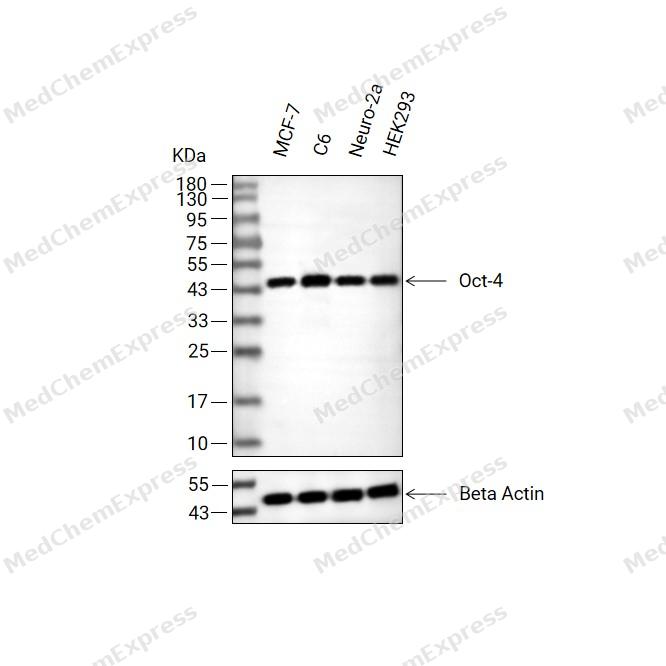 Western blot analysis of extracts from MCF-7(lane 2(20μg) , C6 (lane 3(20μg) ,Neuro-2a(lane 4(20μg)and HEK293( lane 5(20μg) using Oct-4 Antibody(HY-P80770).Proteins were transferred to a PVDF membrane and blocked with 5% non-fat milk in TBST for 2 hour at room temperature. The primary antibody ( 1/1000) and Loading control antibody (Beta Actin, HY-P80993,1/10000) was used in 5% non-fat milk in TBST at 4°C overnight. Goat Anti-Rabbit IgG-HRP Secondary Antibody (HY-P8001,1/10,000) was used for 1 hour at room temperature.
 -
 Immunocytochemistry analysis of HepG2 cells labeling Oct-4 with Oct-4 Antibody (HY-P80770) at 1/100 dilution. Cells were fixed in 4% paraformaldehyde for 15 minutes at room temperature, permeabilized with 0.1% Triton X-100 in PBS for 15 minutes at room temperature, then blocked with quick block buffer for 10 minutes at room temperature. Cells were then incubated with Oct-4 Antibody (HY-P80770) at 1/100 dilution in quick block buffer overnight at 4 ℃. AF488-conjugated Goat Anti-Rabbit IgG H&L(HY-P8002, Green) was used as the secondary antibody at 1/1,000 dilution. PBS instead of the primary antibody was used as the secondary antibody only control. The Nuclear counterstain was DAPI (Blue).
 -
 Immunocytochemistry analysis of HepG2 cells labeling Oct-4 with Oct-4 Antibody (HY-P80770) at 1/200 dilution. Cells were fixed in 4% paraformaldehyde for 15 minutes at room temperature, permeabilized with 0.1% Triton X-100 in PBS for 15 minutes at room temperature, then blocked with quick block buffer for 10 minutes at room temperature. Cells were then incubated with Oct-4 Antibody (HY-P80770) at 1/200 dilution in quick block buffer overnight at 4 ℃. AF488-conjugated Goat Anti-Rabbit IgG H&L(HY-P8002, Green) was used as the secondary antibody at 1/1,000 dilution. PBS instead of the primary antibody was used as the secondary antibody only control. The Nuclear counterstain was DAPI (Blue).


Background
-
Function
2026-10-04 00:00:00 transcription factor that binds to the octamer motif (5'-ATTTGCAT-3'). Forms a trimeric complex with SOX2 or SOX15 on DNA and controls the expression of a number of genes involved in embryonic development such as YES1, FGF4, UTF1 and ZFP206. Critical for early embryogenesis and for embryonic stem cell pluripotency
-
Subcellular Localization
Cytoplasm; Nucleus
-
Expression
Tissue_specificity:It is expressed in the developing brain. The highest expression levels are found in specific cell layers of the cerebral cortex, olfactory bulb, hippocampus, and cerebellum. Expression levels are lower in adult tissues.
Induction:Transcriptional activity is positively regulated by PKM (PubMed:18191611) . Upon cell differentiation, expression is repressed by NR6A1 (PubMed:26769970) -
Isoforms & Post-Translational Modification
Q01860 has 2 isomers: Q01860-1: 38571 Da (predicted); Q01860-2: 30085 Da (predicted).
Sumoylation enhances the protein stability, DNA binding and transactivation activity. Sumoylation is required for enhanced YES1 expression;Ubiquitinated; undergoes 'Lys-63'-linked polyubiquitination by WWP2 leading to proteasomal degradation;ERK1/2-mediated phosphorylation at Ser-111 promotes nuclear exclusion and proteasomal degradation. Phosphorylation at Thr-235 and Ser-236 decrease DNA-binding and alters ability to activate transcription -
Subunit
Interacts with PKM. Interacts with WWP2. Interacts with UBE2I and ZSCAN10 (By similarity). Interacts with PCGF1 (PubMed:26687479). Interacts with ESRRB; recruits ESRRB near the POU5F1-SOX2 element in the NANOG proximal promoter; the interaction is DNA independent (By similarity). Interacts with ZNF322 (By similarity). Interacts with MAPK8 and MAPK9; the interaction allows MAPK8 and MAPK9 to phosphorylate POU5F1 on Ser-355 (By similarity). Interacts (when phosphorylated on Ser-355) with FBXW8 (By similarity). Interacts with FBXW4 (By similarity). Interacts with SOX2 and SOX15; binds synergistically with either SOX2 or SOX15 to DNA (By similarity). Interacts with DDX56 (By similarity)
-
SwissProt ID
-
Synonyms
MGC22487; Oct 3; Oct 4; Oct-3; Oct-4; OCT3; Oct4; Octamer binding protein 3; Octamer binding protein 4; Octamer binding transcription factor 3; Octamer-binding protein 3; Octamer-binding protein 4; Octamer-binding transcription factor 3; OTF 3; OTF 4; OTF
-
Research Field
Epigenetics and Nuclear Signaling


Documentation
-
Data Sheet (259 KB)
-
SDS (252 KB)
- English - EN (252 KB)
- Français - FR (252 KB)
- Deutsch - DE (252 KB)
- Norwegian - NO (252 KB)
- Español - ES (252 KB)
- Swedish - SV (252 KB)
- Italian - IT (252 KB)
- Korean - KR (252 KB)
- Portuguese - PT (252 KB)
-
User Guide for Antibodies (1077 KB)

 Powered by Bioz
