



Phospho-Tau (T231) Antibody (YA3477)
(Synonyms: MAPT; MAPTL; MTBT1; TAU; Microtubule-associated protein tau; Neurofibrillary tangle protein; Paired helical filament-tau; PHF-tau)
Based on 1 Customer Validation
Phospho-Tau (T231) Antibody (YA3477) is a Rabbit-derived and non-conjugated IgG monoclonal antibody, targeting to Phospho-Tau (T231).
-
Host:
Rabbit
-
Isotype:
IgG
-
Application:
WB, IHC-P, IHC-F, IP, IF-Tissue
-
Reactivity :
Human, Mouse, Rat
-
Formulation:
Supplied in 1*TBS (pH7.4), 0.05% BSA, 40% Glycerol. Preservative: 0.05% Sodium Azide.
-
Conjugation:
Non-conjugated


To place orders, for customer services and technical support, please contact: MedChemExpress USA
Tel: 609-228-6898 E-mail: [email protected] [email protected]





Applications
| Application |
WB

WB: Western Blot
|
IHC-P
IHC-P: Immunohistochemistry-Paraffin
|
IF-Tissue
IF-Tissue: Immunofluorescence-Tissue
|
IHC-F
IHC-F: Immunohistochemistry-Frozen
|
|---|---|---|---|---|
| Dilution Ratio | 1:2000 | 1:1000 | 1:200 | 1:200-1:500 |


Product Details
Phospho-Tau (T231) Antibody (YA3477) is a Rabbit-derived and non-conjugated IgG monoclonal antibody, targeting to Phospho-Tau (T231).
-
Host Rabbit

-
Clonality Monoclonal,Recombinant

-
Species ReactivityHuman, Mouse, Rat Predicted Reactivity: Pig
Note: The predicted reactivity is for reference only and should not be considered a guarantee of product performance.
-
Observed Molecular WeightObserved band size: 35-70 kDa
Note: Due to possible protein modifications or aggregation, the molecular weight should be confirmed by actual measurement, and the predicted value is for reference only.

-
Calculated Molecular Weight Predicted band size: 46 kDa

Synthetic phospho-peptide corresponding to residues surrounding Thr231 of human Tau-F (P10636-8).
affinity purified
Non-conjugated
Unmodified
IgG


Product Properties
-
Appearance
Liquid
-
Formulation
Supplied in 1*TBS (pH7.4), 0.05% BSA, 40% Glycerol. Preservative: 0.05% Sodium Azide.
-
Concentration
Batch-dependent, Please check the COA for the concentration of each lot. Check Lot Concentration
-
Storage & Stability
Stored at -20°C for 1 year. Avoid repeated freeze / thaw cycles.
-
Shipping
Shipping with blue ice.


Verification Images
-
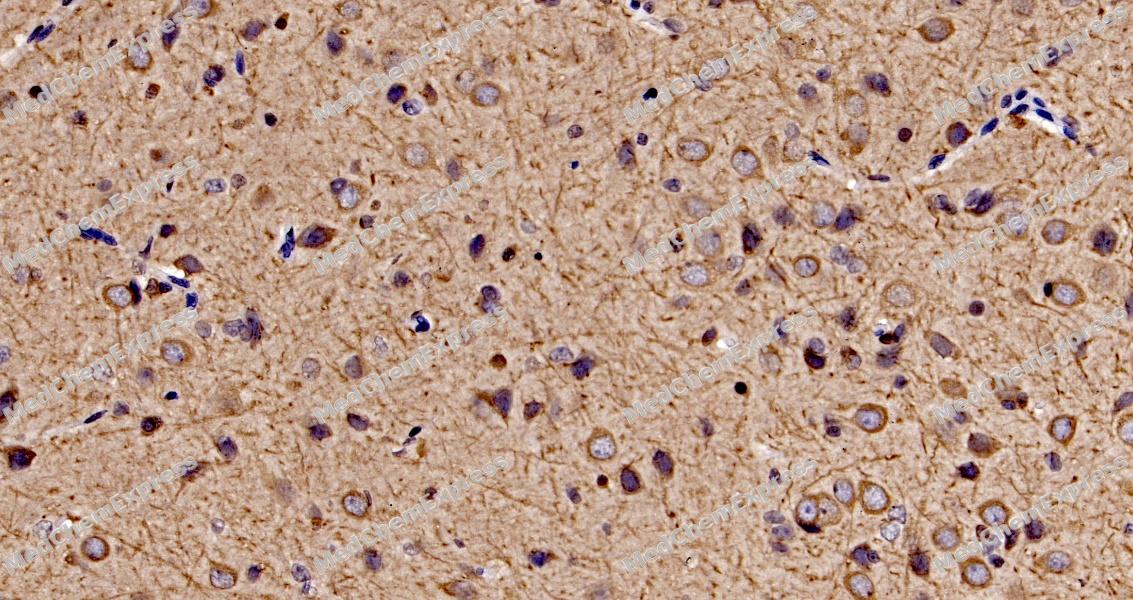 Immunohistochemical analysis of paraffin-embedded rat brain tissue using Phospho-Tau Antibody. The section was pre-treated using heat mediated antigen retrieval with sodium citrate buffer (pH 6.0) for 8 minutes. The tissues were blocked in QuickBlock for 20 minutes at room temperature, washed with ddH2O and PBS, and then probed with the primary antibody at 1/100 dilution in 4℃ overnight. The detection was performed using an HRP conjugated compact polymer system. DAB was used as the chromogen. Tissues were counterstained with hematoxylin and mounted with DPX.
 -
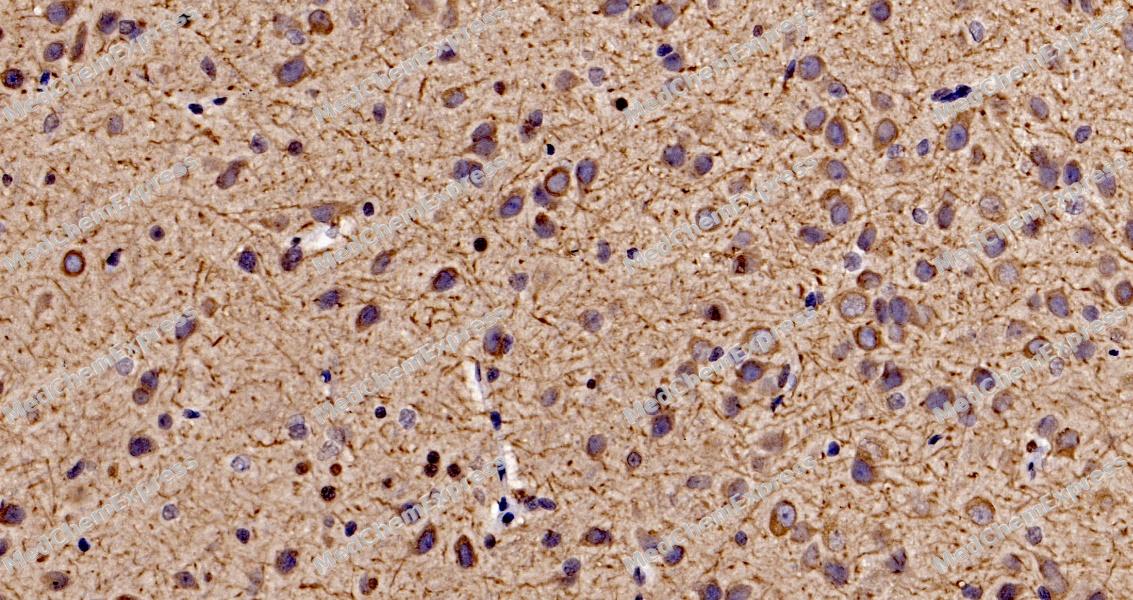 Immunohistochemical analysis of paraffin-embedded rat brain tissue using Phospho-Tau Antibody. The section was pre-treated using heat mediated antigen retrieval with sodium citrate buffer (pH 6.0) for 8 minutes. The tissues were blocked in QuickBlock for 20 minutes at room temperature, washed with ddH2O and PBS, and then probed with the primary antibody at 1/100 dilution in 4℃ overnight. The detection was performed using an HRP conjugated compact polymer system. DAB was used as the chromogen. Tissues were counterstained with hematoxylin and mounted with DPX.


Background
-
Function
Tau promotes microtubule assembly and stability, and might be involved in the establishment and maintenance of neuronal polarity. The C-terminus binds axonal microtubules while the N-terminus binds neural plasma membrane components, suggesting that tau functions as a linker protein between both. Axonal polarity is predetermined by TAU/MAPT localization (in the neuronal cell) in the domain of the cell body defined by the centrosome. The short isofo[1][2].
-
Subcellular Localization
Cytoplasm, cytosol; Cell membrane; Peripheral membrane protein; Cytoplasm, cytoskeleton; Cell projection, axon; Cell projection, dendrite; Secreted
-
Expression
Tissue specificity:
Expressed in neurons. Isoform PNS-tau is expressed in the peripheral nervous system while the others are expressed in the central nervous system. -
Isoforms & Post-Translational Modification
Human (P10636): 9 isomers: PNS-tau, Tau-G: 79-80 kDa (predicted); Fetal-tau, Tau-A, Tau-B, Tau-C, Tau-D, Tau-E, Tau-F: 32-45 kDa (predicted).
Mouse (P10637): 6 isomers: PNS-tau: 76 kDa (predicted); Tau-A, Tau-B, Tau-C, Tau-D, Tau-E: 35-44 kDa (predicted).
Rat (P19332): 8 isomers: Tau-A, Tau-B, Tau-H: 71-81 kDa (predicted); Tau-C, Tau-D, Tau-E, Tau-F, Tau-G: 38-51 kDa (predicted).
Multiple serine and threonine residues are phosphorylated.
Polyubiquitinated.
O-glycosylated. -
Subunit
Interacts with MARK1, MARK2, MARK3 and MARK4 (PubMed:23666762). Interacts with PSMC2 through SQSTM1 (By similarity). Interacts with SQSTM1 when polyubiquitinated (PubMed:15953362). Interacts with FKBP4 (By similarity). Binds to CSNK1D (PubMed:14761950). Interacts with SGK1 (PubMed:16982696). Interacts with EPM2A; the interaction dephosphorylates MAPT at Ser-396 (PubMed:19542233). Interacts with PIN1 (PubMed:11313338). Interacts with LRRK2 (PubMed:26014385). Interacts with LRP1, leading to endocy
-
SwissProt ID
-
Synonyms
MAPT; MAPTL; MTBT1; TAU; Microtubule-associated protein tau; Neurofibrillary tangle protein; Paired helical filament-tau; PHF-tau


Documentation
-
Data Sheet (235 KB)
-
SDS (252 KB)
- English - EN (252 KB)
- Français - FR (252 KB)
- Deutsch - DE (252 KB)
- Norwegian - NO (252 KB)
- Español - ES (252 KB)
- Swedish - SV (252 KB)
- Italian - IT (252 KB)
- Korean - KR (252 KB)
- Portuguese - PT (252 KB)
-
User Guide for Antibodies (1077 KB)

 Powered by Bioz
