



Phospho-YAP1 (Ser127) Antibody (YA136)
(Synonyms: YAP1; YAP65; Yorkie homolog; 65 kDa Yes-associated protein; YAP65)Based on 1 publication(s) in Google Scholar
Phospho-YAP1 (Ser127) Antibody (YA136) is a Rabbit-derived and non-conjugated IgG monoclonal antibody, targeting to Phospho-YAP1 (Ser127).
-
Host:
Rabbit
-
Isotype:
IgG
-
Application:
WB, IHC-P
-
Reactivity :
Human, Mouse, Rat
-
Formulation:
Supplied in 50 mM Tris-Glycine (pH 7.4), 0.15 M NaCl, 40% Glycerol and 0.05% BSA. Preservative: 0.01% Sodium azide
-
Conjugation:
Non-conjugated


To place orders, for customer services and technical support, please contact: MedChemExpress USA
Tel: 609-228-6898 E-mail: [email protected] [email protected]



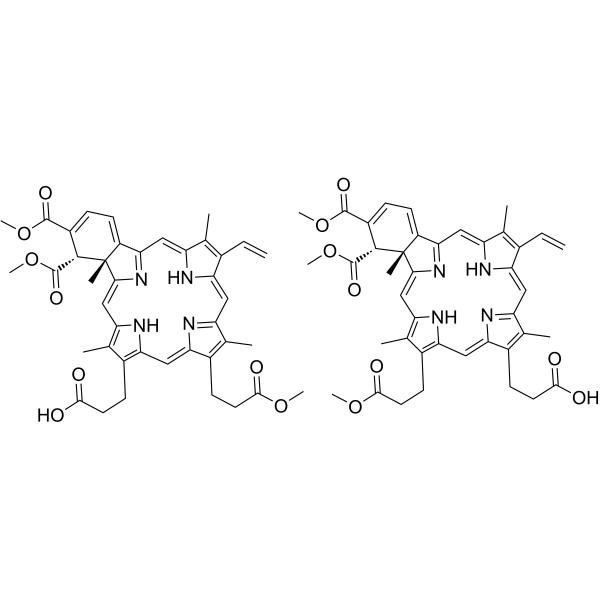
Publications Citing Use of MedChemExpress (MCE) Phospho-YAP1 (Ser127) Antibody (YA136)
More

Applications
| Application |
WB

WB: Western Blot
|
IHC-P
IHC-P: Immunohistochemistry-Paraffin
|
|---|---|---|
| Dilution Ratio | 1:500-1:1000 | 1:50-1:100 |


Product Details
Phospho-YAP1 (Ser127) Antibody (YA136) is a Rabbit-derived and non-conjugated IgG monoclonal antibody, targeting to Phospho-YAP1 (Ser127).
-
Host Rabbit

-
Clonality Recombinant,Monoclonal

-
Species ReactivityHuman, Mouse, Rat
-
Observed Molecular WeightObserved band size: 70-75 kDa
Note: Due to possible protein modifications or aggregation, the molecular weight should be confirmed by actual measurement, and the predicted value is for reference only.

-
Calculated Molecular Weight Predicted band size: 54 kDa

Entrez Gene: 10413 Human ; 22601 Mouse ; 363014 Rat
SwissProt: P46937 Human ; P46938 Mouse ; Q2EJA0 Rat
OMIM: 120433 Human
Synthetic phosphopeptide corresponding to residues surrounding Ser127 of Human YAP1.The exact sequence is proprietary to MCE.
Endogenous
affinity purified
Non-conjugated
Phosphorylated
IgG


Product Properties
-
Appearance
Solution
-
Formulation
Supplied in 50 mM Tris-Glycine (pH 7.4), 0.15 M NaCl, 40% Glycerol and 0.05% BSA. Preservative: 0.01% Sodium azide
-
Concentration
Batch-dependent, Please check the COA for the concentration of each lot. Check Lot Concentration
-
Storage & Stability
Stored at -20°C for 1 year. Avoid repeated freeze / thaw cycles.
-
Shipping
Shipping with blue ice.


Publications (1)
-
Journal Impact Factor
-
Most Recent
-
Biochem Pharmacol
Mst1 inhibition mitigates steroid-induced femoral head osteonecrosis by modulating autophagy in bone microvascular endothelial cells. [Abstract]2025 Sep:239:117081. PMID: 40562116


Verification Images
-
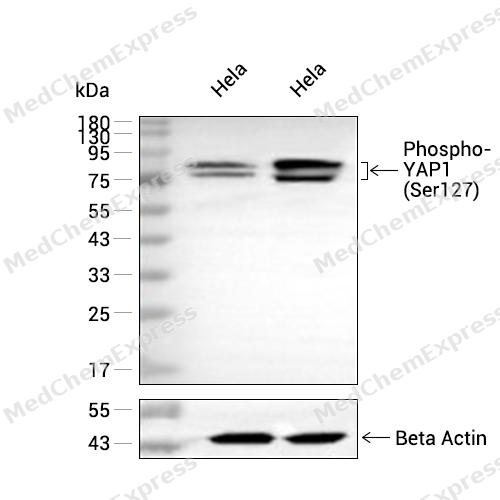 Western blot analysis of extracts from Hela (lane 2(20μg) and Hela(lane 3(40μg) using Phospho-YAP1 (Ser127) (HY-P80864) Rabbit mAb. Proteins were transferred to a PVDF membrane and blocked with 5% non-fat milk in TBST for 2 hour at room temperature. The primary antibody (1/1000) and Loading control antibody (Beta Actin, HY-P80438, 1/10000) was used in 5% non-fat milk in TBST at 4°C overnight. Goat Anti-Mouse/Rabbit IgG-HRP Secondary Antibody (1/10000) was used for 1 hour at room temperature.
 -
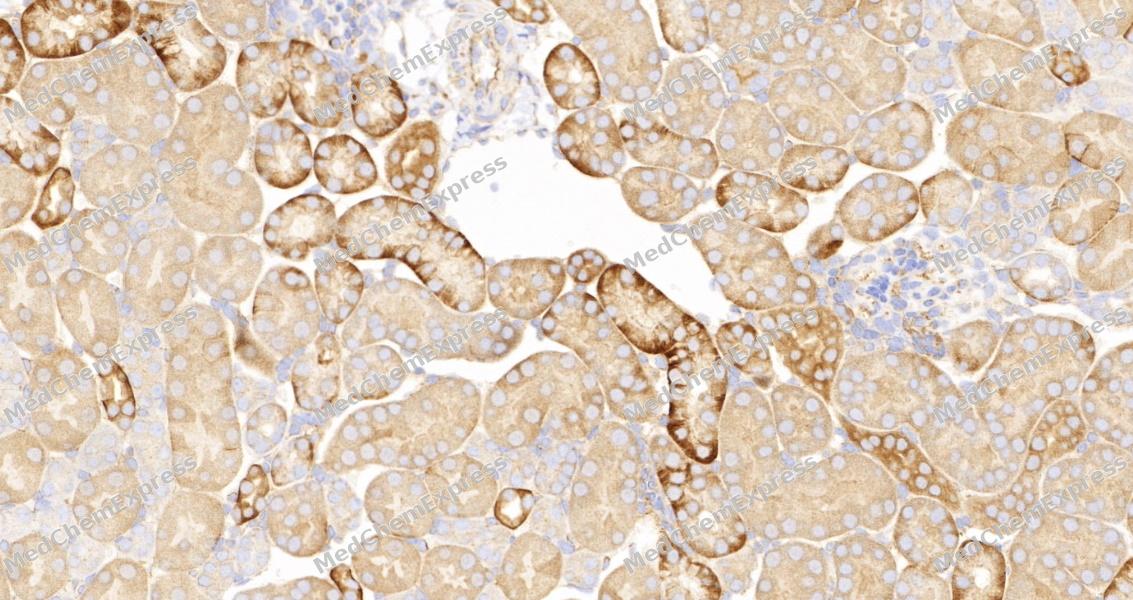 Immunohistochemical analysis of paraffin-embedded mouse kidney tissue using Phospho-YAP1 Antibody. The section was pre-treated using heat mediated antigen retrieval with Tris-EDTA buffer (pH 9.0) for 8 minutes. The tissues were blocked in QuickBlock for 20 minutes at room temperature, washed with ddH2O and PBS, and then probed with the primary antibody at 1/100 dilution in 4℃ overnight. The detection was performed using an HRP conjugated compact polymer system. DAB was used as the chromogen. Tissues were counterstained with hematoxylin and mounted with DPX.
 -
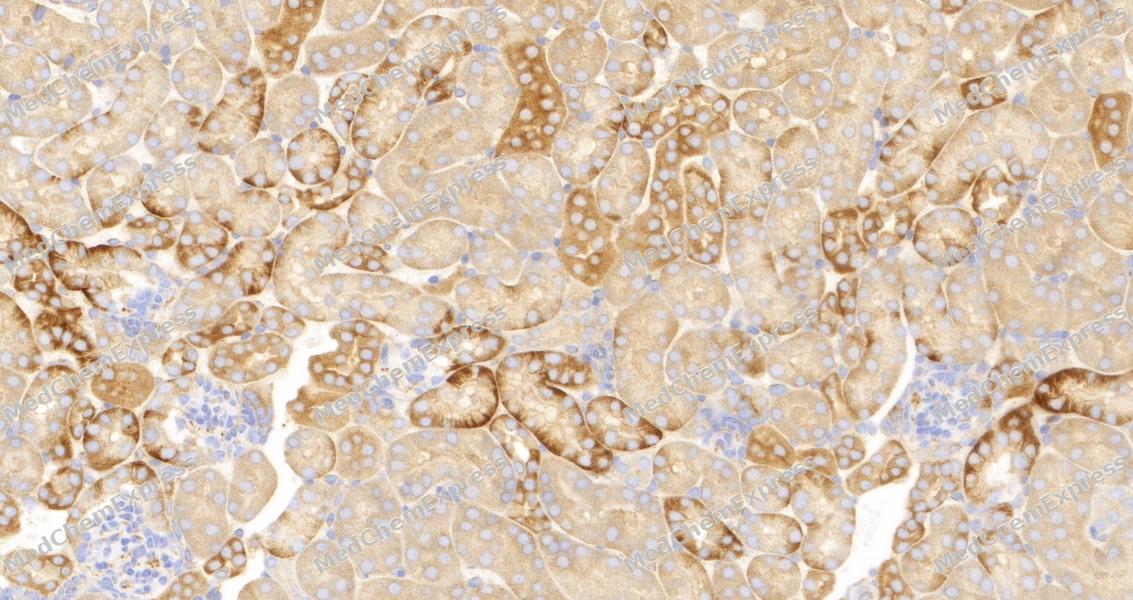 Immunohistochemical analysis of paraffin-embedded mouse kidney tissue using Phospho-YAP1 Antibody. The section was pre-treated using heat mediated antigen retrieval with Tris-EDTA buffer (pH 9.0) for 8 minutes. The tissues were blocked in QuickBlock for 20 minutes at room temperature, washed with ddH2O and PBS, and then probed with the primary antibody at 1/100 dilution in 4℃ overnight. The detection was performed using an HRP conjugated compact polymer system. DAB was used as the chromogen. Tissues were counterstained with hematoxylin and mounted with DPX.


Background
-
Function
YAP1 (Yes-associated protein 1) is a transcriptional co-activator that functions as a major downstream effector of the Hippo signaling pathway, integrating mechanical and cellular signals to regulate cell proliferation, tissue homeostasis, organ size control, and transcriptional programs mediated by TEAD transcription factors[4]. When the Hippo kinase cascade is active, LATS1/2-mediated phosphorylation restricts YAP1 nuclear localization and suppresses expression of genes involved in proliferation, migration, and epithelial-mesenchymal transition (EMT) [4]. Mechanistically, YAP1 lacks intrinsic DNA-binding activity and exerts most of its transcriptional output through TEAD family proteins, which recruit YAP1 to enhancer elements and drive target gene activation[1]. Dysregulated YAP1 signaling has been associated with cancer initiation, tumor progression, metastasis, therapy resistance, and stem cell-related phenotypes, making the Hippo-YAP1-TEAD axis an important experimental model for studying oncogenic transcriptional regulation[2][5]. Compared with its closely related paralog TAZ (WWTR1), YAP1 exhibits distinct alternatively spliced isoforms, and characterization of these isoforms has provided insight into structural and functional diversity within Hippo pathway signaling[6]. For experimental applications, disruption of the YAP1-TEAD complex is widely used to investigate YAP-dependent transcription, and verteporfin has been reported to suppress YAP-TEAD activity and serves as a commonly employed pharmacological tool in preclinical studies[3][7].
-
Subcellular Localization
Cytoplasm; Nucleus; Cell junction, tight junction; Cell membrane
-
Expression
Tissue_specificity:Increased expression has been observed in certain liver and prostate cancers. A subtype (protein level) lacking the transcriptional activation domain has been found in striatal neurons of Huntington's disease.
Induction:Induced in the hours following cyclic mechanical strain in keratinocytes -
Isoforms & Post-Translational Modification
P46937 has 9 isomers: P46937-1: 54462 Da (predicted); P46937-2: 52748 Da (predicted); P46937-3: 48755 Da (predicted); P46937-4: 36232 Da (predicted); P46937-5: 48275 Da (predicted); P46937-6: 49989 Da (predicted); P46937-7: 50469 Da (predicted); P46937-8: 53228 Da (predicted); P46937-9: 54942 Da (predicted).
Phosphorylated by LATS1 and LATS2; leading to cytoplasmic translocation and inactivation (PubMed:18158288, PubMed:20048001). Phosphorylated by ABL1; leading to YAP1 stabilization, enhanced interaction with TP73 and recruitment onto proapoptotic genes; in response to DNA damage (PubMed:18280240). Phosphorylation at Ser-400 and Ser-403 by CK1 is triggered by previous phosphorylation at Ser-397 by LATS proteins and leads to YAP1 ubiquitination by SCF(beta-TRCP) E3 ubiquitin ligase and subsequent degradation (PubMed:20048001). Phosphorylated at Thr-119, Ser-138, Thr-154, Ser-367 and Thr-412 by MAPK8/JNK1 and MAPK9/JNK2, which is required for the regulation of apoptosis by YAP1 (PubMed:21364637). Phosphorylated in the nucleus by PRP4K; phosphorylation leads to nuclear exclusion (PubMed:29695716);Lactylation by AARS1 promotes nuclear localization and stabilization of YAP1, leading to increased Hippo signaling pathway (PubMed:38512451). Delactylated by SIRT1 (PubMed:38512451);Ubiquitinated by SCF(beta-TRCP) E3 ubiquitin ligase -
Subunit
Part of a complex when phosphorylated that contains DSG3, PKP1, YAP1 and YWHAG; the complex is required for localization of DSG3 and YAP1 to the cell membrane in keratinocytes (PubMed:31835537). Binds to the SH3 domain of the YES kinase. Binds to WBP1 and WBP2 (PubMed:9202023). Binds, in vitro, through the WW1 domain, to neural isoforms of ENAH that contain the PPSY motif (By similarity). The phosphorylated form interacts with YWHAB (PubMed:17974916). Interacts (via WW domains) with LATS1 (via PPxY motif 2) (PubMed:18158288). Interacts with LATS2 (PubMed:18158288). Interacts with TEAD1, TEAD2, TEAD3 and TEAD4 (PubMed:18579750, PubMed:20123905, PubMed:20123908). Interacts with TP73 (PubMed:18280240). Interacts with RUNX1 (PubMed:18280240). Interacts with HCK (PubMed:17535448). Interacts (via WW domains) with PTPN14 (via PPxY motif 2); this interaction leads to the cytoplasmic sequestration of YAP1 and inhibits its transcriptional coactivator activity (PubMed:22525271). Interacts (when phosphorylated at Ser-127) with SMAD2, SMAD3 and WWTR1 (By similarity). Interacts with PRRG2 (via cytoplasmic domain) (PubMed:17502622). Interacts (via WW domains) with PRRG4 (via cytoplasmic domain) (PubMed:23873930). Interacts (phosphorylated) with CLDN18; the interaction sequesters YAP1 away from the nucleus and thereby restricts transcription of YAP1 target genes (By similarity). Interacts with SMAD1 (PubMed:21685363). Interacts with AMOTL2, the interaction is required for ubiquitination of AMOTL2 and localization of YAP1 to tight junctions (PubMed:21205866, PubMed:26598551). Interacts with AMOT isoform 1; the interaction facilitates translocation of YAP1 to the cytoplasm and tight junctions (PubMed:21205866)
-
SwissProt ID
-
Synonyms
YAP1; YAP65; Yorkie homolog; 65 kDa Yes-associated protein; YAP65
-
Research Field
Signal Transduction
Documentation
-
Data Sheet (261 KB)
-
SDS (252 KB)
- English - EN (252 KB)
- Français - FR (252 KB)
- Deutsch - DE (252 KB)
- Norwegian - NO (252 KB)
- Español - ES (252 KB)
- Swedish - SV (252 KB)
- Italian - IT (252 KB)
- Korean - KR (252 KB)
- Portuguese - PT (252 KB)
-
User Guide for Antibodies (1077 KB)
References
[1]. Feng J, et al. Verteporfin, a suppressor of YAP-TEAD complex, presents promising antitumor properties on ovarian cancer. Onco Targets Ther. 2016;9:5371-5381. [Content Brief]
[2]. Stein C, et al. YAP1 Exerts Its Transcriptional Control via TEAD-Mediated Activation of Enhancers. PLoS Genet. 2015 Aug 21;11(8):e1005465. [Content Brief]
[3]. Szulzewsky F, et al. YAP1 and its fusion proteins in cancer initiation, progression and therapeutic resistance. Dev Biol. 2021;475:205-221. [Content Brief]
[4]. UCSC.edu. DATAbase.
[5]. Battina R, et al. Targeting TEAD in cancer. Front Oncol. 2025;15:1692512.
[6]. Sudol M. YAP1 oncogene and its eight isoforms. Oncogene. 2013;32:3922.
[7]. Elisi GM, et al. Repurposing of Drugs Targeting YAP-TEAD Functions. Cancers (Basel). 2018;10(9):329.

 Powered by Bioz
